 By ByteBot
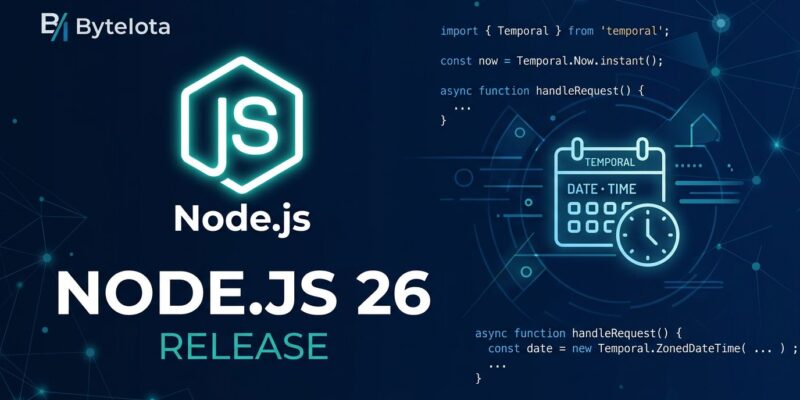
Node.js 26 shipped on May 5 with the Temporal API finally enabled by default — no flags, no polyfills, no workarounds required. After more than a decade of developers duct-taping date logic with Moment.js, Luxon, and date-fns, the fix is now part of the runtime. But the real story for teams evaluating an upgrade is not the headline feature. It is three removals that will crash existing applications on first boot. If you run a production Node.js service, you need the checklist before you touch the version number.
What Will Break First
Node.js 26 removes several APIs that have been deprecated for years. The core team has been warning about these for multiple major versions — but warnings do not break CI, and removals do.
http.writeHeader is gone. Any middleware or custom HTTP server calling http.Server.prototype.writeHeader() will crash on startup, not at runtime. The fix is mechanical — rename every call to writeHead(), which has the same signature — but you have to find them all first. Search your codebase and your dependencies.
The legacy _stream_* modules are gone. The internal modules _stream_readable, _stream_writable, _stream_duplex, _stream_transform, _stream_passthrough, and _stream_wrap have been removed entirely. These were never public API, but older npm packages required them directly. The symptom is Cannot find module _stream_readable thrown by a transitive dependency you did not know existed. Run npm ls and audit anything older than 2022.
The –experimental-transform-types flag is gone. Projects that used this TypeScript transformation flag in their npm scripts will fail silently or loudly depending on how the script is structured. Migrate to ts-node, esbuild, or a proper build step.
Native addon maintainers have additional requirements: GCC 13.2 or later, Python 3.10+ (3.9 is dropped), and recompilation against the new module version. If your CI pipeline builds native addons from source, update the toolchain before you upgrade the runtime.
Teams that kept up with Node.js 22 and 24 will hit one or two of these. Teams that have been on v18 LTS through its entire lifecycle are about to get the full bill at once.
Temporal: What Changed and Why It Matters
JavaScript Date object has been broken since 1995 and everyone knows it. Months are zero-indexed — January is 0, December is 11 — which has caused real bugs in production systems for thirty years. Date is mutable, so passing a date object into a function can silently modify the original. Arithmetic around daylight saving time transitions is unreliable. Parsing behavior for ambiguous date strings was, for years, literally undefined by the spec.
Temporal fixes all of this. It reached TC39 Stage 4 in March 2026 and is now part of the ES2026 specification. The four types you will use most: Temporal.PlainDate for a calendar date with no time or timezone, Temporal.ZonedDateTime for a full timezone-aware timestamp, Temporal.Instant for a fixed point in universal time, and Temporal.Duration for representing time spans. Every Temporal object is immutable — operations return new instances, so you can pass them freely without defensive copying.
The practical case for Temporal on the server side is strongest in scheduling, financial calculations, and any code that crosses timezone boundaries. If you are computing what time is 9 AM Pacific in Tokyo next Tuesday after DST, Temporal handles it correctly by default. Date requires a prayer and a library.
That said: do not rip out existing date logic to rewrite it with Temporal just because you can. The migration cost on entangled legacy code almost always exceeds the benefit. Use Temporal for new code and migrate strategically, not comprehensively. The MDN Temporal reference is the right starting point for the full API surface.
V8 14.6: Map.getOrInsert and Iterator.concat
V8 upgrades to 14.6, which brings two practical additions. The first is the Upsert proposal: Map.prototype.getOrInsert() and Map.prototype.getOrInsertComputed().
The before/after is clean:
// Before: verbose get-or-set pattern
if (!cache.has(key)) cache.set(key, computeDefault());
const val = cache.get(key);

// After: clean and readable
const val = cache.getOrInsert(key, defaultValue);

// Lazy variant: callback only fires if key is missing
const val = cache.getOrInsertComputed(key, () => expensiveCompute());
The lazy variant matters when the default value is expensive to compute — the callback is only invoked when the key is not present. WeakMap gets the same methods. The second addition is Iterator.concat() for sequencing iterators. Both are available in Node.js 26 without flags.
When to Actually Upgrade
Node.js 26 is the Current release, not LTS. It goes LTS in October 2026. Teams running Node.js 22 LTS (supported through April 2027) or Node.js 24 LTS have no production urgency.
The right move is to test your application against Node.js 26 now. Run your test suite. Surface the breaking changes in your dependencies — particularly the _stream_* removals, which are most likely to appear in transitive dependencies you do not directly control. Find them in staging, not in production at 2 AM in October.
One broader pattern worth noting: Node.js 26 continues the native-first direction the project has been moving for years. Built-in SQLite now has serialize/deserialize methods. The native test runner adds mock timers and randomized execution order. Undici 8 improves HTTP/2 performance and WebSocket stability. The dependency graph for a standard Node.js application is shrinking by design. Temporal is the most visible piece of that, but the direction is consistent.
If you are evaluating Node.js 26, the upgrade is worth preparing for. The breaking changes are all mechanical fixes. The gains — Temporal, Map.getOrInsert, a smaller native surface — are permanent. Do the checklist, test in staging, and plan for October. The full Node.js 26 release notes and NodeSource breakdown are worth reading before you schedule the migration.