 By ByteBot
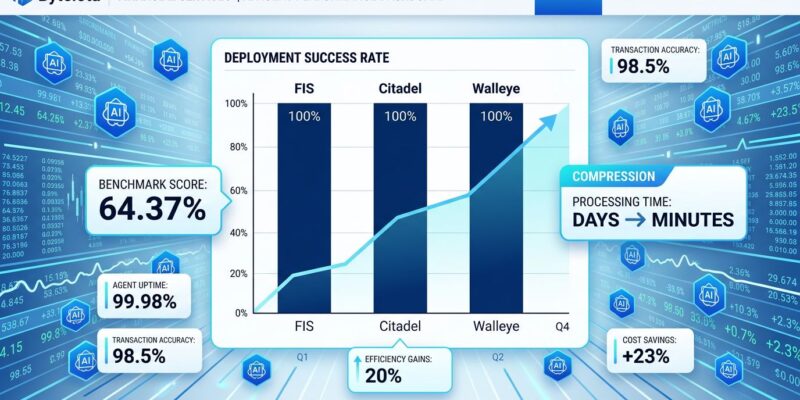
Anthropic released 10 production-ready AI agent templates on May 5, targeting the most time-consuming work in financial services across banking, insurance, asset management, and fintech. The templates—spanning research tasks like pitchbook building and compliance work like KYC screening—pair with a $1.5 billion joint venture backed by Blackstone, Goldman Sachs, and other Wall Street firms, plus full Microsoft 365 integration and a Moody’s partnership providing access to 600 million entities of credit data. Real deployments show measurable impact: FIS reports compressing anti-money laundering investigations from days to minutes, while Walleye Capital’s 400-person hedge fund has achieved 100% Claude Code adoption.
From Days to Minutes: Real Deployments Show Measurable Gains
FIS announced on May 4 that its Financial Crimes AI Agent compresses anti-money laundering alert and case investigations from days to minutes, reducing false positives while enhancing investigative quality. BMO and Amalgamated Bank will be among the first to deploy the agent, with broader availability planned for the second half of 2026. The agent automatically assembles evidence across bank core systems, evaluates activity against known typologies, and surfaces the highest-risk cases for investigator review.
Citadel’s investment professionals are using Claude for Excel to build and update coverage models with what Atte Lahtiranta, Head of Core Engineering, calls “a step-change in efficiency.” The integration meets analysts where they work, helping them separate signal from noise and pressure-test their analysis. Meanwhile, Walleye Capital’s CEO Will England reports 100% Claude Code adoption across the hedge fund’s 400 employees, reflecting an “AI-first mindset” where teams constantly ask how AI can improve their workflows.
BNY’s CIO Leigh-Ann Russell describes the impact differently: agents as “digital employees who work the case end to end.” This framing shifts the conversation from automation tools to autonomous workflow ownership—agents don’t just assist, they execute complete processes from intake through resolution.
10 Templates: Research and Operations on Autopilot
The 10 agent templates split evenly between research and operations. Research agents handle pitch building (target lists, comparables, draft pitchbooks), meeting preparation (client and counterparty briefs), earnings review (transcript analysis and model updates), financial model building, and market research synthesis. Operations agents tackle valuation review, general ledger reconciliation, month-end close workflows, statement auditing, and KYC screening with document assembly and compliance escalation packaging.
Each template packages three components: skills (instructions and domain knowledge for specific tasks), connectors (governed access to financial data sources like FactSet and S&P), and subagents (additional Claude models called for specialized sub-tasks such as comparables selection or methodology checks). This architecture distinguishes Anthropic’s approach—templates aren’t monolithic systems but composable frameworks that can be configured for institution-specific workflows.
Deployment speed is the differentiator. Templates are available as plugins in Claude Cowork and Claude Code, or as cookbooks for Claude Managed Agents (public beta), deployable in days rather than the months required for custom agent development. For institutions needing deeper customization, Anthropic’s Applied AI team and forward-deployed engineers can co-design agents while transferring knowledge to internal teams for independent evolution.
Related: Agent Skills: How to Extend AI Coding Agents (2026 Guide)
Wall Street Bets $1.5B on Anthropic’s Financial Agent Platform
The agent launch follows Anthropic’s $1.5 billion joint venture with Blackstone, Goldman Sachs, General Atlantic, Leonard Green, Apollo Global Management, GIC, and Sequoia Capital. Blackstone and Goldman each kicked in roughly $300 million and $150 million respectively, according to Fortune’s reporting. The scale of Wall Street’s investment signals confidence that Anthropic’s agent infrastructure will become the AI backbone for financial services.
Microsoft 365 integration amplifies the agents’ reach. Claude now works across Excel, PowerPoint, Word, and Outlook through add-ins, with context carrying automatically between applications. Analysts can start work in an Excel model and seamlessly export to a PowerPoint deck without re-explaining anything—the agent maintains full context across the workflow.
Moody’s partnership via Model Context Protocol (MCP) provides agents native access to 600 million entities, 2 billion ownership links, and interconnected risk intelligence spanning credit, compliance, and operational domains. At launch, Moody’s agents support credit memo generation, peer comparisons, scorecard assessments, entity profiling, ownership structure mapping, adverse media screening, and sanctions checks—all without leaving the Claude environment. The ecosystem now includes 16+ financial data connectors including FactSet, S&P Capital IQ, MSCI, PitchBook, Dun & Bradstreet, and Third Bridge.
The Forward-Deployed Engineer Problem
Templates promise democratized agent deployment, but custom implementations still require Anthropic’s forward-deployed engineers (FDEs)—specialized Applied AI team members who embed with institutions to co-design agents. Gartner analyst Alex Coqueiro predicts 70% of enterprises will abandon FDE-led agentic AI solutions by 2028 due to high vendor costs and lack of internal skills to evolve agents independently. FDE engagements are estimated at $1 million or more annually, creating a bottleneck that templates alone don’t solve.
The analysis from CIO.com cuts to the core issue: “The bottleneck is no longer model capability—it’s the human expertise required to deploy, integrate, and maintain agents at scale.” FIS’s deployment model addresses this through knowledge transfer—Anthropic’s FDEs embed to co-design the Financial Crimes AI Agent, then train FIS teams to build and scale additional agents independently. The success of this transfer-then-scale approach will determine whether agent templates truly democratize access or simply shift dependency from custom code to custom consulting.
Claude Opus 4.7, the model powering these agents, leads the Vals AI Finance Agent benchmark at 64.37%, outperforming Claude Sonnet 4.6 (63.33%), Muse Spark (60.59%), and DeepSeek V4 (60.39%). The benchmark tests 537 questions spanning SEC filing research, equity analysis, credit analysis, and investment due diligence, measuring multi-step financial reasoning, tool use, and coherent output across complex tasks. This technical leadership validates that agents can handle sophisticated financial analysis, even as the FDE bottleneck questions whether institutions can deploy them at scale.
Key Takeaways
- Anthropic’s 10 agent templates target time-consuming financial work (pitch building, KYC screening, month-end close) with production deployments showing days-to-minutes compression at FIS and 100% adoption at Walleye Capital
- $1.5B joint venture (Blackstone, Goldman Sachs, others) plus Microsoft 365 integration and Moody’s 600M-entity MCP app create a comprehensive financial services AI ecosystem
- Template deployment model (days vs months of custom development) democratizes agent access, but forward-deployed engineers remain a bottleneck—Gartner predicts 70% abandonment by 2028 due to costs and skills gaps
- Claude Opus 4.7 leads financial AI benchmarks at 64.37%, proving technical capability for complex financial reasoning
- The strategic race between Anthropic and OpenAI for financial services represents a shift from consumer AI to durable enterprise revenue ahead of potential IPOs later in 2026