 By ByteBot
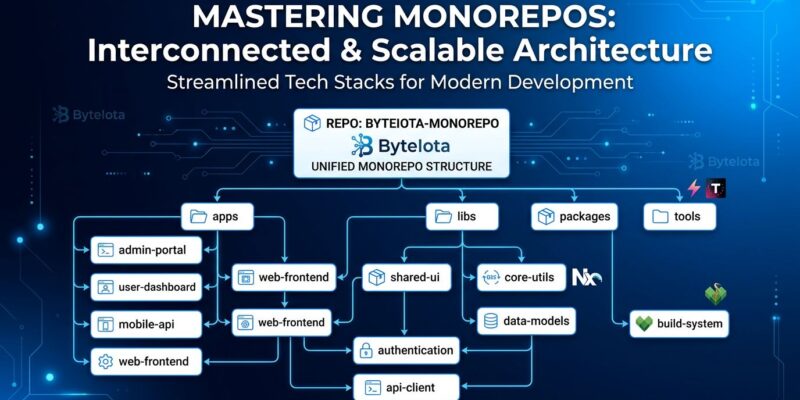
Enterprise code management crossed a threshold in 2026: 63% of companies with 50+ developers now use monorepos, up from a minority approach just a few years ago. What was once Google’s exotic architecture is now the industry default. Tools like Turborepo, Nx, and Bazel solved the traditional pain points that made monorepos impractical, and the results speak for themselves—build times dropping from 30 minutes to 2 minutes, dependency bugs down 40%, and CI pipelines running 90% faster with remote caching.
But here’s the part most analysis pieces miss: 37% of teams still use polyrepos, and they’re not wrong. The choice between monorepo and polyrepo isn’t about picking the “right” architecture—it’s about matching your organizational structure to your tooling strategy.
The Enterprise Shift: Monorepos Hit Majority Adoption
The data is clear. Monorepos are no longer experimental. Nx, one of the leading monorepo tools, hit 36 million monthly downloads in early 2026, a 63% year-over-year increase. Companies that made the leap are seeing concrete results: Stripe consolidated 300+ services and cut CI times from 45 minutes to under 7 minutes. JPMorgan Chase migrated 850+ microservices and saw a 40% reduction in build times.
The tooling finally caught up with the promise. Turborepo, Nx, and Bazel each solved different parts of the monorepo complexity puzzle, making it practical for teams that aren’t Google. You don’t need billions of lines of code and a dedicated build infrastructure team anymore—though if you have those, Bazel is still the answer.
Tool Wars: Turborepo vs Nx vs Bazel
Choosing the wrong tool is where most teams stumble. Adopting Bazel for a 10-person team is like buying an aircraft carrier when you need a speedboat. Here’s the breakdown by team size and complexity:
Turborepo: The Speedboat (5-50 packages, under 10 developers)
Turborepo is simple. One turbo.json file, content-aware caching, and you’re running. Cold builds drop from 94 seconds to 31 seconds with zero custom infrastructure. Vercel’s first-party support makes it the obvious choice for Next.js projects. The tradeoff: no code generation, no CI distribution, no advanced dependency analysis. For small teams shipping fast, that’s fine. You don’t need those features yet.
Nx: The Feature-Rich Platform (20+ packages, 20+ developers)
Nx is where teams graduate when Turborepo hits its ceiling. It’s 16% faster than Turborepo on large builds (28-second cold builds vs 31 seconds), but the real advantage is Nx Agents: distributed CI that cuts builds from 21 minutes to 9 minutes. Add code generation with Nx Generators, module boundary enforcement, and multi-framework support, and you have a platform built for teams managing complexity at scale.
The 63% year-over-year growth in downloads isn’t hype—it’s teams realizing they need advanced tooling to stay productive past 20 developers.
Bazel: The Enterprise Tank (1,000+ engineers, polyglot repos)
Bazel is for when you’re Google, Stripe, or JPMorgan Chase. It’s hermetic builds, action-level caching, and remote execution across machine clusters. The results are undeniable: Google manages billions of lines of code, Stripe shaved 38 minutes off CI times. But here’s the catch: Bazel requires a dedicated build infrastructure team. If you don’t have engineers focused full-time on developer experience, Bazel will frustrate your team, not empower them.
The Hidden Costs: Monorepo Tax and DX Pain Points
Let’s be honest about the downsides. Monorepos aren’t free. They come with a “monorepo tax” that small teams often underestimate. Here are the six gotchas that bite teams in production:
- Incomplete cache outputs: Missing
.d.tsfiles or.nextdirectories causes Turborepo to skip caching and rebuild unnecessarily. - Missing task dependencies: Forgetting
"dependsOn": ["^build"]creates intermittent build failures that are hard to reproduce. - Undeclared cross-package imports: Importing from sibling source code (
../packages/ui/src/Button) bypasses the package’s public API and breaks caching. - Over-consolidated shared libraries: One mega-utility package means any change invalidates the cache for the entire monorepo.
- Misconfigured workspaces: Wrong npm/pnpm/yarn config leads to duplicate installs, missing hoisting, and phantom dependencies.
- Skipping remote caching: A one-hour setup that cuts CI times by 50-80% on subsequent runs. Not setting this up is leaving performance on the table.
One developer described it as “a chaotic battle against node_modules.” Changing shared packages can trigger rebuilding 50 apps. For small teams with 2-3 developers, the infrastructure investment often isn’t worth the complexity.
AI Coding Agents: The New Reason for Monorepos
Here’s the fresh angle most teams haven’t considered: AI coding agents are accelerating monorepo adoption in 2026. Agentic workflows need reliable context and predictable project structure. A monorepo provides one canonical AGENTS.md file with project conventions, eliminating the context-switching nightmare that polyrepos create for AI tools.
When Claude Code, GitHub Copilot, or Cursor need to understand your codebase, consolidated documentation alongside code means more accurate, contextually relevant suggestions. Multi-agent systems—GitHub’s Agent HQ running Claude, Copilot, and Codex simultaneously—benefit even more from unified project structure.
The stats back this up: 80% of developers will use AI coding tools daily by the end of 2026. Gartner reported a 1,445% surge in multi-agent system inquiries from Q1 2024 to Q2 2025. Monorepos are becoming infrastructure for AI agents, not just code organization.
When Polyrepo Still Makes Sense
Now for the part most monorepo evangelists skip: the 37% who stick with polyrepos aren’t wrong. Polyrepo architecture is still the right choice for:
- Autonomous teams with independent release schedules: If services don’t share code and teams ship on their own timelines, forcing them into a monorepo adds coordination overhead with no benefit.
- Varied technology stacks: Polyglot organizations with Java, Python, Go, and Rust services spread across repos avoid the complexity of multi-language monorepo tooling.
- Small teams (2-3 developers): The “monorepo tax”—learning curve, configuration, tooling—outweighs the benefits when you’re managing 5 packages, not 50.
- Git performance consistency: Some teams prioritize consistent Git operations over advanced caching and build optimization.
The choice depends on organizational structure, not just technical factors. Polyrepo isn’t obsolete—it’s contextual.
The Decision Framework
Here’s how to choose:
- Under 10 developers: Start with Turborepo. Simple, fast, Vercel-native.
- 20+ developers: Upgrade to Nx. CI distribution and affected detection become concrete time-savers.
- 1,000+ engineers: Bazel, but only if you have a dedicated infrastructure team.
Both Turborepo and Nx support incremental adoption. You don’t have to restructure your monorepo to adopt them. Start with Turborepo, migrate to Nx when you hit scale limitations around code generation or CI optimization.
And if your teams operate autonomously with no shared code? Stick with polyrepo. Architecture isn’t about picking the “right” answer—it’s about matching tools to your organization’s structure and scale.