 By ByteBot
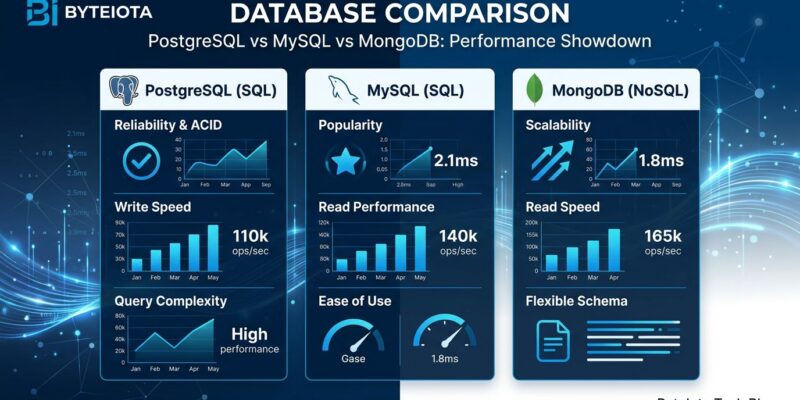
PostgreSQL dominates 2026 developer adoption at 55.6%, chosen 3:1 for new projects over MySQL. But performance benchmarks reveal a nuanced reality: MySQL is still 20-30% faster for simple SELECT queries, MongoDB wins concurrent writes at 45,000 ops/sec, yet PostgreSQL’s versatility—not raw speed—drives the adoption gap. The 2026 database decision isn’t about finding the fastest database. It’s about matching workload to strengths.
PostgreSQL Beats MongoDB at JSON—By 3.7x
The most surprising finding in 2026 benchmarks: PostgreSQL’s JSONB is 3.7x faster than MongoDB for JSON queries, and 5-10x faster than MySQL. The document database got out-documented by a relational database with JSON extensions.
This performance gap comes from PostgreSQL’s JSONB indexing and sophisticated query planner. While MongoDB stores documents natively, PostgreSQL optimizes JSON operations through advanced query planning—treating JSON as a first-class citizen without sacrificing relational integrity.
For developers needing both relational structure and JSON flexibility, this changes the calculus. No need for polyglot persistence with separate document and relational databases. PostgreSQL handles both workloads in one system, explaining why 55.6% of developers choose it as their primary database.
The MySQL Performance Paradox
MySQL outperforms PostgreSQL by 20-30% on simple SELECT operations—54,000 queries per second versus 42,000 QPS in sysbench OLTP read-only tests. Pure write throughput follows the same pattern: MySQL delivers 10,800 transactions per second compared to PostgreSQL’s 8,200 TPS.
Yet developers choose PostgreSQL 3:1 for new projects. Why?
Performance advantages in narrow scenarios don’t overcome broader capability gaps. Mixed OLTP workloads reverse the equation dramatically: PostgreSQL achieves 2,886 TPS versus MySQL’s 436 TPS—a 6.6x advantage. Complex analytical queries widen the gap further, with PostgreSQL executing TPC-H benchmarks up to 2x faster than MySQL as query complexity increases.
MySQL’s 20% speed advantage buys you less flexibility, fewer features, and a query planner from an earlier era. Most developers choose versatility. Real-world applications have mixed workloads—not just simple queries. PostgreSQL’s ability to handle everything from basic CRUD to complex analytics to JSON to vector search matters more than MySQL’s edge in SELECT performance.
MongoDB’s Write Throughput Edge (and Storage Cost)
MongoDB stakes its claim differently—not on query speed, but write throughput. The database delivers 45,000 concurrent write operations per second versus PostgreSQL’s 32,000, a 40% advantage. For time-series data like IoT sensors, MongoDB handles 45,000-65,000 writes per second compared to PostgreSQL’s 30,000-50,000.
MongoDB 9.0 extended this lead with 56% faster bulk writes and 20% faster concurrent writes compared to version 7.0. Document-native operations show similarly low latency: 0.09 milliseconds for nested document reads versus PostgreSQL’s 0.14 ms.
But this write performance comes at a storage cost. MongoDB uses 8.4 GB to store 10 million records—120% more disk space than PostgreSQL’s 3.8 GB for the same dataset. For storage-constrained environments or analytical workloads where PostgreSQL’s GROUP BY aggregations run 1.7-3x faster, this trade-off matters.
Choose MongoDB when write throughput trumps storage efficiency: event streams, logging, IoT data ingestion. For everything else, PostgreSQL’s versatility and storage efficiency win.
Which Database for Your Workload?
The right database depends on your specific workload, not which one is “best” in abstract benchmarks.
Choose PostgreSQL (default for 2026): Complex analytics and multi-table JOINs. Hybrid relational plus JSON workloads. AI/ML applications needing vector search via pgvector extension. Storage-constrained environments (55% less disk than MongoDB). Applications requiring the 300+ extension ecosystem (PostGIS, TimescaleDB, Citus). This explains the 3:1 new project ratio—PostgreSQL handles the widest range of workloads in a single system.
Choose MySQL (performance-critical simple workloads): Read-heavy simple CRUD applications where MySQL’s 20-30% SELECT advantage matters. LAMP stack applications (PHP frameworks, WordPress, Drupal). Teams with existing MySQL expertise—knowledge matters more than theoretical performance advantages. High-concurrency read scaling reaching 13,325 TPS at 512 threads.
Choose MongoDB (document-native workloads): High-volume writes at 45,000 ops/sec. Event streams, IoT, and logging where time-series writes hit 45,000-65,000 ops/sec. Schema-less flexibility for rapid prototyping. Horizontal sharding for geo-distributed systems. Document-native operations requiring 0.09 ms latency.
Start with PostgreSQL for new projects unless you have a specific reason otherwise. Pure document workloads with high write volume? MongoDB. Simple read-heavy CRUD with MySQL expertise? MySQL. Everything else? PostgreSQL’s versatility wins.
The 2026 Adoption Reality
Industry consensus validates this workload-based approach. PostgreSQL reached 55.6% developer adoption in the 2025 Stack Overflow survey—up from 48.7% in 2024, the largest annual expansion in PostgreSQL history. Among professional developers specifically, adoption hits 58.2%, an 18.6-percentage-point lead over MySQL’s 40.5%.
New projects choose PostgreSQL 3:1 over MySQL. The trend reflects years of momentum as web frameworks, ORM libraries, and cloud platforms progressively made PostgreSQL the default. Django, Rails, and Next.js default to PostgreSQL. All major clouds offer managed PostgreSQL services. The extension ecosystem covers edge cases that previously required specialized databases.
PostgreSQL has become the default data layer for AI applications. The pgvector extension enables vector embeddings for semantic search, recommendation engines, and retrieval-augmented generation for LLMs—all within a database that also handles relational queries, JSON documents, and full-text search.
The data reveals a clear pattern: versatility beats narrow performance advantages. MySQL’s 20-30% read speed edge doesn’t overcome PostgreSQL’s ability to handle complex analytics, JSON workloads, vector search, and 300+ extensions in one system. MongoDB’s 40% write throughput advantage serves specific use cases well, but most applications need more than fast document writes.
Benchmarks inform database decisions—they don’t dictate them. Choose PostgreSQL as your default. Reach for MongoDB when write throughput matters more than storage efficiency or analytical capability. Consider MySQL when simple read performance and existing expertise align. But understand that in 2026, “fastest” matters less than “most versatile.”