 By ByteBot
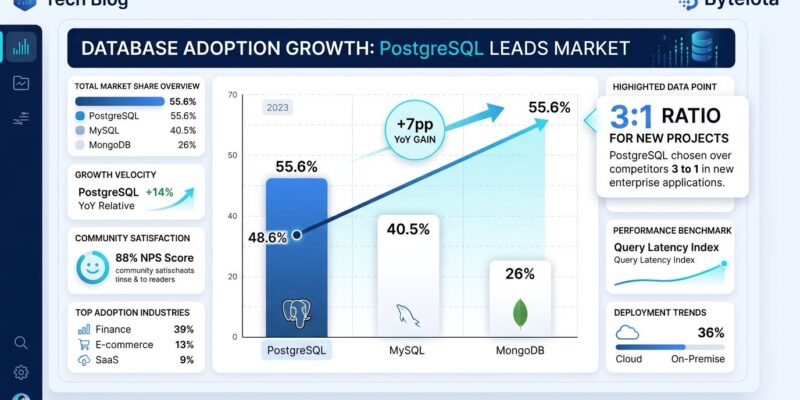
PostgreSQL reached 55.6% developer adoption in 2026 according to the Stack Overflow Developer Survey 2025—up from 48.7% in 2024—marking the largest annual expansion in PostgreSQL’s history. Among professional developers specifically, adoption hits 58.2%, establishing an 18.6 percentage point lead over MySQL (40.5%). The trend is unmistakable: new projects now choose PostgreSQL over MySQL at a 3:1 ratio.
This isn’t marketing hype. It’s a measurable industry consolidation backed by data from 50,000+ developers across 177 countries. For the third consecutive year, PostgreSQL has dominated all three database metrics in the Stack Overflow survey, opening a 15 percentage point gap over second-place MySQL. The database landscape has fundamentally shifted.
Why PostgreSQL Won: JSON, AI, and 300+ Extensions
PostgreSQL’s dominance stems from three technical advantages that matter to modern applications. First, JSON performance: PostgreSQL leads JSON queries by 3.7x compared to MySQL, making it superior for applications storing configuration data, user preferences, or metadata as JSON. PostgreSQL 17, released in late 2025, added native JSON table functions and improved parallel query performance by 35%.
Second, the AI/ML wave. The pgvector extension adds native vector similarity search with HNSW and IVFFlat indexes, enabling RAG pipelines, semantic search, and recommendation systems without requiring a separate vector database. In 2026, every non-trivial application is either using vector search or evaluating it. PostgreSQL with pgvector delivers something no other database can match: relational + document + vector search in a single database, with full ACID compliance.
Third, the extension ecosystem. PostgreSQL offers 300+ extensions, and most play well together—you can run pgvector, PostGIS (geospatial), and TimescaleDB (time-series) in the same database. This operational simplification is driving the 3:1 preference for new projects. Why run three databases when PostgreSQL handles all three workloads?
MySQL’s Position: Installed Base vs New Projects
MySQL isn’t dead—it powers nearly half the web through WordPress, which commands 43.5% market share for all websites and 60.8% of content management systems. Over 63 million websites run WordPress today, and MySQL (alongside its fork MariaDB) remains the standard database choice for WordPress hosting.
However, among new projects, the gap is widening. PostgreSQL’s 3:1 preference ratio shows MySQL has been relegated to two primary use cases: WordPress hosting and legacy application maintenance. The MySQL/MariaDB split (roughly 50/50 in the WordPress ecosystem) further fragments the installed base. Meanwhile, among open-source relational databases, PostgreSQL has been gaining points consistently year over year while MySQL’s ranking has plateaued or declined incrementally.
For developers making database decisions in 2026, MySQL is the right choice only if you’re hosting WordPress at scale or maintaining a legacy application with massive MySQL infrastructure. For everything else, PostgreSQL is the default.
MongoDB’s Shrinking Niche: JSONB Erodes Advantage
MongoDB retains 26% adoption (fifth place overall) for document-heavy, schema-flexible workloads like IoT sensor data, content platforms, and real-time feeds. MongoDB excels at insert-heavy workloads with simple retrieval, where its document storage model avoids the overhead of normalizing data across multiple tables.
But PostgreSQL’s JSONB capabilities have eroded MongoDB’s core advantage. Teams that previously ran PostgreSQL (relational data) + MongoDB (flexible documents) are consolidating to PostgreSQL alone, using JSONB columns for semi-structured data. Add pgvector for AI/ML workloads, and the value proposition for running a separate NoSQL database diminishes significantly.
MongoDB recognizes the shift. MongoDB 8.0 introduced native SQL support through queryable encryption and Atlas SQL interface, showing convergence toward the relational guarantees customers demand. The practical advice for 2026 is clear: start with PostgreSQL and use JSONB for the flexible parts. Only evaluate MongoDB if you hit a scaling wall that partitioning and read replicas cannot solve—or if you have insert-heavy workloads where MongoDB’s architecture delivers measurable performance advantages.
Decision Framework: When to Choose PostgreSQL vs MySQL vs MongoDB
The 3:1 ratio reveals the industry consensus: PostgreSQL is the 2026 default. Choose PostgreSQL for new projects, SaaS applications with relational data and subscriptions, AI/ML workloads requiring RAG or semantic search, applications needing ACID compliance for billing and payments, and hybrid workloads combining structured data, JSON documents, and vector search.
Choose MySQL only for WordPress hosting at scale or legacy applications with massive MySQL infrastructure where migration costs outweigh PostgreSQL’s advantages. MySQL’s replication remains battle-tested at Meta’s scale, and the WordPress ecosystem tooling is optimized for MySQL/MariaDB.
Choose MongoDB for insert-heavy workloads with simple retrieval (IoT applications generating millions of sensor readings), document-like data with frequently changing schemas, or applications requiring horizontal scaling from day one. MongoDB’s architecture handles these use cases better than PostgreSQL—but verify you actually need these characteristics before adding database complexity.
Most teams overcomplicate this decision. The question isn’t “which database is best?” It’s “do I have specific requirements that PostgreSQL doesn’t handle?” If the answer is no, PostgreSQL is your database.
What’s Driving This: Survey Data and Industry Consolidation
The Stack Overflow Developer Survey 2025, drawing from 50,000+ developers across 177 countries, shows PostgreSQL’s 7 percentage point year-over-year gain represents millions of developers choosing PostgreSQL over alternatives. This is the largest annual expansion in PostgreSQL’s history, cementing its position as the #1 most-wanted database in the Stack Overflow 2026 survey with 12% adoption growth year-over-year.
The consolidation around PostgreSQL reflects a broader industry trend: reducing multi-database architectures. Instead of PostgreSQL + MongoDB + Pinecone (three databases requiring separate infrastructure, monitoring, and expertise), teams are choosing PostgreSQL + JSONB + pgvector (one database with full ACID compliance). This operational simplification reduces infrastructure costs, eliminates data synchronization overhead, and decreases the surface area for failures.
The data reveals a fundamental database market shift. MySQL retains its WordPress stronghold but has plateaued for new development. MongoDB keeps domain-specific niches but loses ground to PostgreSQL’s JSONB. PostgreSQL, meanwhile, continues expanding across use cases—relational, document, vector, geospatial, time-series—becoming the “one database to rule them all” for modern applications.
Key Takeaways
- PostgreSQL reached 55.6% developer adoption in 2026 (up from 48.7% in 2024), with new projects choosing PostgreSQL over MySQL at a 3:1 ratio—the largest annual expansion in PostgreSQL’s history
- Technical drivers: 3.7x JSON performance advantage over MySQL, 300+ extensions including pgvector for AI/ML workloads, and the ability to handle relational + document + vector search in a single database with full ACID compliance
- MySQL retains its WordPress stronghold (43.5% of all websites) but has plateaued for new development, relegated primarily to WordPress hosting and legacy application maintenance
- MongoDB keeps 26% adoption for insert-heavy, document-focused workloads, but PostgreSQL’s JSONB capabilities have reduced MongoDB’s competitive advantage, driving industry consolidation toward “one database” architectures
- Default to PostgreSQL for new projects in 2026, only evaluating MySQL (WordPress hosting, legacy apps) or MongoDB (insert-heavy workloads, horizontal scaling requirements) if you have specific needs PostgreSQL doesn’t address