 By ByteBot
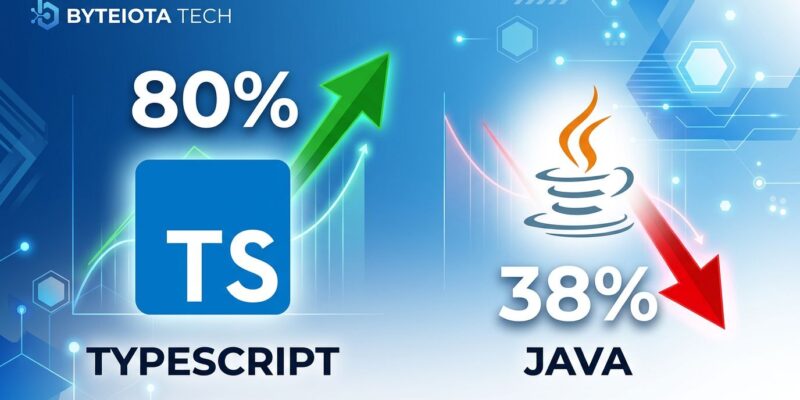
The Nitor 2026 developer survey reveals a seismic shift in programming language adoption. TypeScript has hit 80% usage among developers, establishing a commanding 16-point lead over JavaScript (64%). Meanwhile, Java has collapsed from 65% usage in 2021 to just 38% in 2026—a near-halving that drops it to sixth place behind shell scripting (50%) and Python (47%). This isn’t a temporary trend. TypeScript’s dominance reflects the industry’s irreversible move toward type safety and AI-assisted development, while Java’s decline signals a generational shift to cloud-native architectures where heavyweight Spring Boot frameworks can’t compete with lightweight alternatives.
TypeScript Hits 80%, Java Collapses to Sixth Place
The numbers tell a brutal story. Nitor’s sixth annual developer survey (96 responses, December 2025) shows TypeScript reaching 80% adoption—the highest of any programming language. JavaScript follows at 64%, SQL at 57%, shell scripting at 50%, Python at 47%, and Java limping in at 38%.
Java’s ranking is the real shock. In 2021, Java claimed 65% usage. Five years later, it’s dropped 27 points—a 41% decline that represents structural market change, not cyclical fluctuation. Python surpassed Java for the first time. Even shell scripting now claims higher developer usage.
TypeScript’s 16-point gap over JavaScript has widened year-over-year. The 2024 State of JavaScript survey showed similar 80% adoption, confirming this isn’t a Nitor anomaly—it’s industry consensus. The TypeScript vs JavaScript debate is over. TypeScript won.
Type Safety, AI Tools, and Ecosystem Maturity Drove TypeScript’s Dominance
TypeScript’s 80% dominance stems from three converging forces: type safety, AI tool integration, and ecosystem maturity.
Type safety catches errors before production. Developers report 60-70% faster iteration cycles with TypeScript single-language stacks compared to multi-language setups. The type system eliminates an entire class of integration bugs at service boundaries. Enterprise adoption reflects this: private repos grew 33% year-over-year, with TypeScript disproportionately represented. 69% of developers now use TypeScript for large-scale applications.
AI coding tools amplify TypeScript’s advantage. Typed languages pair better with AI models because they provide structure models can rely on instead of inferring everything from loose JavaScript. The Nitor survey shows Claude Code achieved a 70% net like ratio (highest among AI tools), while GitHub Copilot hit 68% adoption (+22 percentage points year-over-year). TypeScript’s typed interfaces give these tools context that dramatically improves autocomplete and code generation quality.
The ecosystem matured. React, Next.js, Node.js, tRPC, Prisma—the entire modern web stack is TypeScript-native. Developers no longer fight the toolchain. They work with it.
Related: VS Code Copilot Co-Author Default: Copyright Chaos Ensues
Cloud-Native Mismatch: Why Spring Boot Can’t Compete with Lightweight Alternatives
Java’s collapse isn’t about the language itself. It’s about architecture mismatch.
Spring Boot applications’ slow startup times and high memory footprints clash with cloud-native microservices expectations. Kubernetes clusters demand instant scaling. Serverless functions charge by millisecond. Container orchestration favors lightweight processes. Spring Boot’s complexity made sense for monoliths. In microservices-driven architecture, expectations changed—systems must scale instantly.
Modern cloud stacks favor Go, Python, and Node.js/TypeScript. These languages start in milliseconds, not seconds. They consume 30-40% less memory than equivalent Java applications. For serverless and edge computing, this performance gap is disqualifying.
The job market reflects this shift. Python job postings grew 18% year-over-year (Q1 2026), driven by AI and cloud-native roles. Java postings grew just 3%. Absolute numbers still favor Java (112,000 LinkedIn positions vs Python’s 98,000), but the trend lines are diverging. Python offers 62% remote positions compared to Java’s 48%—a signal that modern, distributed teams favor modern stacks.
Here’s the enterprise paradox: 55-60% of enterprise applications still run Spring Boot (JetBrains 2025 data), but only 38% of developers use Java. That’s not dominance. That’s legacy maintenance. Companies depend on Java systems but struggle to hire Java developers. The talent pipeline is drying up.
Salary, Job Growth, and the Remote Work Divide
Language trends have economic consequences.
TypeScript developers average $129,000-$132,000 annually (ZipRecruiter 2026, Wellfound startup data). Python developers earn $129,000 on average, with AI-focused roles commanding 10-15% premiums. Java developers? $119,000. The gap isn’t massive today—but salary trajectories matter more than point-in-time comparisons.
Job growth tells the real story. Python recruiter demand hit 45.7% compared to Java’s 30-35%. Python’s 18% year-over-year job growth compounds. Java’s 3% growth stagnates. Over five years, these different slopes create vastly different career opportunity landscapes.
Remote work percentages reveal another divide. Python positions offer 62% remote opportunities. Java sits at 48%. That 14-point gap reflects an on-premise enterprise bias. Banks, healthcare providers, and government agencies hire Java developers for on-site roles. Startups and AI companies hire Python developers for remote-first positions. The future of work favors flexibility. Java doesn’t.
For developers, this isn’t just about today’s paycheck. It’s about career trajectory over 5-10 years. Languages with 18% job growth and remote-first cultures create compounding opportunity. Languages with 3% growth and on-premise bias create career lock-in.
Key Takeaways
TypeScript is now the default for professional web development. 80% adoption with a 16-point lead over JavaScript means it’s no longer optional—it’s expected. The ecosystem is mature, the AI tools are optimized for it, and enterprise adoption is accelerating.
Java’s 27-point decline from 65% to 38% over five years represents structural change, not temporary fluctuation. The language isn’t dying, but it’s being niche-ified—relegated to legacy maintenance in finance, healthcare, and government. New developers avoid Java. The talent pipeline crisis is real.
Python offers the strongest growth trajectory. 18% job growth, 62% remote positions, AI/ML dominance, and $129k average salaries signal where the market is moving. For developers seeking career optionality, Python provides it.
AI tools favor typed languages. Claude Code’s 70% satisfaction rating and GitHub Copilot’s 68% adoption validate what developers already know: typed code (TypeScript, Python with type hints) works better with AI assistance. The structure gives models context. The productivity gains compound.
Salary stagnation signals declining demand. Java’s $119k vs TypeScript/Python’s $129k represents more than a 10k gap. It represents market momentum. When job growth diverges (18% vs 3%) and remote opportunities favor modern stacks, salary premiums follow. Watch the slope, not the point.