 By ByteBot
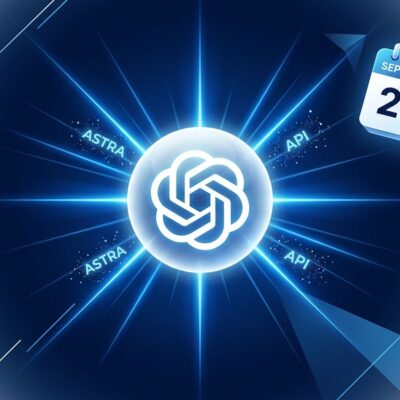
OpenAI released GPT-5.5 on April 23, just seven weeks after GPT-5.4—the fastest major model release in the company’s history. This isn’t an incremental update. It’s the first fully retrained base model since GPT-4.5 and signals OpenAI’s shift toward “agentic” AI that handles complete workflows autonomously. The model powers the company’s “super app” vision: consolidating ChatGPT, Codex, and Operator into a unified platform where AI doesn’t just answer questions but executes multi-step tasks from start to finish.
What OpenAI Is Actually Building
OpenAI co-founder Greg Brockman confirmed GPT-5.5 is “a meaningful step toward more agentic computing” and brings the company closer to its “super app” goal—unifying ChatGPT (chat), Codex (coding), and Operator (browsing) into a single platform for autonomous task execution. This isn’t about better chatbots. It’s about replacing entire toolchains with AI agents that plan, execute, and iterate until tasks complete.
The capabilities are concrete. GPT-5.5 can write and debug code, research online, analyze data, create documents, operate software, and “move across tools until a task is finished.” A Harvard AI researcher reported tasks that “would normally take 10 minutes instead take just a few seconds” with “much less hand-holding.” This is the strategic context everyone is missing: GPT-5.5 isn’t competing with Claude on benchmarks—it’s positioning to replace Slack, Jira, GitHub, and Notion with a single AI interface.
Performance Where It Matters
GPT-5.5 dominates on agentic benchmarks but loses to Claude Opus 4.7 on deep code reasoning. This isn’t a weakness—it’s specialization. GPT-5.5 optimizes for orchestration and planning across tools, while Claude optimizes for single-codebase deep dives. On Terminal-Bench 2.0, which tests real command-line workflows (planning, iteration, tool coordination), GPT-5.5 scores 82.7% versus Claude’s 69.4%—a 13.3-point gap.
The long-context gains are dramatic. On MRCR v2 at 1M-token contexts, GPT-5.5 jumps to 74% from GPT-5.4’s 36.6%, enabling analysis of entire codebases or documentation sets in single sessions. Meanwhile, Claude wins SWE-bench Pro (64.3% versus 58.6%)—the benchmark for GitHub issue resolution across multiple programming languages.
The benchmark war narrative is wrong. GPT-5.5 and Claude aren’t competing head-to-head; they’re specializing. Use GPT-5.5 for long-horizon automation: feature implementation, research synthesis, multi-tool workflows. Use Claude for complex refactoring in large codebases. The “which model is better?” question misses that they solve different problems.
Pricing Reality: 2x Cost, But Not 2x Expensive
GPT-5.5 API costs $5/$30 per million tokens versus GPT-5.4’s $2.50/$15—a 2x sticker price increase. However, GPT-5.5 uses 40% fewer tokens to complete identical tasks, meaning actual cost increase is ~20%, not 100%. Token efficiency is architectural, not accidental.
The math: GPT-5.4 at 100,000 tokens costs $1.75 total. GPT-5.5 at 60,000 tokens (40% reduction) costs $2.10 total—a 20% increase for higher quality and faster completion. Cached input pricing ($0.50 versus $5 per million) slashes repeat costs by 90%.
The “$5/$30 is too expensive” narrative dominates developer discussions, but it’s based on ignoring token efficiency. Teams that understand this economics will adopt GPT-5.5 for complex tasks while keeping GPT-5.4 for simple completions—tiered strategies win. Those who reject GPT-5.5 based on sticker shock will fall behind on quality and capability.
Release Velocity as Strategic Signal
GPT-5.4 shipped March 5. GPT-5.5 shipped April 23—a seven-week gap. This is the fastest major release cadence in OpenAI’s history, suggesting six to eight major model drops in 2026. The AI development pace isn’t stabilizing; it’s accelerating.
Historical context matters. GPT-4 (March 2023) to GPT-4.5 (March 2024) was 12 months. GPT-5.4 to GPT-5.5 was seven weeks—a 7x acceleration. This aligns with $630-650B in Big Tech AI capital expenditure for 2026. Microsoft raised its fiscal 2026 forecast to $190B, well above the $154.6B analysts expected.
Seven weeks between major releases means your production systems will face constant upgrade decisions. Teams need infrastructure to evaluate, test, and deploy new models rapidly—or they’ll lock into GPT-5.5 while GPT-5.6 or GPT-6 ships. The “wait for stability” strategy is dead. Continuous model evolution is the new normal.
The ROI Question Everyone Is Avoiding
Big Tech committed $630-650B in AI capex for 2026, with OpenAI alone making $610B+ in infrastructure commitments ($250B Azure, $300B Oracle, $500B Stargate project). Q1 2026 cloud revenue grew impressively—Google Cloud up 63%, Azure up 40%, AWS up 28%—but the ROI gap between capital deployed and revenue generated has reached ~$600B. Analyst projections warn that free cash flow could drop 90% as capex outpaces returns.
GPT-5.5 isn’t just a model release—it’s OpenAI’s strategic bet that agentic AI will finally justify the infrastructure boom. If autonomous workflows don’t deliver measurable productivity gains in 2026-2027, the AI investment thesis collapses. Developers should watch adoption patterns closely: which companies deploy GPT-5.5 agents at scale, and do they cut headcount or increase output? The answer determines whether this is transformative or another hype cycle.