 By ByteBot
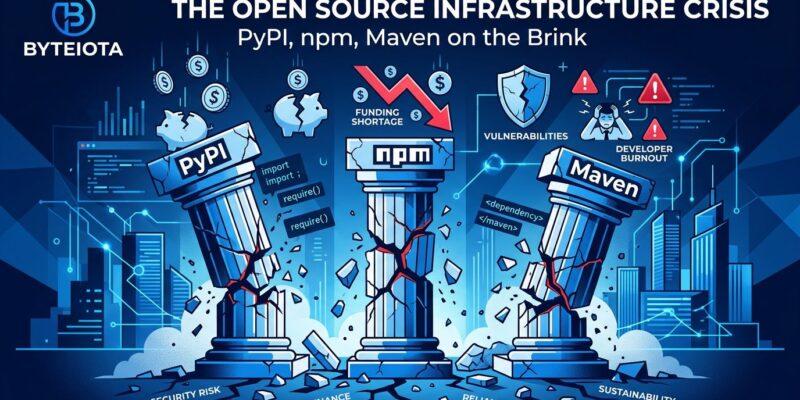
Open source package repositories—npm, PyPI, Maven Central, RubyGems, Crates.io—are approaching financial collapse. PyPI (Python’s package index) faces $1.8 million in monthly bandwidth costs without Fastly’s sponsorship. Crates.io (Rust’s registry) requires $5-8 million annually just to stay online. Meanwhile, 86% of open source developers receive zero payment for their work. The model functioned when open source was a weekend hobby. It fractures when Fortune 500 companies extract trillions in value while more than 90% contribute nothing back. The sustainability crisis isn’t theoretical anymore—it’s measurable in dollars, burnout rates, and security incidents that trace directly to underfunded maintainers.
The Economics Don’t Add Up
Package repositories face exponential cost growth with flat funding. According to a February 2026 FOSDEM presentation by Michael Winser, Alpha-Omega co-founder, PyPI’s bandwidth alone costs $1.8 million monthly without Fastly’s sponsorship. The registry processes 747 petabytes annually—189 gigabits per second sustained. Crates.io, Rust’s package registry, needs $5-8 million per year to handle 125 billion downloads. The cost breakdown hits hard: 25% goes to bandwidth, 18% to storage, 15% to compute power, and 12% to malware mitigation.
Funding comes from intermittent grants and donations with zero enterprise accountability. Downloads grew 10x over the past five years. Funding grew less than 2x. Fastly sponsors PyPI’s bandwidth, but there’s no SLA—the sponsorship can end tomorrow. The Register reported in February 2026 that registries “operate at the very edge of profitability” despite 90% of Fortune 500 companies relying on this infrastructure daily.
Every npm install, pip install, or cargo build depends on volunteer labor operating at the edge of financial viability. When the economics break, supply chains collapse. The question isn’t if, it’s when.
Burnout Isn’t a Wellness Problem—It’s a Security Vulnerability
The XZ Utils backdoor nearly compromised every Linux distribution globally in March 2024. The attacker, using the alias Jia Tan, spent two years deploying fake accounts to pressure a burned-out maintainer until he ceded repository control. The maintainer cited “overwork and burnout” in public messages before handing over access. Jia Tan inserted a backdoor into the SSH compression library, discovered only by chance weeks before widespread deployment.
Researchers analyzing the incident concluded: “XZ Utils was an intentional, patient, sophisticated attack that used maintainer isolation and burnout as the attack vector.” This wasn’t a technical exploit. It was social engineering targeting unpaid volunteers working 22-hour days.
Log4Shell (December 2021) and Heartbleed (April 2014) followed the same pattern. Log4j’s volunteer maintainers were overwhelmed by patch demands after the zero-day disclosure. OpenSSL, which protected millions of servers when Heartbleed hit, was maintained by four people—one full-time, earning approximately $2,000 per year from donations. Critical infrastructure, volunteer-maintained, zero enterprise funding.
When maintainers burn out, they quit or make mistakes. Either outcome creates supply chain risk. The solution isn’t better wellness programs. It’s sustainable economics.
New Funding Models Emerge (Finally)
Three major initiatives launched between mid-2025 and early 2026. The Open Source Endowment, a 501(c)(3) nonprofit, raised $750,000 in commitments and achieved nonprofit status in February 2026. The model: Build a permanent endowment fund where interest income supports critical maintainers. Target: $10 million for self-sustaining operations. Governance is community-driven with transparent allocation decisions.
HeroDevs committed $20 million in June 2025 to fund end-of-life software security. Maintainers who plan EOL transitions thoughtfully receive grants between $25,000 and $250,000. The goal: Prevent sudden project abandonment that creates security vacuums. First payments went out in Q1 2026.
Tiered access models offer a third path. The Open Invention Network’s OIN 2.0 (launched January 2026) introduced tiered pricing: companies under $10 million revenue participate free, while enterprises over $500 million pay $24,000 annually. The principle: individuals and small projects stay free while enterprise-scale consumers contribute proportionally.
Tidelift operates a corporate subscription model where companies pay $100-150 per developer annually. The funds redistribute monthly to maintainers based on actual dependency usage. Over 4,000 projects are funded through Tidelift’s partnership with GitHub Sponsors. It’s usage-based, fair, and requires corporate buy-in—which remains the bottleneck.
These models work if adopted. The question: Will Fortune 500 companies adopt them, or continue free-riding until infrastructure fails?
Regulation Forces Change
The EU’s Cyber Resilience Act adds pressure whether the industry is ready or not. Vulnerability reporting requirements begin September 11, 2026. Full compliance kicks in by December 2027. Monetized open source projects face documentation and security reporting burdens. Non-monetized projects get exemptions, but the definition of “monetized” remains unclear for many projects.
“Open source stewards”—foundations managing projects—receive a lighter-touch regulatory regime. Still, the compliance requirements add costs to already-tight budgets. Timeline: September 2026 for horizontal Type A products, October 2026 for Types B and C, and December 2027 for full requirements.
Regulation may force formalization of funding (positive) or kill volunteer projects unable to afford compliance overhead (negative). Either way, the volunteer labor model faces extinction in regulated markets.
The Developer’s Choice
“Free as in beer” is ending for enterprise users. Tiered models preserve free access for individual developers and hobbyists while asking companies above $10 million in revenue to contribute proportionally. Open source stewards frame it this way: “Any funding models we explore must preserve openness for individuals and small projects while ensuring that enterprise-scale consumers contribute proportionally. It’s about aligning responsibility with usage, not closing doors.”
Some developers see this as betraying open source principles. Others see it as the only path to sustainability. The philosophical debate misses the practical reality: infrastructure costs money. Volunteers can’t absorb enterprise-scale bandwidth bills. PyPI’s $1.8 million monthly bandwidth tab won’t pay itself.
Developers face a fork: Accept that enterprises pay while individuals stay free, or watch critical infrastructure crumble under unsustainable economics. The middle path—everyone stays free forever—doesn’t exist. The numbers don’t allow it.
Key Takeaways
The open source sustainability crisis is quantifiable. PyPI: $1.8 million monthly bandwidth. Crates.io: $5-8 million annually. 86% of developers: unpaid. Security incidents from XZ Utils to Log4Shell: rooted in burnout and underfunding.
Three funding mechanisms offer paths forward: endowments (Open Source Endowment), grants (HeroDevs’ $20M fund), and tiered access (OIN 2.0). Adoption remains optional. For now.
EU regulation forces compliance starting September 2026. That timeline isn’t negotiable. The volunteer model ends where regulation begins. Developers who depend on this infrastructure—which means all developers—have a stake in what replaces it.
Audit your dependencies. Support maintainers. Advocate for sustainable economics. The alternative is watching critical infrastructure fail one burned-out volunteer at a time.