 By ByteBot
Microsoft Agent 365 launches on May 1, 2026 as the first enterprise control plane built specifically to govern AI agents at scale. The platform tackles what Microsoft calls the “corporate double agents” problem: organizations deploying hundreds of AI agents without proper observability, governance, or security. Priced at $15/user/month standalone—or bundled into the $99/month Microsoft 365 E7 “Frontier Suite”—Agent 365 provides a centralized registry, OpenTelemetry-based monitoring, and extends Microsoft’s existing security stack (Entra, Purview, Defender) to non-human entities.
Unlike vendor-locked governance platforms, Agent 365 works with agents from any provider: OpenAI, Anthropic’s Claude, ServiceNow, Workday, or custom LangChain implementations. This platform-agnostic approach positions Microsoft to own the enterprise AI management layer without requiring full ecosystem lock-in.
The Corporate Double Agents Risk
Microsoft’s framing is provocative but not entirely marketing hyperbole. Enterprises are deploying AI agents across HR, finance, IT, and operations—often without IT oversight. These agents access corporate systems, read sensitive data, and execute transactions autonomously. Without governance, there’s no visibility into what agents are doing, no audit trail for compliance, and no security controls to prevent data leakage.
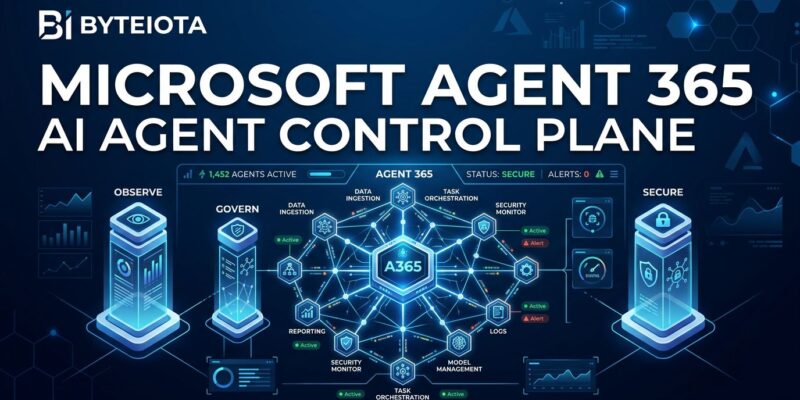
Agent 365 addresses this with three pillars: Observe, Govern, and Secure. The Observe layer provides a centralized registry of all agents across the organization, with OpenTelemetry-based telemetry capturing agent activity, performance metrics, and resource usage. The Govern layer enforces IT-approved agent blueprints—pre-configured definitions that specify agent capabilities, required tool permissions, security constraints, DLP policies, and audit requirements. The Secure layer extends Microsoft Entra for agent identity management (Entra-backed service principals like agent-hr@company.com), Microsoft Purview for data governance and DLP enforcement, and Microsoft Defender for continuous threat detection.
This isn’t just monitoring—it’s purpose-built governance for non-human entities. Agents get their own identities, access controls, compliance policies, and threat protection. IT teams can track which agents exist, what they’re authorized to do, and what they’re actually doing in production.
Platform-Agnostic Approach: Works with Any Agent Vendor
Here’s where Agent 365 differentiates itself: it’s not limited to Microsoft-built agents. The platform works with agents created on Copilot Studio, Azure AI Foundry, OpenAI Agents SDK, Claude Code SDK, LangChain, or any other framework. Agents can be hosted on Azure, AWS, Google Cloud, or on-premises infrastructure. They register with Agent 365 via the Microsoft Agent 365 SDK or CLI, exposing consistent Model Context Protocol (MCP) interfaces for tool integration.
Microsoft’s ecosystem partners—ServiceNow, Workday, Adobe, Cognition, and Genspark—are integrating Agent 365 into their platforms. ServiceNow’s AI Control Tower, for instance, will work alongside Agent 365 to provide cross-platform governance for agents deployed on both ServiceNow and Microsoft platforms. Workday’s Agent Gateway uses open standards (MCP, A2A) to allow external agents to interact with Workday systems while inheriting Agent 365’s security and compliance rails.
This is Microsoft’s play to own the “AI operating system” layer for enterprises. They’re betting that heterogeneous agent environments will become the norm—mixing Microsoft Copilot agents with Salesforce agents, custom LangChain workflows, and third-party autonomous systems. Agent 365 provides the control plane to manage all of them from one interface.
Pricing Strategy: $15 Standalone vs $99 E7 Bundle
Agent 365 pricing follows two models. The standalone version costs $15/user/month and works with any Microsoft 365 plan that includes Copilot. The Microsoft 365 E7 “Frontier Suite” bundles E5 ($60), Copilot ($30), Entra Suite ($12), and Agent 365 ($15) for $99/month—a 15% savings compared to buying components separately ($117/month).
Licensing is per-user, not per-agent. All agents acting “on behalf of” a licensed user are covered under that user’s Agent 365 license. This shifts the economics: organizations don’t need separate licenses for each agent, just for the users those agents serve. For existing E5+Copilot customers, the E7 bundle is compelling if they need enterprise-grade agent governance.
But $15/user/month adds up quickly. An organization with 1,000 employees pays $15,000/month for agent governance—$180,000 annually. That cost makes sense if you’re running dozens of production agents handling sensitive workflows (HR, finance, compliance). It’s harder to justify if you’ve deployed three experimental chatbots. Agent 365 is positioned for enterprise scale (500+ employees), not SMB experimentation.
Real-World Use Cases: HR, Expense Management, IT Self-Help
Early adopters are deploying Agent 365 for high-volume, repetitive workflows. HR self-service agents answer benefits and policy questions, freeing HR teams from repetitive queries while Agent 365 ensures they don’t leak personally identifiable information. Expense management agents (like HSO’s case study) extract data from receipt photos, match to expense categories and project codes, and auto-populate Dynamics 365—cutting expense entry time by 50%. IT self-help agents resolve common technical issues using internal SharePoint knowledge, reducing help desk load.
The more interesting use cases involve financial controls. HSO’s Order Management Agent reads incoming order communications (emails, forms, any format), extracts structured order data, validates against Dynamics 365 pricing and inventory in real-time, and creates sales orders automatically. Orders that pass validation complete without human input; failed orders route to staff with context already surfaced. HSO’s PayFlow Agent handles supplier payment inquiries end-to-end without manual lookup or human intervention. Agent 365’s audit trails and DLP enforcement make these production deployments compliant with financial controls.
Deployment timelines for well-scoped use cases run in weeks, not months. The governance layer actually accelerates production rollout by providing the security, compliance, and observability infrastructure that IT teams require before signing off on agent deployments.
Developer Implications: Governance-First Agent Design
For developers building AI agents, Agent 365 introduces a new governance layer that affects the development workflow. Agents now require IT-approved blueprints before provisioning. These blueprints define capabilities, required tool permissions, security constraints, audit requirements, and DLP policies. Developers can’t just spin up an agent and point it at production systems—IT approval is mandatory.
Agents must integrate the Agent 365 SDK for observability. Here’s what that looks like conceptually:
from agent365_sdk import Telemetry, AgentContext

telemetry = Telemetry(agent_id="hr-selfservice-001")

@telemetry.trace_operation("answer_question")
def answer_hr_question(question: str, context: AgentContext):
    response = search_knowledge_base(question)
    telemetry.log_event("question_answered", {
        "question_type": classify_question(question),
        "confidence": response.confidence
    })
    return response
This telemetry integration (based on OpenTelemetry standards) captures agent activity for centralized monitoring. Developers also configure agent identity using Entra-backed service principals. These identities enforce least-privilege access—agents only get the minimum permissions needed for their defined capabilities. Multi-factor authentication can be required for sensitive operations.
The trade-off: more guardrails mean more development overhead. Blueprint approval workflows, SDK integration, telemetry instrumentation, and identity configuration add time to agent projects. But they enable production-grade deployments. IT teams won’t approve agents for sensitive workflows without this governance infrastructure. Agent 365 makes that infrastructure standard, not custom-built per agent.
Key Takeaways
- Agent 365 launches May 1, 2026 as the first enterprise control plane specifically for AI agent governance
- Three pillars: Observe (OpenTelemetry telemetry + centralized registry), Govern (IT-approved blueprints + lifecycle management), Secure (Entra identity + Purview DLP + Defender threat protection)
- Platform-agnostic design works with any agent vendor (OpenAI, Claude, ServiceNow, Workday) and any cloud (Azure, AWS, GCP)
- Pricing: $15/user/month standalone or $99/month E7 bundle (E5 + Copilot + Entra + Agent 365, saves 15%)
- Real-world ROI from HR automation, expense management, order processing, and IT self-help use cases
- Developer impact: governance-first design requires IT-approved blueprints, SDK integration, and agent identity configuration
- Best for enterprises at scale (500+ employees, dozens of agents); harder to justify for small deployments