 By ByteBot
Cursor 3 shipped April 2, 2026 with the Agents Window—a feature that fundamentally rewrites how developers work. Instead of a traditional IDE where you write code and AI assists, Cursor 3 is an agent orchestration platform where you manage multiple AI agents writing code in parallel. The numbers show a dramatic shift: in March 2025, developers used tab completion 2.5 times more than agents. Today, agents are used twice as frequently. At Cursor itself, 35% of merged pull requests now come from autonomous cloud agents. This isn’t a feature addition. It’s a paradigm shift already in production.
What the Agents Window Actually Does
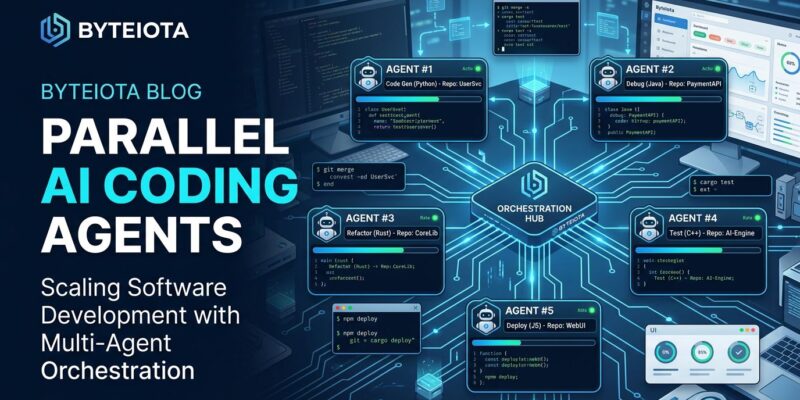
The core capability: run multiple AI coding agents simultaneously across different repositories, environments, and contexts—all from one unified sidebar.
Practical features include parallel execution (launch separate agents for frontend, backend, and tests simultaneously), seamless environment handoff (start an agent on cloud during your commute via mobile, pull to local when you arrive for hands-on review, push back to cloud for extended execution), multi-repo support (one agent per repository or shared agents across workspaces), and a unified sidebar consolidating all agent instances from local, cloud, mobile, Slack, GitHub, and Linear.
Design Mode (Cmd+Shift+D) lets you annotate UI elements directly in the browser—click to select interface components instead of describing changes textually. Cloud agents generate screenshots and demos of their work, providing visual documentation for human review before approval without requiring local execution.
The Architectural Bet: Agent Orchestration Over IDE
Unlike earlier versions that forked VS Code, Cursor 3 was “built from scratch, centered around agents,” according to the official blog. This represents a complete reconception of development environments.
The workflow shift: the old model had developers write code while AI assisted with autocomplete. The new model has developers orchestrate agents while agents write code autonomously. The developer role changes from coder to architect, reviewer, and orchestrator.
Cursor dogfoods this aggressively—35% of their merged PRs originate from autonomous cloud agents. They’re betting their own engineering velocity on this model. The broader industry validates this bet: 57% of organizations now deploy multi-step agent workflows in production. Anthropic research found multi-agent setups outperform single Claude Opus by 90.2%. The pattern emerging: a central “planner” agent decomposes tasks while specialized “worker” agents execute in parallel.
The Reality Check: Costs and Quality Gaps
Developer feedback is split. Supporters call it “the most capable version of Cursor yet.” Critics argue “this view makes you lose any connection to your code.” The design tension: agent-first workflows need ambient autonomy, while code-first workflows need synchronous control.
The cost problem is real. Cursor advertises $20/month Pro plans, but actual bills run $40-50/month (120% overage from per-request fees). Heavy users report “$2,000 per week.” Context construction and tool call management significantly impact effective costs.
The quality gap is more concerning. Research shows developers feel 20% faster but measure 19% slower. Common complaints include AI deleting code, breaking imports, and creating “loops of errors” where fixing one bug creates another. The verification burden remains: 96% of developers distrust AI-generated code, yet 48% don’t verify it. The critical question: does parallelizing agents amplify this verification burden or distribute it?
Security remains a concern, with reports of .env files containing API keys sent to external servers even when configured otherwise.
What This Signals: The End of the IDE Era
SpaceX’s potential $60 billion move for Cursor signals developer tools are becoming a strategic battleground. The focus isn’t general chat AI—it’s tools that directly augment high-value work like coding, engineering, and technical decision-making.
Competitive pressure is mounting. Against Claude Code, Cursor is now competitive on agentic tasks (though Claude Code remains stronger for terminal-heavy workflows). Against GitHub Copilot, the gap widens—Copilot’s $10/month autocomplete model looks limited compared to Cursor’s agent orchestration. Against traditional IDEs, the prediction: environments without agent orchestration will become legacy, similar to how VS Code displaced older editors.
The timeline: within 6-12 months, expect more IDEs to launch agent features under competitive pressure. In 1-2 years, developer roles shift and parallel workflows become standard. In 2-3 years, agent orchestration becomes table stakes, like Git integration today.
Should You Switch?
Teams juggling multiple services, full-stack developers working across frontend and backend simultaneously, and product engineers balancing features across the stack benefit most. Developers preferring direct code control, teams with strict manual review processes, and those with tight budgets should wait.
To try it: upgrade Cursor, hit Cmd+Shift+P, type “Agents Window,” and start with one agent before adding parallel agents. Track actual productivity (not perceived feelings), and verify agent output religiously. Your feelings lie. Your metrics don’t.
The IDE just died. Cursor 3 didn’t add agents to an IDE—it built an agent orchestrator that happens to have IDE features. That inversion matters. In three years, developers who can’t orchestrate AI agents will be like developers who can’t use Git today: technically employable, but at a disadvantage.