 By ByteBot
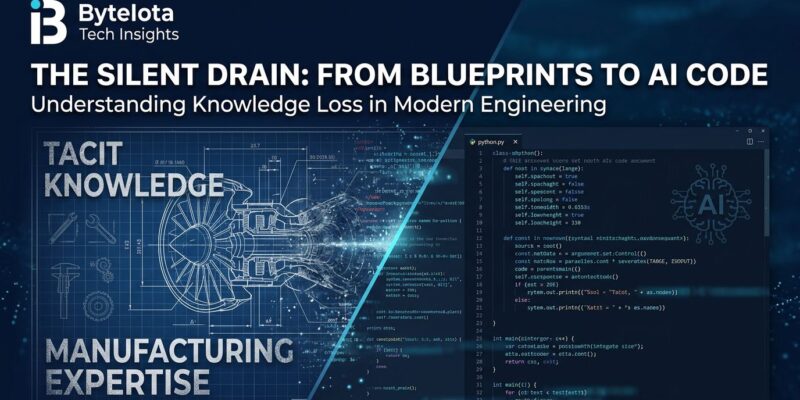
“The West forgot how to make things. Now it’s forgetting how to code.” That’s the thesis sparking 547 comments on Hacker News this week, and the debate isn’t about whether AI tools work—it’s whether companies are destroying coding expertise the same way they destroyed manufacturing. Raytheon had to bring back engineers in their seventies to restart Stinger missile production after a 20-year gap because nobody transferred the knowledge before they retired. Tech companies are doing exactly the same thing: cutting experienced developers, eliminating junior hiring, and calling it “AI productivity gains.” This isn’t about productivity. It’s about short-term profit destroying long-term capability.
Tacit Knowledge Is Disappearing
Eighty percent of organizational knowledge is tacit—it can’t be documented, only transferred person-to-person through mentorship. This includes why architectural decisions were made, debugging instincts from years of experience, trade-off judgments in system design, and the crucial “why we built it this way” context that never makes it into documentation. Tacit knowledge is your competitive moat, but companies are systematically eliminating it by cutting “organizational slack”—the mentorship time and experienced workers they consider wasteful overhead.
The Raytheon example isn’t an outlier. The Department of Energy lost critical knowledge when Fogbank nuclear material production staff retired. Engineers later discovered the original batch contained an “unintentional impurity that was critical to its function” that existed nowhere in documentation. They had to reverse-engineer their own product because tacit knowledge was never transferred. Now developers face the same pattern: they increasingly can’t explain their own code because AI does the thinking while they just press enter. As one Hacker News commenter put it: “Knowledge doesn’t transfer to the AI. It just disappears.”
The Junior Hiring Collapse Broke the Pipeline
Companies justify eliminating junior hiring with simple math: AI coding tools cost $20-30/month versus a junior developer salary plus 6-12 months of ramp-up time. The result is a 67% entry-level hiring collapse since 2022, with hiring into those levels dropping 73% in the past year alone. Microsoft cut 8,750 jobs in April. Meta eliminated 8,000 to fund its $115 billion AI spending. Fifty-four percent of engineering leaders now believe AI will reduce junior hiring long-term.
But juniors aren’t just task-doers—they’re the future senior engineers. The math cuts both ways: a 67% hiring cliff in 2024-2026 means 67% fewer potential leaders in 2031-2036. Companies optimizing for quarterly results are creating a senior engineer shortage five to ten years out. Moreover, the bar for juniors has skyrocketed. As one hiring manager noted, “The Junior of 2026 needs the system-design understanding of a Mid-Level engineer of 2020, just to be useful.” The catch? Without mentorship time and organizational slack, who teaches them?
AI Productivity Claims Don’t Hold Up
Companies market AI coding tools as “10x productivity gains,” but experienced developers were 19% slower with AI in a controlled study by METR—not faster. The perception gap is striking: developers predicted AI would reduce task time by 24%, then estimated after the study that it reduced time by 20%, but reality showed it actually increased completion time by 19%. Only 29-46% of developers trust AI outputs in 2026, and when you include review time—checking AI-generated code for correctness—experienced developers are often slower, not faster.
Another study found 93% of developers use AI tools, but measured productivity gain is only 10%. The gap exists because “coding speed” metrics exclude review time, verification work, and fixing subtle bugs AI introduces. AI excels at boilerplate but struggles with architecture and system understanding. The real purpose becomes clear: AI tools aren’t about productivity—they’re about workforce reduction. Companies eliminate experienced developers and juniors, deploy AI, and call it “efficiency gains.” Cost-cutting disguised as innovation. Productive at what? Shipping code that nobody understands?
We’ve Seen This Pattern Before
Manufacturing knowledge loss followed this exact pattern: outsource for cost savings, eliminate experienced workers, stop training new workers, watch tacit knowledge disappear, then face a crisis when expertise is suddenly needed. Ukraine’s war exposed this brutally. European ammunition production delivered one-third of official capacity claims because the knowledge pipeline had been optimized away during decades of peace. Raytheon needed 30+ months to restart Stinger production, working from Carter administration blueprints, because engineers who knew how to build them had retired without transferring knowledge.
Now coding follows the same trajectory. Deploy AI tools as “productivity gains.” Eliminate experienced workers who are expensive and supposedly replaceable. Stop hiring juniors because “AI handles entry-level tasks.” Tacit knowledge disappears. Then the crisis emerges—though we don’t yet know what form it takes. A major security incident requiring deep system understanding? Complex architectural problems AI can’t solve? The need to maintain systems nobody understands anymore? Like General Electric’s decline, tech companies risk becoming unable to recover expertise once discarded, leaving them dependent on external knowledge they no longer control.
This Is Management Failure, Not AI Failure
AI tools aren’t the problem. How companies use them is. Workforce reduction disguised as “productivity.” Organizational slack—mentorship time, knowledge transfer—dismissed as wasteful overhead. Quarterly cost savings prioritized over long-term capability. Tacit knowledge transfer unmeasured and therefore deemed nonexistent. The assumption that documentation replaces expertise, when it demonstrably doesn’t.
The contrarian position: resist AI dependency. Demand mentorship time as a strategic investment, not overhead. Value expertise and tacit knowledge as irreplaceable competitive advantages. Hire and train juniors to preserve the talent pipeline. This pattern ends badly if tech doesn’t change course. The crisis moment is coming—we’ve seen it happen in manufacturing, defense, and nuclear production. Tech isn’t special. Management that optimizes away expertise will face the same consequences when the crisis emerges and the knowledge is gone.