 By ByteBot
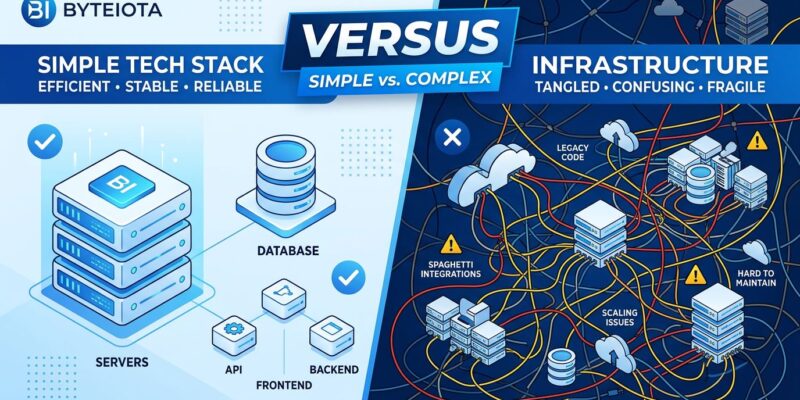
Boring tech stacks won. The 2010s complexity cargo-cult lost. And the industry wasted billions learning this lesson the hard way. The CNCF’s 2025 survey found 42% of organizations that adopted microservices are quietly consolidating back to monoliths. Kubernetes clusters burn money at 8% CPU utilization while 88% of users report rising costs. Stack Overflow still runs its 2 billion monthly page views on nine servers and a single SQL database. The debate is over. Boring won.
The Great Microservices Retreat
The numbers don’t lie. The CNCF polled 689 organizations in fall 2024 and found 42% consolidating microservices back to larger deployable units. Service mesh adoption collapsed from 18% to 8% in two years. Amazon Prime Video cut costs 90% by reverting their video quality monitoring service from microservices to a monolith.
This isn’t fringe behavior. This is the mainstream correcting a decade-long mistake.
The 2026 Kubernetes Optimization Report quantifies the damage. 88% of Kubernetes users saw total cost of ownership increase in the past year. CPU overprovisioning jumped from 40% to 69%. Actual utilization? 8% for CPU, 20% for memory. Companies are paying for 92% unused CPU capacity because someone convinced them Kubernetes was “industry standard.”
Meanwhile, small teams maintain hundreds of Helm charts, dozens of operators, and labyrinthine custom resource definitions to support a handful of product engineers. The operational overhead doesn’t scale down—it scales up.
Why Complexity Happened: Resume-Driven Development
Engineers didn’t adopt Kubernetes because it solved business problems. They adopted it because it looked good on resumes.
IEEE research on resume-driven development found 82% of software professionals believe using trending technologies makes them more attractive to employers. Sixty percent of hiring managers admitted tech trends influence their job advertisements. This created a feedback loop. Companies demand Kubernetes experience. Engineers learn Kubernetes. Engineers bring Kubernetes to their next company. Repeat.
Dan McKinley’s 2015 essay “Choose Boring Technology” warned about this. He introduced the concept of innovation tokens—roughly three per team. Each non-boring tech choice (new language, new database, Kubernetes for a 5-person startup) consumes one token. Most teams burned their tokens on infrastructure theater instead of product innovation.
The result? Resume-driven legacy code. Trendy frameworks that lose support in two years. Kubernetes clusters for apps that could run on a single VPS. Billions spent on complexity nobody needed.
Proof Boring Scales
The “you need microservices to scale” dogma was always wrong.
Stack Overflow handles 6,000 requests per second and 2 billion page views per month with a 15-year-old monolith running on nine web servers. One SQL Server database with a hot standby. Two Redis servers. That’s it. Pages render in 12 milliseconds. The secret? A SQL Server with 1.5TB of RAM keeping 30% of database access in memory.
Shopify processes 30TB of data per minute on a Ruby on Rails modular monolith. The entire core platform is a single large application internally split into domain-focused components. It runs on Kubernetes, but the application architecture is monolithic with smart internal boundaries.
Both companies prove the same point: you don’t need distributed systems to scale. You need good architecture. Boring tech with strong fundamentals outperforms trendy complexity every time.
The Kubernetes Tax
Let’s talk about what Kubernetes actually costs. The 2026 State of Kubernetes Resource Optimization Report found CPU overprovisioning at 69% and memory at 79%. Actual CPU utilization dropped to 8%, down from 10% the previous year. Memory utilization fell from 23% to 20%.
Translation: companies are burning cloud budget on 90% idle infrastructure because capacity planning is harder in distributed systems.
The operational cost is worse. Platform teams supporting small product squads find themselves maintaining hundreds of configuration files, debugging network issues that don’t exist in monoliths, and explaining why the deployment took six hours when the code change was three lines.
Complexity is a tax you keep paying forever. Boring tech is a one-time investment that compounds.
The Smart Path Forward
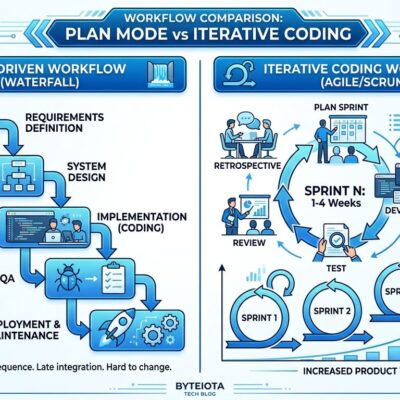
Modular monoliths are the industry’s answer. Enforce module boundaries from day one. Keep deployment simple with a single artifact. Communication stays in-process, eliminating network latency and debugging nightmares. When growth demands it, extract high-demand modules into separate services. This is evolution, not revolution.
The pattern is proven. Start boring. Add complexity only when economics demand it. Spend innovation tokens on your product, not on replacing PostgreSQL with the database your CTO read about on Hacker News.
Dan McKinley had it right in 2015. Teams need to pick the “least worst” solution that handles all business needs with minimum overhead. That solution is almost never the newest framework or the trendiest architecture pattern.
When Boring Isn’t Enough
Real exceptions exist. Netflix serves hundreds of millions of users across global regions with complex licensing requirements. Google operates at planet scale with custom hardware. These companies need distributed systems, polyglot architectures, and dedicated platform teams.
But your startup with 50,000 users is not Netflix. Your SaaS product with 200 paying customers is not Google. Most companies are not operating at the scale where complexity pays for itself. They’re cargo-culting Fortune 500 architecture at Fortune 5000 budgets.
The modular monolith handles the vast majority of real-world scale requirements. The companies actually operating at microservices-necessary scale know who they are. Everyone else is LARPing.
The Verdict
Boring tech won because it always wins. PostgreSQL outlasted MongoDB’s hype cycle. VPS hosting outlasted serverless mania. Monoliths are outlasting microservices fever.
The 2010s taught an expensive lesson: innovation theater doesn’t build products. Features build products. Reliability builds products. Solving customer problems builds products. Your tech stack is invisible to users. They care if the button works when they click it.
Forty-two percent of organizations are consolidating microservices. Kubernetes burns 92% of its CPU allocation doing nothing. Stack Overflow runs on nine servers. The evidence is overwhelming.
Default to boring. Budget your innovation tokens. Build features, not infrastructure. And for the love of all that compiles, stop pretending you’re Google.