 By
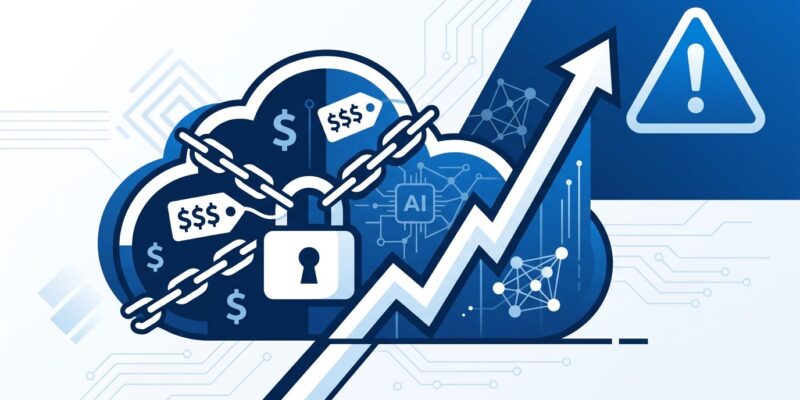
By CTOs signing 3-year AI contracts in April 2026 are locking in today’s subsidized pricing—but when those contracts renew in 2029, they’ll discover what AI infrastructure actually costs. Anthropic loses up to $87,600 annually per power Claude Max user, maintaining a staggering 25:1 ratio between real costs and subscription revenue. This isn’t an accident—it’s the cloud pricing playbook all over again, and the subsidy window is closing fast.
The Economics Don’t Add Up (And They’re Not Supposed To)
Claude Max costs $200 per month. For power users, Anthropic’s real compute costs can hit $90,000 annually. That’s a 25:1 subsidy ratio—the company loses $87,600 per year on every heavy user. The equivalent API value ranges from $2,200 to $31,500 depending on usage patterns. No business runs at this kind of loss indefinitely.
This is deliberate market capture, funded by tens of billions in venture capital. OpenAI has raised over $78 billion. Anthropic has pulled in more than $33 billion. However, these companies aren’t trying to break even right now—they’re buying market share the way Uber, WeWork, and Amazon Prime did before them. Subsidize heavily, create dependency, monetize later.
We’ve Seen This Movie Before
Cloud providers ran this exact playbook between 2010 and 2020. AWS reduced prices 134 times from 2006 to 2020 to gain market dominance. Once enterprises were locked in—data migrated, architectures rebuilt, teams trained—the price cuts stopped. Indeed, in 2023 alone, AWS raised average on-demand compute prices by 23%. Customers who built their entire infrastructure on the assumption of continued price decreases discovered switching costs were prohibitive.
Moreover, the AI industry is replicating this pattern, just faster. What took cloud computing ten years to execute, AI is achieving in eighteen months. Heavily subsidized enterprise plans create dependencies that compound over time, and when those 3-year contracts renew in 2029, the subsidy disappears.
Five Layers of Vendor Lock-In You’re Building Right Now
Vendor lock-in in AI is more subtle and more dangerous than traditional software. According to a Zapier survey from early 2026, 81% of enterprise leaders are concerned about AI vendor dependency—and they should be. Lock-in accumulates across five layers simultaneously.
First, API dependency means your architecture bends around a vendor’s specific design choices. Second, agent framework capture means proprietary orchestration layers make switching exponentially more expensive as workflows mature. Third, data gravity means every fine-tuning run, every embedding, every accumulated context deepens your investment in one platform. Fourth, ecosystem entanglement means AI decisions become inseparable from cloud, productivity suite, and compliance infrastructure. Finally, infrastructure integration means your data pipelines, monitoring systems, and telemetry are vendor-specific.
The switching cost at year one might be three months of engineering effort. By year three, you’re looking at 6-18 months of work—and that assumes you can even extract your data in a usable format. Consequently, none of this reverses through policy decisions. It only reverses through expensive, time-consuming engineering work.
The 2026-2029 Timeline Trap
Here’s the timeline trap facing CTOs right now. In Q2 2026, you sign a 3-year contract at what looks like reasonable pricing. Between 2026 and 2029, your company builds products around those AI capabilities, potentially reduces headcount based on AI-driven efficiency gains, and accumulates the technical debt of deep integration. Then in Q2 2029, your contract comes up for renewal—and the subsidy is gone.
Enterprise AI spending is already up 108% year-over-year in 2026, with the average enterprise spending $1.2 million annually on AI-native applications. Additionally, predictions suggest agentic AI subscriptions could increase somewhere between 10x and 100x from January 2026 levels by the end of 2027. Around 30% of survey respondents are already hitting usage limits and being forced to upgrade plans or switch to more expensive API pricing.
When your renewal lands in 2029, you’ll face a choice: pay exponentially more, or commit to an 18-month migration project while explaining to the board why the “cost-effective” AI infrastructure you championed three years ago is now untenable.
What You Can Actually Do
The subsidy era is ending in 2026, but you still have options—if you act before lock-in solidifies. Sovereign cloud infrastructure spending is projected to hit $80 billion in 2026, representing a 35.6% year-over-year increase as enterprises look for alternatives to hyperscaler dependency. Furthermore, by 2030, analysts predict 20% of existing workloads will migrate from global hyperscalers to regional or sovereign cloud providers.
Multi-model strategies offer another path. Don’t architect your entire infrastructure around a single vendor’s capabilities. Instead, build abstraction layers that allow model portability. Negotiate contracts with price caps, escalation limits, and actual data portability guarantees—not just vague assurances. Enterprise buyers who commit to meaningful volumes can often secure 25-40% below list rates, but make sure those discounts come with contractual protections.
If you’re signing contracts in 2026, consider delaying renewals to Q1 2027 if possible. OpenAI’s planned IPO will force public disclosure of margins and customer data that currently sit in a black box, giving enterprise buyers real benchmarks for renewal negotiations instead of flying blind.
Most importantly, budget for true costs, not subsidized rates. The pricing you see today is funded by venture capital that’s running dry. Therefore, build your financial models around what AI infrastructure will actually cost when companies need to turn a profit, not what they’re willing to lose to capture market share.
The cloud providers already ran this playbook successfully. Don’t fall for it twice.