 By ByteBot
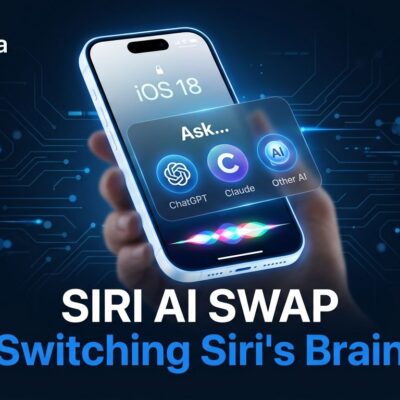
Apple spent three years insisting it would build a competitive AI stack. On June 8, at WWDC26, it will announce it has stopped trying. iOS 27 ships with a new Extensions framework that lets users choose which LLM powers Siri — ChatGPT, Google Gemini, or Anthropic Claude at launch. That is not a partnership announcement. That is Apple turning itself into a platform layer and letting the model race happen on top of it.
What the Extensions Framework Actually Is
Extensions is a new system-level API that allows third-party AI chatbot providers to integrate directly with Siri, Writing Tools, and Image Playground across iOS 27, iPadOS 27, and macOS 27. A provider builds one Extension that ships to every device across all three platforms — reaching over two billion active Apple devices from a single App Store submission.
The architecture will be familiar to iOS developers. Apple has supported Extensions since iOS 8 for share sheets, keyboards, and widgets. The AI Extensions system applies the same containerized, permission-gated model to LLM integrations. Users enable their preferred providers in Settings > Apple Intelligence & Siri and can route different types of requests to different backends — Claude for code, Gemini for research, ChatGPT for writing — based on each model’s strengths.
Three providers ship at launch: OpenAI, Google, and Anthropic. But the API is open: any AI chatbot app that passes App Review can ship an Extension, and Apple is adding a dedicated App Store section for AI Extensions. That section is a new discovery surface that has never existed before.
Core AI Replaces Core ML
Extensions is not the only developer-facing change. Apple is replacing Core ML with a new framework called Core AI. Core ML was introduced in 2017 and was built for traditional machine learning models — classifiers, regressors, image recognition. Core AI is rebuilt from scratch for LLMs and generative models.
On-device execution is preserved. Core AI still runs on the Neural Engine, GPU, and CPU without a network connection. Privacy guarantees stay intact. What changes is that the system now dynamically routes tasks between on-device and cloud-based models based on performance requirements and privacy context — rather than leaving that decision entirely to developers.
Existing Core ML apps continue to work. But Core AI becomes the default once iOS 27 SDKs ship in fall 2026. If you are building anything with on-device inference today, start reading the migration documentation when it drops at WWDC.
Apple Stopped Competing on Models — on Purpose
The Extensions play is a deliberate strategic retreat from the LLM race, and it was the right call. Apple’s own AI capabilities have been a reliable source of embarrassment since Apple Intelligence launched. Rather than pouring more resources into catching up with OpenAI, Google, and Anthropic, Apple is repositioning as the trusted platform layer that those providers compete on top of.
Apple keeps the UX chrome, the trust signals, the privacy presentation, and the App Store monetization cut. LLM providers get access to Apple’s installed base and fight each other for user preference. Apple wins regardless of which model “wins.” It is a cleaner business than trying to build a frontier model, and it conveniently satisfies EU regulators who were watching for gatekeeper behavior before it became a formal complaint.
What Developers Should Do Before Fall 2026
If you build AI-powered iOS apps, the Extensions API is the most important developer surface announced in the last several years. Apps that ship Extensions support will be eligible for the dedicated App Store AI section and for Siri routing. Apps that do not will increasingly be invisible to users who rely on Siri to launch and operate apps.
Niche AI providers — legal research tools, medical diagnostics, coding assistants, accessibility apps — now have a first-class integration path without workarounds. The dedicated App Store AI section is a new discovery channel that is separate from keyword search, which has favored incumbents.
The practical checklist: review the Extensions API documentation when it drops June 8 at WWDC26, plan your Core ML to Core AI migration before the fall SDK drop, and decide which AI provider integrations make sense for your app’s use case.
The Risks Worth Watching
Apple controls the Extensions API approval process, which means it can reject providers without explanation. The dedicated App Store AI section creates a new gatekeeping surface right as regulators are scrutinizing Apple’s control over app discovery. Privacy is not fully resolved: Siri still transmits device metadata to Apple servers with every query, regardless of which backend handles the response. App Review timelines could put smaller AI providers at a disadvantage against the three launch-day partners that clearly had early API access.
None of that makes the Extensions framework a bad idea. It makes it a platform with real power dynamics, which is exactly what Apple intended.