 By
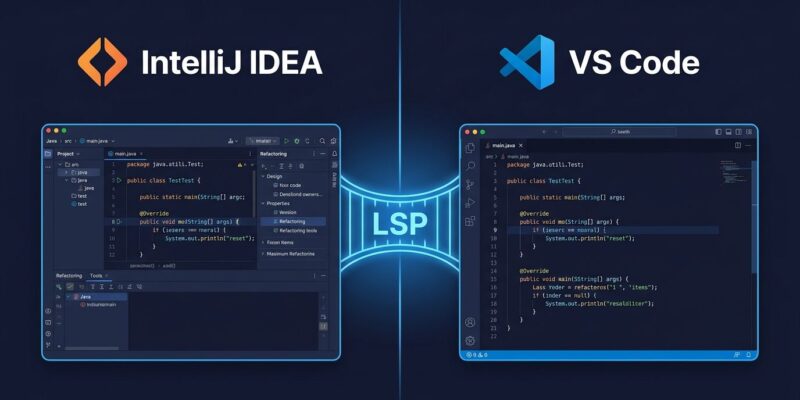
By JetBrains just did something that would have seemed like a concession three years ago: they shipped IntelliJ IDEA’s language intelligence as a VS Code extension. Not just Kotlin — they covered that ground at KotlinConf in May — but full Java support, DAP debugging, and build system integration for Maven, Gradle, and Bazel. It’s free during preview, and if you work in Java or mixed Java/Kotlin codebases and live in VS Code, it’s worth knowing what you’re actually getting.
What the Extension Actually Does
The extension is called “Java and Kotlin by IntelliJ IDEA” and it’s powered by IntelliJ’s underlying language server, not the Eclipse JDT engine that has driven the Red Hat Java extension for years. That distinction matters in practice. You get IntelliJ-class code completion and diagnostics, over 50 automated refactoring options versus the handful VS Code’s built-in tooling offers, and full debugging via DAP — IntelliJ’s debugger running inside VS Code rather than Eclipse’s.
It handles Maven, Gradle, and Bazel build systems out of the box and is explicitly optimized for large codebases and monorepos. On project open, it auto-analyzes and imports build configs. For teams maintaining large Spring or multi-module projects who want to stay in VS Code or Cursor, that matters.
How This Compares to What You Already Have
The Red Hat Language Support for Java extension — which wraps Eclipse JDT — has around 29 million installs and is good enough for most VS Code Java work. But “good enough” starts to fray at the edges: basic refactoring that won’t confidently rename across module boundaries, a debugger that lacks advanced features like deadlock analysis, and performance that slows on large multi-module projects. IntelliJ’s extension targets exactly those gaps.
If you’re on Kotlin only, skip this for now. The Kotlin Language Server (Apache 2.0, free, 3.5k GitHub stars) covers your use case and does not require a subscription. We covered it when JetBrains first shipped it in alpha back in May. The IntelliJ server extension is the play for Java or mixed projects.
The Subscription Catch
The preview is free. Each biweekly build resets the 30-day evaluation timer, so you’re not on a countdown to a paywall just yet. But when v1.0 ships, you’ll need an IntelliJ IDEA Ultimate subscription to keep using it — currently around $24.90 per month.
There’s a reasonable argument here: one license covers both the desktop IDE and the VS Code extension, so if you’re already an Ultimate subscriber you’re getting extra coverage at no cost. If you’re currently running the free Red Hat extension, though, this will eventually cost you. JetBrains is betting the IntelliJ intelligence advantage is worth that delta. They’re probably right for enterprise Java teams, less so for solo developers or budget-constrained shops.
One practical note: JetBrains recommends disabling the Red Hat and Oracle Java extensions to avoid feature overlap. That’s a real commitment — you’re not keeping both.
Why JetBrains Is Doing This Now
VS Code now holds 75.9% overall developer adoption — its highest share ever. Even in Java specifically, where IntelliJ dominates professional developer market share at around 72%, VS Code usage has climbed to 31% and is growing. JetBrains discontinued Fleet in December 2025 and redirected those resources back into IntelliJ. In June 2026 they open-sourced the LSP Client API. In May, the Kotlin Language Server alpha. Now this.
This is not JetBrains retreating. It’s them extending their intelligence layer into the editor where more developers spend time, before someone else does it first. The positioning is clear in the announcement itself: they frame the extension explicitly around AI coding agents, not just human developers.
The Agentic Angle
JetBrains is explicit that this targets agent-based workflows. Coding agents working on Java or Kotlin codebases currently face an ugly tradeoff: pass raw source files to the model (expensive, context-heavy) or use grep-style navigation (imprecise). An LSP-based server gives agents structured, IntelliJ-class code intelligence without spinning up a full desktop IDE. JetBrains plans to publish data on reduced token consumption for agent workflows, and agent plugins are on the near-term roadmap.
If you’re building or customizing AI coding agents that touch Java or Kotlin — in Cursor, Claude Code, or anything else LSP-aware — this is worth watching even before v1.0.
Install It Now
The extension is available on the VS Code Marketplace and Open VSX Registry. Version 0.0.8 is current. It’s free during preview, the biweekly updates keep the trial active, and JetBrains is collecting feedback ahead of the stable release. If you’ve been running IntelliJ for Java and VS Code for everything else, this is the bridge worth testing.
The full announcement on the JetBrains blog covers the roadmap in more detail, including plans for terminal-based agentic workflows and agent plugins.