 By ByteBot
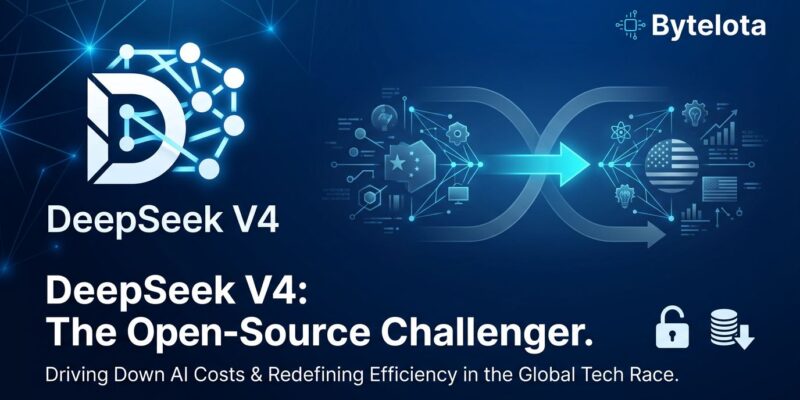
DeepSeek released V4 Flash and V4 Pro on April 24—one day after OpenAI’s GPT-5.5 announcement—and the open-source models are forcing an uncomfortable question: can OpenAI and Anthropic justify charging 8.6x more for 13% better performance? The Chinese startup’s new models achieve 85-95% of frontier intelligence at roughly one-sixth the inference cost, with V4-Flash output priced at $0.28 per million tokens compared to GPT-5.5’s $30. Both models carry an MIT license, with weights available on Hugging Face.
The Cost Disruption
The pricing gap is staggering. DeepSeek V4-Pro costs $1.74 per million input tokens and $3.48 per million output tokens. GPT-5.5 charges $5 and $30 respectively. That’s 8.6x more expensive on output alone. Against Claude Opus, the differential widens—DeepSeek is roughly 50x cheaper on input and 68x cheaper on output.
V4-Flash takes this further. At $0.28 per million output tokens, it’s 107 times cheaper than GPT-5.5. The model undercuts every Western frontier-tier small model, creating what developers on X are calling a cost-performance ratio that “shatters the market.”
This isn’t price dumping funded by venture capital subsidies. DeepSeek’s technical innovation drives the economics. The V4 architecture uses a Hybrid Attention mechanism combining Compressed Sparse Attention and Heavily Compressed Attention. At the 1-million-token context setting, V4-Pro requires only 27% of V3.2’s single-token inference FLOPs and 10% of the KV cache. The efficiency gains make low-cost inference sustainable, not just a temporary land grab.
Performance Reality Check
The Artificial Analysis Intelligence Index gives GPT-5.5 a score of 60, Gemini 3.1 Pro a 57, and DeepSeek V4 Pro a 52. That 13% gap from the leader matters less when you examine specific benchmarks.
DeepSeek V4-Pro beats GPT-5.4 xHigh on Codeforces competitive programming (3206 vs 3168). It crushes Claude Opus 4.6 on IMO math problems (89.8 vs 75.3), a 14.5-point margin. On general knowledge (MMLU), V4 scores 88.4%, matching GPT-5 and Claude Opus 4. For agentic web browsing tasks, DeepSeek hits 83.4%, within one percentage point of GPT-5.5’s 84.4%.
An internal DeepSeek survey of 85 experienced developers found that over 90% included V4-Pro among their top model choices for coding tasks. Arena.ai ranked it 3rd among open-source models and 14th overall, calling it “a significant leap compared to DeepSeek V3.2.”
The model trails on some fronts. On Humanity’s Last Exam academic reasoning without tools, DeepSeek scores 37.7% against Claude Opus 4.7’s 46.9%. But for most real-world applications—code generation, data analysis, technical writing—the performance is good enough. The question becomes: is 10-15% better performance worth 6-8x higher cost?
Open-Source Timing and Geopolitics
DeepSeek didn’t wait long to respond to OpenAI. GPT-5.5 launched April 23. V4 arrived April 24. Both V4-Pro (1.6T total parameters, 49B active) and V4-Flash (284B total, 13B active) are Mixture-of-Experts models supporting 1-million-token context windows. The MIT license means no vendor lock-in, no proprietary constraints.
This isn’t just technical competition. It’s geopolitical. DeepSeek’s V4 runs on Huawei Ascend chips, circumventing US export restrictions. NVIDIA’s Jensen Huang reportedly called the Huawei integration a “disaster”—for NVIDIA. China’s AI capabilities now rival US leaders, and they’re open-sourcing the results at prices that make Western proprietary models look like luxury goods.
The timing amplifies the message. DeepSeek upended Silicon Valley with R1 in January 2025. A year later, they’re trading blows with OpenAI on launch schedules, demonstrating both technical parity and strategic confidence. The frontier AI race is now a three-way competition: Anthropic (writing, citation rigor), DeepSeek (analytical depth, cost efficiency), and OpenAI (speed, market dominance).
What This Signals
DeepSeek V4 forces a reckoning with AI economics. ByteIota recently covered the “AI Subsidy Trap”—how companies like Anthropic lose up to $87,600 annually per power user to build market share before eventual price hikes. If DeepSeek can deliver near-frontier performance profitably at $3.48 per million output tokens, why does GPT-5.5 cost $30?
Enterprise ROI calculations shift dramatically. Paying 8.6x more for 13% better performance might make sense for mission-critical applications requiring absolute best performance. But for the majority of use cases—coding assistance, content generation, data analysis—DeepSeek’s 85-95% performance at 1/6th the cost changes the equation.
Developers gain negotiating power. Proprietary vendors can no longer rely solely on performance leads to justify premium pricing. They need to demonstrate clear value that justifies the cost differential: enterprise support, reliability guarantees, regulatory compliance, integration quality.
Open-source catching up to proprietary faster than expected doesn’t mean the frontier leaders are doomed. However, it means they can’t coast on technology advantages alone. The market now demands justification for premium pricing, and “it scores 60 instead of 52” might not be enough.
This isn’t another “DeepSeek Moment” like R1’s January 2025 disruption—analysts at Morningstar call V4 a “competent follow-up, not a watershed.” Nevertheless, competent evolution at 1/6th the cost is exactly the kind of pressure that transforms markets. The AI pricing model built on venture subsidies and performance monopolies is facing its first real challenge from sustainable, open-source economics.