 By ByteBot
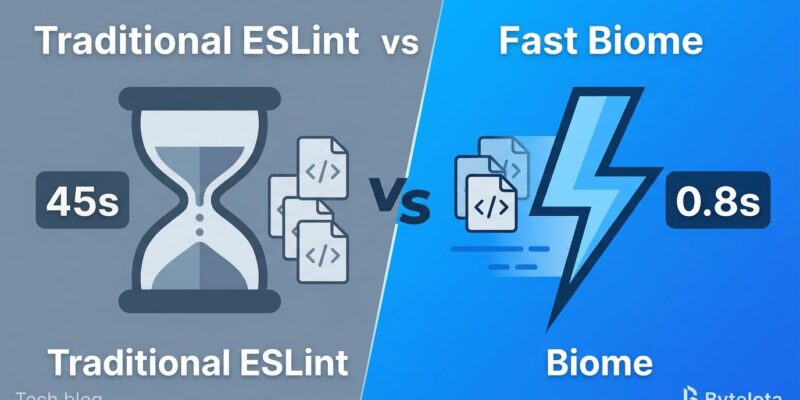
JavaScript developers are ditching ESLint and Prettier for Biome in 2026, a Rust-powered all-in-one toolchain that lints 10,000 files in 0.8 seconds compared to ESLint’s 45.2 seconds. With production deployments at AWS, Google, Microsoft, Cloudflare, Coinbase, and Slack, and Biome v2’s 491 type-aware lint rules closing the functionality gap, the migration from ESLint+Prettier is accelerating across enterprise teams seeking performance gains without sacrificing code quality. This isn’t just another linter—it’s a fundamental shift in how JavaScript tooling approaches the speed vs ecosystem trade-off.
The Performance Problem ESLint Can’t Fix
Slow linting kills developer productivity. ESLint takes 45.2 seconds to lint 10,000 files while Biome finishes the same job in 0.8 seconds—a 56x performance difference. In large enterprise codebases, developers report waiting 3-5 minutes or more for ESLint to complete, turning linting into a CI/CD bottleneck that slows deployments and frustrates developers.
The problem isn’t just ESLint’s architecture—it’s specific plugins that compound the slowdown. The eslint-plugin-import‘s import/no-cycle rule alone consumes 70% of lint time by building a complete dependency graph. Type-aware linting through typescript-eslint requires calling TypeScript’s type checking APIs, adding significant overhead. Developers resort to workarounds like --cache flags and --concurrency parallelization, but these are band-aids on a fundamentally slow tool.
Biome solves this by design. Written in Rust with arena allocators and zero-copy string handling, it’s fast by default—no configuration tricks needed. For teams shipping code multiple times daily, saving 4+ minutes per lint run translates to faster deployments, better developer experience, and reduced compute costs. Performance benchmarks consistently show Biome’s 10-20x advantage.
Enterprise Adoption Signals Production-Readiness
When AWS, Google, Microsoft, and Cloudflare trust a tool for production workloads, it signals maturity and de-risks adoption for smaller teams. Biome has crossed that threshold with deployments at 10+ major companies including Coinbase, Discord, Node.js project itself, Slack, Vercel, and Astro.
The release timeline shows accelerating maturity. Biome v2.0 “Biotype” (late 2025) introduced type-aware linting without requiring the TypeScript compiler—a technical breakthrough. Biome v2.3 (January 2026) expanded to 491 lint rules with type-aware features. Biome v2.4 (February 2026) continues stability improvements. This rapid iteration backed by enterprise validation demonstrates that Biome isn’t experimental—it’s production-ready for teams seeking ESLint alternatives.
One Tool to Replace ESLint + Prettier
ESLint and Prettier require separate configurations, separate runs, and careful coordination to avoid conflicts between formatting and linting rules. Developers juggle .eslintrc and .prettierrc files, install both dependencies, and run two commands to achieve what Biome handles with one tool.
Biome unifies linting and formatting in a single configuration file (biome.json) with a single command (biome check). The linter contains zero formatting rules—Biome’s opinionated formatter handles all formatting decisions automatically. This design eliminates tool conflicts and simplifies the developer toolchain from two dependencies to one.
Migration is straightforward. The built-in biome migrate eslint --write command reads ESLint configuration (both legacy and flat formats) and automatically converts it to Biome’s format, including supported plugin rules from TypeScript ESLint, JSX A11y, React, and Unicorn. Getting started takes minutes, not hours. The official migration guide provides step-by-step instructions.
# Install Biome
npm install --save-dev @biomejs/biome

# Migrate from ESLint
npx @biomejs/biome migrate eslint --write

# Lint and format
biome check --write ./src
Type-Aware Linting Without the Compiler Overhead
Type-aware linting catches bugs that standard linting misses—async/await issues, floating promises, type mismatches. TypeScript’s typescript-eslint provides this through type checking APIs, but requires invoking tsc for every lint pass, adding significant performance overhead.
Biome v2 introduced built-in type inference that achieves type-aware linting without running the TypeScript compiler. The noFloatingPromises rule detects 75% of floating promise cases compared to typescript-eslint’s full coverage, maintaining Biome’s speed advantage while catching most real-world bugs. For large TypeScript codebases where tsc runs add minutes to CI/CD pipelines, this trade-off—75% coverage at 20x speed—is compelling.
This technical innovation separates Biome from other fast linters like Oxlint. While Oxlint achieves 50-100x speed gains over ESLint, it lacks type-aware features. Biome delivers both speed and type safety, making it suitable for enterprise TypeScript projects that can’t sacrifice safety for performance.
When to Migrate (and When to Wait)
Biome is production-ready for most JavaScript and TypeScript projects, but it’s not a drop-in replacement for every ESLint setup. The decision to migrate depends on your plugin dependencies and framework requirements.
Migrate if:
- You’re starting a new project (greenfield code with no legacy config)
- Performance is a bottleneck (slow CI/CD pipelines killing velocity)
- You use standard JavaScript/TypeScript without specialized plugins
- You want simpler tooling (one tool vs ESLint + Prettier + config)
Wait if:
- You rely on Vue or Svelte framework plugins (hundreds of framework-specific rules missing in Biome)
- You use Cypress testing with
eslint-plugin-cypress - Your React projects need exhaustive hook dependency linting (Biome catches basic issues but misses exhaustive dependencies in
useEffect) - You depend on custom ESLint rules that Biome doesn’t support
The plugin ecosystem gap is Biome’s main limitation. While Biome handles TypeScript ESLint, JSX A11y, React, and Unicorn plugins, framework-specific tooling for Vue, Svelte, and testing frameworks lags behind ESLint’s mature ecosystem. Teams should audit their .eslintrc dependencies before migrating—if you rely heavily on specialized plugins, the performance gains may not outweigh lost functionality. This comparison guide details when to wait.
Key Takeaways
- Biome delivers 10-20x performance gains over ESLint (0.8s vs 45.2s for 10,000 files), eliminating CI/CD bottlenecks and improving developer experience
- Enterprise adoption at AWS, Google, Microsoft, and Cloudflare validates production-readiness—Biome v2’s 491 rules and type-aware linting make it feature-complete for most teams
- Unified tooling replaces ESLint + Prettier with one tool, one config, and simpler maintenance via built-in migration command
- Type-aware linting without TypeScript compiler overhead catches async/await bugs at 20x speed, trading 25% coverage for massive performance gains
- Migration makes sense for standard JavaScript/TypeScript projects and new codebases, but wait if you depend on Vue/Svelte/Cypress plugins that Biome doesn’t support yet
- Biome is part of a broader Rust revolution in JavaScript tooling (alongside SWC, Turbopack, Bun) that prioritizes native-language performance over JavaScript-based extensibility—for most teams, speed wins
Biome isn’t replacing ESLint everywhere, but 2026 marks the tipping point where it becomes the default choice for new projects and performance-critical teams. The trade-off between raw speed and ecosystem flexibility is real, but as Rust-powered tooling matures, the gap narrows. JavaScript developers accustomed to waiting minutes for linting can now expect sub-second results—and that expectation reset changes everything.