 By ByteBot
Kubernetes has become the default infrastructure choice for modern development teams, but the data tells a different story: 90% of companies waste resources on complexity they don’t need. Teams are now publicly documenting their migrations away from Kubernetes back to Docker Compose, reporting savings of 60 hours per week and slashing infrastructure costs from $800/month to $50/month. The uncomfortable truth? Most teams adopted Kubernetes not because their business needed it, but because Google uses it.
The Real Cost of Kubernetes
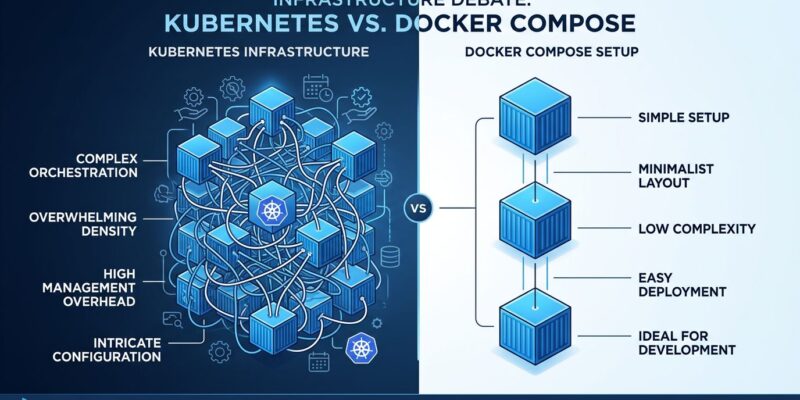
Kubernetes imposes a measurable “complexity tax” on every deployment, debug session, and new engineer onboarded. Real teams report infrastructure costs increasing 4x-16x, deployment times slowing from 30 seconds to 10+ minutes, and engineers spending 5-10 hours weekly on cluster maintenance instead of shipping features.
Consider one SaaS startup with 500 customers and 50 requests per minute. They migrated from Heroku ($200/month) to Kubernetes ($800/month), spent six weeks on setup, and saw zero business benefit. Another eight-person team spent 60 hours weekly managing Kubernetes before switching to Docker Compose and saving thousands monthly. Approximately 35% of total Kubernetes spending goes to operational overhead—DevOps time spent on cluster management, patching, and upgrades rather than product work.
The control plane alone requires 2-4 GB RAM minimum, compared to Docker Compose’s 50 MB footprint. For small VPS deployments, that difference determines whether your application has room to breathe or suffocates under infrastructure overhead.
Related: Cloud Waste Crisis 2026: $100B Lost to Poor Optimization
The Cargo Cult Problem
The root cause of Kubernetes over-adoption is cargo culting—teams copying Google and Netflix’s infrastructure patterns without understanding that those companies operate at scales 99.9% of teams will never reach. Google manages 200,000+ microservices. Most teams have five to ten.
Kelsey Hightower, a Kubernetes advocate at Google, put it bluntly: “That would be like going to the airport, looking out the window, seeing a brand-new 747 and telling the airline that you want that plane. Even if they let you buy it, you don’t have a pilot’s license, you don’t know how to fuel it. Some things just aren’t meant for everyone.”
Engineers often lobby for Kubernetes without fully weighing trade-offs, driven by resume value rather than business need. This pattern—individual career goals misaligned with company needs—is classic resume-driven development. The technology isn’t bad. The scale mismatch is the problem.
When Kubernetes Actually Makes Sense
Kubernetes is justified when teams meet at least three of these five criteria: 200+ microservices, 10,000+ requests per minute consistently with unpredictable spikes, multi-region deployment with automatic failover, dedicated platform engineering team (5+ engineers), and adequate budget ($50,000+/year for infrastructure plus engineering).
Netflix, Uber, and Spotify operate hundreds of microservices handling millions of requests per second with global distribution. Teams with fewer than 10 microservices see no benefit from Kubernetes orchestration. Platform teams are expensive because they need senior engineers with specialized Kubernetes expertise—skills that take months to develop. Budget reality: minimum viable Kubernetes clusters cost $600-1,000 monthly for infrastructure plus $30,000+ in first-year engineering investment.
If you can’t clearly articulate which Kubernetes feature solves which specific business problem you have today, you don’t need Kubernetes.
Better Alternatives for the 90%
Three better paths exist for teams below Kubernetes thresholds. Docker Compose handles 1-10 services on single servers for $50-100 monthly with 30-second deploys. PaaS platforms like Render, Fly.io, and Railway provide zero-ops managed infrastructure for $25-100 monthly. Managed Kubernetes (EKS, GKE, AKS) offers a middle ground only if you need specific Kubernetes features but lack a platform team.
One team runs 500,000 logs daily and serves 28,000 users on Docker Compose for $340 monthly—compared to $1,500-2,000 projected Kubernetes costs. PaaS platforms offer zero-downtime deploys, pull request preview environments, and free tiers for side projects without any infrastructure management.
The progression path is clear: start with PaaS, scale to Docker Compose when outgrowing managed platforms, then graduate to managed Kubernetes only when criteria are met. Managed Kubernetes splits the difference by having cloud providers handle control planes (reducing overhead by roughly 50%), but it’s still complex.
Related: Boring Tech Stacks Won in 2026 — Developers Hate Admitting It
The Deployment Velocity Trap
Kubernetes’s hidden cost is reduced deployment velocity. Teams report slowing from 10 deploys daily to two because Kubernetes deployment cycles—build image, push to registry, apply manifests, wait for rollout—take 5-10+ minutes versus Docker Compose’s 30-second cycles. Engineers spend time debugging YAML configurations and kubectl commands instead of shipping features.
One team saw deployment times increase from five minutes to 30 minutes after Kubernetes migration. Debugging becomes a multi-step nightmare: identify which pod, aggregate logs across replicas, trace through service mesh. Learning curves compound the problem—Kubernetes requires 2-6 months to reach proficiency, compared to 1-2 days for Docker Compose. Moderate Kubernetes deployments often manage 20+ YAML files.
Deployment velocity is a competitive advantage. Slower deploys mean slower iteration, which means slower product development. For startups, this compounds over time and can determine whether you find product-market fit before running out of runway.
The Bottom Line
Choose boring technology that matches your actual scale, not aspirational scale. The data is clear:
- 90% of teams waste resources on Kubernetes complexity they don’t need
- Decision criteria: meet at least three of five indicators (200+ services, 10K+ requests/min, platform team, multi-region, budget)
- Better alternatives exist—Docker Compose for small teams, PaaS platforms for zero-ops, managed Kubernetes only as a middle ground
- Deployment velocity matters more than infrastructure flexibility for most teams
- If you can’t articulate which Kubernetes feature solves which business problem today, you don’t need it
Infrastructure should accelerate product development, not slow it down. Most teams are better served by simple, boring tools that let them focus on building products customers want.