 By ByteBot
Cursor 3 launched April 2, 2026 with a radical bet: developers won’t write code anymore—they’ll orchestrate AI agents that write it for them. The company rebuilt its interface from scratch around an “Agents Window” where multiple AI agents work in parallel while the developer manages them. This isn’t a feature update. It’s a bet that the developer’s job is transforming from coder to orchestrator, happening at exactly the moment 67% of junior developer hiring has collapsed and 20% of developers aged 22-25 have lost their jobs since 2022.
The Shift From IDE to Agent Orchestration
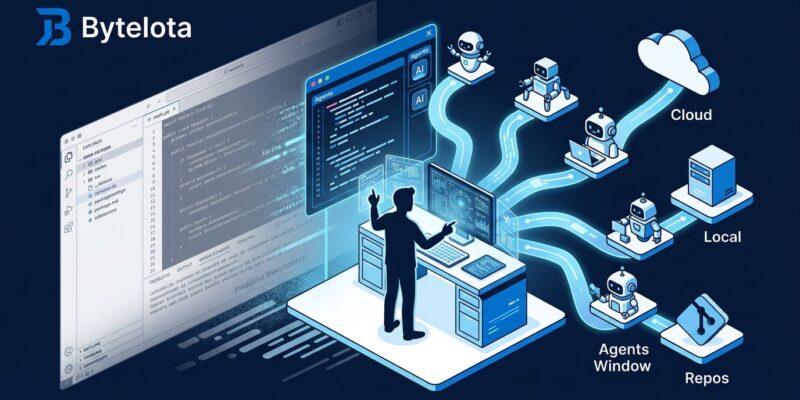
Cursor 3’s fundamental bet is explicit: “most code will be written by AI agents, and the developer’s job is to orchestrate them.” The Agents Window replaces the single AI assistant model with multiple parallel agents that execute across repositories, cloud environments, and local machines simultaneously. You describe tasks in plain language. Agents handle file discovery, dependency tracking, implementation, and testing. You review outputs, not individual edits.
This is different from GitHub Copilot or Claude Code assistance models. Previous AI coding tools helped you write code faster. Cursor 3 assumes AI writes the code entirely. Your role is management, not implementation. Trigger a refactoring agent from your phone during your commute, and review results with a generated demo video when you get to the office. The technical execution happens without you.
New features support this orchestration model: Design Mode for visual UI editing (Cmd+Shift+D), cloud/local handoff for asynchronous workflows, /worktree for isolated experimental branches, and /best-of-n for side-by-side model comparisons. The pricing reflects enterprise ambitions: Free tier for limited use, Pro at $20/month, Ultra at $200/month for 20x credits and guaranteed compute.
Developer Community Split on Orchestration Future
Cursor 3 rocketed to Product Hunt’s top spot in its launch week with tens of thousands of installs in 48 hours. Enthusiastic developers flooded X, Hacker News, and Reddit with “I am never going back to my old setup” declarations. Then came the backlash.
Thirty minutes after the Cursor 3 announcement hit Hacker News, the top comment was a plea: “I wish they’d keep the old philosophy of letting the developer drive and the agent assist. I still want to code, not vibe my way through tickets.” A Cursor engineer responded quickly—the IDE still exists. But the tension reveals something deeper.
Orchestration is powerful if you know what good code looks like. Experienced developers with 10+ years of writing React components, debugging production incidents, and refactoring legacy codebases understand what to ask for and how to evaluate agent outputs. They’re getting multiplicative productivity gains. But orchestration doesn’t work when you don’t have coding fundamentals. Junior developers learn by writing code, debugging errors, and understanding why solutions work. When agents handle all that, what are they learning?
The Junior Developer Pipeline Problem
Here’s the catch-22 Cursor 3 doesn’t solve. Tools like this make experienced developers more productive while reducing demand for junior developers who traditionally handled “easy” implementation tasks. Employment for developers aged 22-25 declined 20% since late 2022. Entry-level hiring collapsed 67% between 2024 and 2026. Computer science graduates face 6.1% unemployment—higher than fine arts majors.
The industry is building tools for senior developers while eliminating the path to becoming one. Orchestration requires deep coding knowledge—you need to know what to ask for, how systems fit together, and what good architecture looks like. But if junior developers can’t get hired to build that knowledge through hands-on work, where do future orchestrators come from?
84% of developers now use AI coding tools. 51% of all GitHub commits in early 2026 were AI-generated or AI-assisted. This isn’t a niche workflow—it’s mainstream. Cursor’s agent-first bet is directionally correct about where AI coding is going. But timing matters. We’re creating orchestration tools for a workforce we’re actively dismantling.
What Cursor 3 Means for Developer Roles
Cursor 3 sits at 18% workplace adoption, tied with Claude Code and behind GitHub Copilot’s 29%, according to JetBrains’ January 2026 survey. But adoption numbers miss the real story. The shift from “AI assists coding” to “AI writes code, you orchestrate” is happening across all AI coding tools. Cursor is just making it explicit.
Developers are becoming spec writers, quality gates, and prompt refiners. Code production is increasingly handled by agents. The question isn’t whether this happens—it’s already happening. The question is what we do about the talent pipeline. Companies want senior orchestrators but won’t hire junior developers to train them. Bootcamps teach fundamentals that agents now handle automatically. Universities prepare students for jobs that require 3-5 years of experience no one can get anymore.
Cursor 3’s agent-first interface is a bet on a future where orchestration is the default developer mode. That future probably arrives. But we’re not building the workforce to operate in it. Experienced developers benefit now. The industry pays the cost later when the pipeline runs dry.