 By
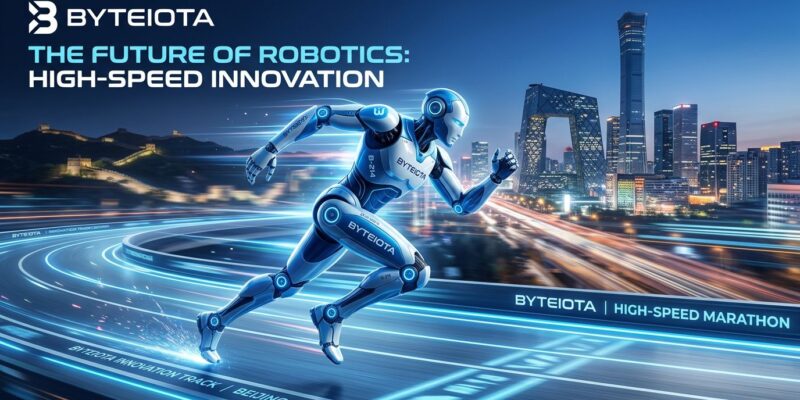
By A humanoid robot from Chinese smartphone maker Honor ran a half-marathon in Beijing on April 19, finishing in 50 minutes and 26 seconds—nearly 7 minutes faster than the human world record. Named Lightning, the robot beat Uganda’s Jacob Kiplimo, who set the human mark at 57 minutes in Lisbon just last month. This wasn’t a controlled lab demonstration. Over 300 robots competed alongside 12,000 human runners in the second annual Beijing E-Town Half Marathon, with Lightning’s autonomous performance marking a 100-minute improvement over last year’s winning robot.
However, the headlines miss critical context. Most competing robots were remote-controlled, Lightning crashed into a railing mid-race, and many robots stumbled at the start line. The marathon showcases genuine progress in bipedal locomotion, but it also raises a more fundamental question: Is running the right benchmark for robotics?
Exponential Progress in One Year
Last year’s Beijing marathon winner, a robot called Tiangong Ultra, finished in 2 hours, 40 minutes, and 42 seconds—barely faster than a human walking. Only 6 of 20 competing robots completed the race. This year, Lightning cut that time by 100 minutes, a 63% improvement. At least four robots posted sub-one-hour finishes, and over 100 teams competed, up from 20 in 2025.
The technical leap is real. Honor’s robot features 95-centimeter legs optimized for stride efficiency and a liquid-cooling system to manage thermal loads during sustained operation. These aren’t incremental tweaks—they represent major advances in control algorithms, energy management, and autonomous navigation. Moreover, 40% of this year’s robots ran autonomously, compared to 100% remote-controlled in 2025. China’s robotics ecosystem is scaling fast, backed by government support and aggressive private investment.
The Fine Print: Remote Control and Crashes
Most coverage buried this detail: 60% of marathon robots were remote-controlled, not autonomous. They’re essentially telepresence systems—impressive engineering, but not the AI autonomy headlines suggest. Lightning itself, despite running autonomously, crashed into a railing near the finish line. Multiple robots stumbled at the start or veered into barriers. The recovery systems worked—Lightning got back up and finished—but these failures reveal persistent challenges in real-world robustness.
Contrast this with claims of “autonomous robots beating humans.” The 40% autonomous figure means most robots had human operators controlling them remotely. Additionally, even the autonomous robots like Lightning struggled with unexpected obstacles. The gap between controlled demonstrations and reliable deployment remains wide. Developers building robotics systems should note: lab performance doesn’t equal production readiness.
Running Fast Doesn’t Mean Useful Work
Here’s the uncomfortable truth: marathon performance has little correlation with practical robotics capabilities. Lightning can run 50 minutes at sustained high speed, yet current industrial humanoid deployments focus on tasks like moving warehouse totes along mapped routes. Agility Robotics’ Digit, deployed at Amazon and GXO Logistics, handles payloads up to 35 pounds across a six-foot reach. BMW’s Figure 02 robots deliver parts between assembly stations. Tesla’s Optimus Gen 2 carries components to human workers in the Fremont factory.
None of these deployments require running. They need precise object manipulation, navigation in cluttered environments with moving obstacles, and decision-making under uncertainty. Furthermore, battery life remains a fundamental constraint—most current humanoids operate for 1-4 hours before requiring recharge, unsuitable for all-day industrial shifts. Running a half-marathon tests locomotion and energy management, but it doesn’t demonstrate the manipulation dexterity or task adaptability that define useful robotics.
Evaluating robots by athletic performance is like judging cars by how well they gallop. It’s a spectacle that measures the wrong capabilities. Developers should focus on manipulation precision, environment adaptability, and multi-hour battery endurance—not speed records.
China’s Strategic Robotics Push
The Beijing marathon isn’t just about technology—it’s industrial policy. China went from 20 competing teams in 2025 to over 100 in 2026. Honor, historically a smartphone manufacturer, announced a $10 billion investment in AI and robotics. Chinese automaker BYD is scaling from 1,500 humanoid robots in 2025 to 20,000 by year-end 2026 across its EV production lines. An estimated 16,000 humanoid robots were deployed globally in 2025, with China dominating manufacturing and logistics sectors.
Western companies like Tesla and Figure AI are piloting humanoids cautiously, testing in controlled factory environments. Meanwhile, China is deploying at scale, using government-backed competitions like this marathon to drive R&D and manufacturing capabilities. Consequently, China may dominate humanoid robotics the way it now controls EV batteries and solar panels—through strategic investment and aggressive scaling.
Key Takeaways
- Bipedal locomotion made genuine progress: 50:26 finish proves control algorithms and energy management are advancing rapidly, with a 100-minute year-over-year improvement
- Context matters: 60% of robots were remote-controlled, and even autonomous units crashed or stumbled, showing the gap between demonstration and deployment remains wide
- Athletic benchmarks measure the wrong capabilities: Running speed doesn’t correlate with manipulation precision, decision-making, or task adaptability—the skills that define useful robotics
- China is scaling aggressively while Western companies pilot cautiously: 100+ teams competed, $10 billion investments, and 20,000-unit deployments signal state-backed industrial strategy
- Real robotics challenges lie elsewhere: Battery life (1-4 hours), manipulation dexterity, cluttered environment navigation, and all-day reliability matter more than marathon times
The Beijing marathon demonstrates impressive locomotion progress. However, developers and tech professionals should resist the hype. The meaningful challenges in robotics—manipulation, adaptability, and sustained operational reliability—remain largely unsolved, regardless of how fast robots can run.