 By ByteBot
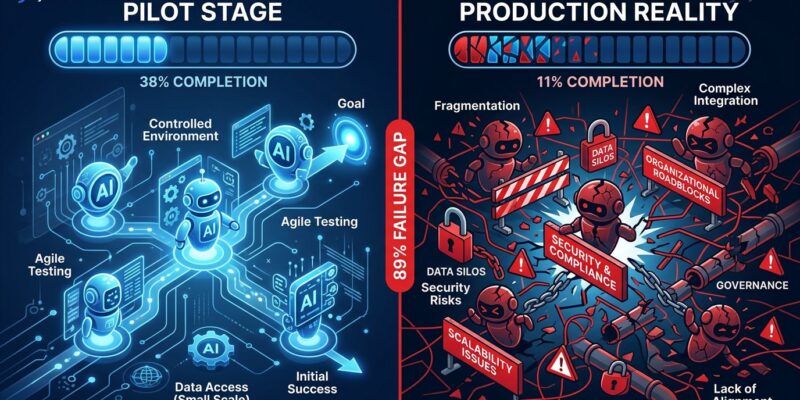
Despite 38% of enterprises piloting AI agents and billions invested, only 11% successfully deploy agentic AI to production according to Deloitte’s 2026 Tech Trends report released this month. This 89% pilot-to-production failure rate reveals a critical industry crisis. The barriers aren’t technical capabilities—they’re organizational governance, legacy system integration, and orchestration complexity. Gartner predicts over 40% of agentic AI projects will be canceled by 2027, not because the models fail, but because enterprises can’t operationalize them.
The hype promised autonomous AI agents transforming work. The reality is billions wasted on demos that never ship.
The 89% Failure Rate Is Organizational, Not Technical
While 30% of organizations explore agentic AI and 38% run pilots, only 11% reach production deployment. MIT’s NANDA Initiative found 95% of GenAI pilots fail to produce measurable financial impact. Currently, 78% of enterprises have pilots stuck at what insiders call “pilot purgatory”—technically impressive demos that can’t cross the production gate.
Stanford research analyzing 51 successful deployments flips the conventional narrative. Organizations addressing non-technical factors early—governance, integration planning, change management—are 3x more likely to succeed. The problem isn’t waiting for better models. The 11% who succeeded used the same LLMs as the 89% who failed. The difference? They fixed organizational readiness before piloting, not after production failures.
This isn’t a future problem. It’s happening now, with Gartner predicting a 2027 cancellation wave that will scrap 40%+ of current projects due to “escalating costs, unclear business value, and insufficient risk controls.” Enterprises are learning the hard lesson: AI agent demos are cheap; production deployment is organizationally expensive.
Three Organizational Barriers Killing 89% of Pilots
The production gap stems from three fixable organizational problems, not technical limitations.
Legacy System Integration: 46% cite integration with existing systems as their primary challenge. Traditional enterprise architectures weren’t built for real-time agent workflows. Most agents rely on conventional APIs and ETL pipelines designed for batch processing, not autonomous decision-making. When agents need real-time data to execute 12-step workflows, polling-based architectures create bottlenecks that kill performance. The “polling tax”—constant API calls checking for updates—becomes more expensive than the AI models themselves.
Governance Chaos: 55% of enterprise leaders describe AI use as a “chaotic free-for-all.” 79% say AI applications are created in silos with no central ownership. Only 23% have a formal enterprise-wide strategy for agent identity management. The result? Teams share human credentials and access tokens with agents because “no alternative exists”—a massive security risk. When production incidents occur and no one owns the AI operations function, rollback rates spike 5.7x compared to organizations that established ownership before piloting.
Orchestration Complexity Explosion: Multi-agent architectures sound elegant in theory. In practice, coordination overhead grows exponentially. A seemingly simple “three agents collaborating” becomes a nightmare where agent-to-agent communication is the bottleneck, not model performance. When one agent’s 12-step journey involves delegating to other agents, retrying failed steps, and dynamically choosing tools, teams need observability infrastructure that simply doesn’t exist yet. Most enterprises have no plan to trace these complex workflows until after deployment fails.
These aren’t unsolvable technical challenges. They’re organizational gaps that successful deployments addressed before wasting money on pilots.
What the 11% Did Differently: Governance Before Demos
The winners didn’t build better agents—they built better readiness. Four key differentiators separate the 11% in production from the 89% stuck in pilot purgatory.
Appoint AI Operations Early: Organizations that established an AI operations function before expanding beyond pilots saw 5.7x lower rollback rates. This team owns production monitoring, evaluation harnesses, and incident response. The 89% who waited until production incidents to assign ownership paid the price—most rolled back deployments rather than fix organizational gaps mid-crisis.
Define Measurable KPIs Week 1: Vague goals like “improve productivity” killed 95% of failed pilots. Successful organizations set concrete targets from day one: ≥95% accuracy, ≥90% task completion rates, specific cost savings thresholds. When you can’t measure success, you can’t prove ROI. When you can’t prove ROI, projects get canceled in the 2027 budget review.
Hire External Expertise: Externally-built pilots reach production 2x more often than internal builds. External teams bring specialized expertise and avoid organizational blind spots. Only 21% of enterprises meet full readiness criteria—data infrastructure, governance capabilities, technical resources, and employee readiness—according to IDC. If you’re in the 79% who aren’t ready, internal teams will hit the same walls that killed other pilots.
Build Observability From Day 1: The 11% didn’t wait for production to add tracing infrastructure. They instrumented multi-step agent journeys during pilots using platforms like Braintrust, Vellum, or Galileo. When agents drift behaviorally—verification steps running less consistently, tools used differently under ambiguity—observability catches it before customers notice. The 89% relied on demos instead of diagnostics, missing subtle drift until production failures forced rollbacks.
McKinsey found only 17% of enterprises have formal AI governance, but those that do scale deployments more successfully. The path to production is clear. Most organizations just don’t follow it.
The 2027 Cancellation Wave: Hype Meets Reality
Gartner’s 40% cancellation prediction isn’t theoretical—it’s already happening. Large financial services firms have canceled $50M+ agent projects after 18-month pilots failed at production due to governance gaps. Major retailers have rolled back customer service agents due to behavioral drift with no observability to diagnose failures. Tech companies have scrapped multi-agent supply chain projects when orchestration complexity exceeded capabilities.
The pattern is consistent: pilot works in controlled environment, deployment fails in messy production reality. 65% of enterprises report running pilots, but only 11% reach production—the “pilot to production death valley” where investments die. This isn’t a few isolated failures. This is an industry-wide reckoning where billions in pilot spending produce zero production value.
2027 brings budget reviews and hard questions. CTOs with $50M investments face existential choices: cancel and admit failure, or double down on broken pilots hoping “the technology will mature.” Gartner’s forecast suggests most will choose cancellation. The survivors will be the 21% who assessed readiness honestly and fixed organizational gaps before piloting, not the 79% who hoped AI would magically fix their processes.
The pilot theater is ending. Production reality is here.
How to Join the 11%: Five Critical Shifts
The path from pilot purgatory to production requires organizational changes, not better models.
Establish Governance Before Piloting: Don’t start with a demo. Start with an AI operations function, formal identity management strategy, and defined KPIs. Organizations that wait until production incidents to establish ownership face 5.7x higher rollback rates. The governance tax is cheaper paid upfront than after deployment fails.
Redesign Workflows, Don’t Agent-Wash: “Agent-washing”—rebranding basic automation as agentic AI—produces terrible ROI. HPE’s successful approach: select transformation opportunities across entire operational functions, then redesign workflows for agents. Don’t automate existing processes. Reimagine them.
Build Event-Driven Architecture: Legacy polling-based systems can’t support real-time agent decisions. Successful deployments use event-driven triggers, not constant API calls. The architecture investment pays for itself in reduced latency and compute costs.
Staff Cross-Functionally: Pilots staffed only by IT or innovation teams fail at production. Engineers build technically impressive agents that don’t align with how work actually happens. Business teams don’t trust systems they didn’t help design. Cross-functional teams—engineering, business owners, governance, change management—succeed 3x more often.
Assess Readiness Honestly: Only 21% of enterprises meet full readiness criteria. If you’re in the 79% who aren’t ready—no governance framework, legacy architecture, siloed teams—either fix the gaps or don’t pilot. Billions wasted on doomed pilots won’t make the technology work. It’ll just make 2027’s cancellation wave bigger.
The 11% didn’t wait for perfect AI. They built organizations capable of deploying imperfect AI to production. That’s the difference.