 By ByteBot
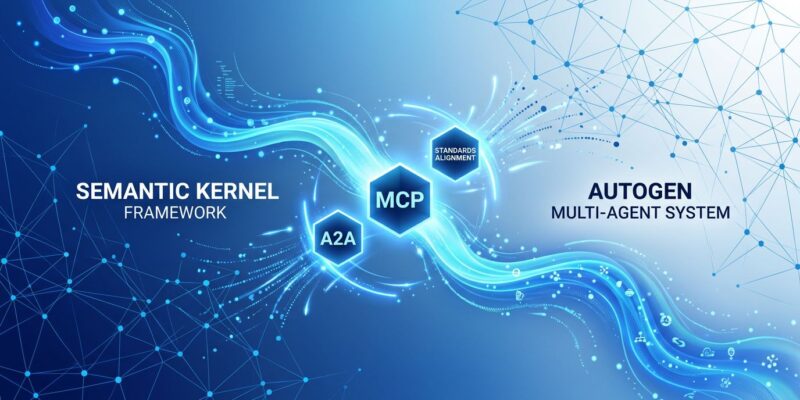
Microsoft released Agent Framework 1.0 on April 3, 2026, unifying Semantic Kernel and AutoGen into a single SDK with stable APIs and long-term support. Six days later, on April 9, Google’s Agent-to-Agent Protocol hit its one-year milestone with 150+ organizations participating and production deployments across Azure AI Foundry, Amazon Bedrock, and major enterprise platforms. This convergence signals a critical moment: MCP + A2A architecture is becoming the default standard for production agentic systems.
For enterprise developers evaluating agent frameworks, this is a rare “safe to build on” signal—stable APIs, LTS commitment, and alignment with emerging industry standards.
Ending the Semantic Kernel vs AutoGen Debate
Microsoft Agent Framework 1.0 resolves the “Semantic Kernel vs AutoGen” question by merging both into one SDK. Consequently, developers get Semantic Kernel’s enterprise stability—middleware, memory architecture, production connectors—plus AutoGen’s multi-agent orchestration patterns like sequential workflows, concurrent execution, handoffs, group chat, and Magentic-One.
Microsoft’s DevBlog stated: “After months of feedback, hardening, and real-world validation with customers and partners, Agent Framework 1.0 is ready for production… full backward compatibility going forward.” Moreover, Visual Studio Magazine noted this LTS commitment is “a rare thing in this space.” It is. Most AI frameworks iterate too fast for multi-year enterprise projects. Therefore, Microsoft is betting on stability over speed.
The unified framework supports .NET and Python with a single programming model. In other words, no more choosing between enterprise features and cutting-edge orchestration. One framework, stable APIs, LTS.
A2A Protocol Hits One-Year Milestone: Standards Take Hold
On April 9, 2026, Google’s Agent-to-Agent Protocol reached its one-year anniversary with impressive adoption: 150+ organizations (up from 50 at launch), 22,000+ GitHub stars, and production deployments in Azure AI Foundry, Amazon Bedrock AgentCore, Copilot Studio, Salesforce, SAP, and ServiceNow. Furthermore, the v1.0 release introduced Signed Agent Cards for cryptographic identity verification and AP2, an extension enabling agent-driven commerce workflows.
IBM’s Agent Communication Protocol merged into A2A under the Linux Foundation AI & Data in August 2025, signaling industry consolidation. As a result, this is the “REST + OpenAPI moment” for AI agents. Just as web APIs standardized around REST and OpenAPI in the 2010s, AI agent architectures are converging around MCP (tool integration) and A2A (agent collaboration).
Microsoft’s 1.0 release with built-in support for both standards validates this convergence. For enterprise teams, consequently, this is the clearest sign yet that MCP-plus-A2A is becoming the production default.
MCP and DevUI: Solving Core Developer Pain Points
Agent Framework 1.0 includes native Model Context Protocol support for dynamic tool discovery and DevUI, a browser-based debugger for visualizing agent execution in real time. Specifically, MCP eliminates the need to hardcode tool schemas—agents dynamically discover and invoke tools from MCP-compliant servers.
The MCP ecosystem has grown to 10,000+ active public servers as of 2026, with confirmed Fortune 500 deployments. Additionally, Gartner predicts 40% of enterprise applications will include task-specific AI agents by end of 2026, up from less than 5% today. Meanwhile, Forrester predicts 30% of enterprise app vendors will launch MCP servers this year.
Tool integration has been a persistent pain point for agent developers—what the community calls “tool integration hell.” MCP standardizes this. Similarly, DevUI addresses the “black box” problem: multi-agent workflows are notoriously opaque. Real-time visualization makes orchestration decisions transparent, a significant debugging improvement.
The Microservices Moment for AI Agents
The multi-agent industry is going through its microservices revolution—shifting from monolithic all-purpose agents to orchestrated teams of specialized agents. In fact, Gartner reported a 1,445% surge in multi-agent system inquiries from Q1 2024 to Q2 2025.
However, 40% of multi-agent pilots fail within six months. The problem: teams pick the wrong orchestration pattern or over-engineer solutions that don’t need multi-agent complexity. Most problems don’t. Therefore, start with a single agent. Add orchestration only when necessary.
The framework landscape reflects this shift. Microsoft Agent Framework offers graph-based workflows. LangGraph provides state machines with conditional logic. CrewAI uses role-based team abstractions. All bet on orchestration—but nevertheless, all warn against premature complexity.
Choosing a Framework: Stability, Flexibility, or Simplicity
Microsoft Agent Framework competes with LangGraph (97,000+ GitHub stars, flexible state machines) and CrewAI (45,900+ stars, intuitive team metaphor, 12 million daily agent executions in production). Each wins in different scenarios.
Microsoft wins on stability: LTS, .NET parity, Azure integration. LangGraph wins on flexibility: conditional logic, durable execution, LangSmith observability. In contrast, CrewAI wins on ease-of-use: working multi-agent pipeline “before lunch.”
The honest recommendation from industry comparisons: Start with CrewAI for intuitive prototypes. Afterward, migrate parts needing more control to LangGraph (gradual transition via LangChain compatibility). Choose Microsoft if you’re on Azure, building in .NET, or need LTS for multi-year enterprise projects.
Framework fatigue is real, but the decision criteria are clear. Not “Microsoft is best” but “Microsoft is best for these scenarios.” Pick the framework that fits your requirements: stability, flexibility, or simplicity.