 By ByteBot
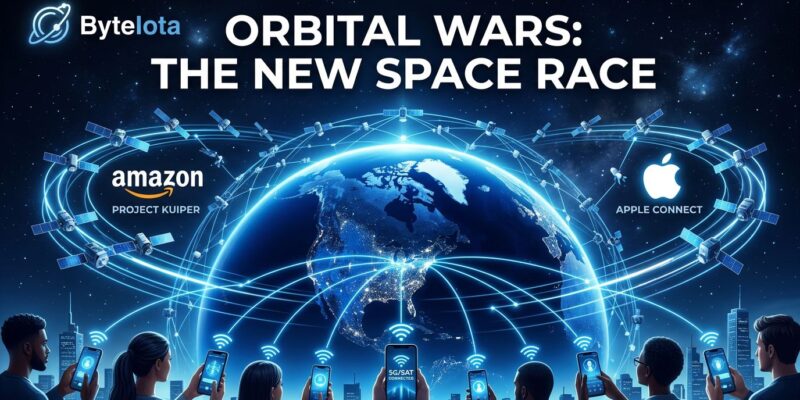
Amazon just dropped $11.57 billion to acquire Globalstar, the satellite operator powering Apple’s iPhone Emergency SOS. The deal gives Amazon an immediate operational satellite fleet, spectrum licenses, and ground infrastructure for its Amazon Leo constellation. But here’s the telling part: Amazon committed to continuing Globalstar’s Apple partnership, creating an unusual Big Tech alliance against SpaceX. The space race just got crowded, raising questions about who controls orbital infrastructure when cell towers fail.
Amazon Now Controls Apple’s Satellite Lifeline
Amazon didn’t just buy satellites—it bought Apple’s Emergency SOS infrastructure. Globalstar’s 24 satellites handle every iPhone Emergency SOS request. With this acquisition, Amazon becomes Apple’s satellite partner, and Apple chose Amazon over Musk’s SpaceX. That’s telling in the increasingly fragmented Big Tech landscape.
This isn’t limited to emergency services. Amazon Leo will offer direct-to-device (D2D) connectivity—voice, text, and data—for standard smartphones. Apple could expand beyond Emergency SOS to full satellite connectivity powered by Amazon. That’s tight integration between two companies that compete everywhere else, happening because neither wants to depend on Musk’s Starlink.
The antitrust implications are obvious. Amazon controls e-commerce AND orbital infrastructure. Regulators will ask whether this Amazon-Apple partnership creates a “walled garden in space” excluding smaller device makers.
Playing Catch-Up to Starlink’s 9 Million Subscribers
SpaceX Starlink dominates: 10,000 satellites, 9 million subscribers, 34% market share. Amazon Leo has 241 satellites and zero commercial subscribers. Globalstar doesn’t close that gap, but it accelerates Amazon’s timeline dramatically.
Amazon faces a hard FCC deadline: July 30, 2026, to deploy 50% of its 3,236-satellite constellation or risk losing its license. Globalstar provides an immediate operational fleet, spectrum, and infrastructure to meet that deadline. Amazon’s betting $11.57 billion on leapfrogging years of delays.
Competitive dynamics favor Amazon in some ways. Terminals cost under $400 versus Starlink’s $599+. Speeds claim 1 Gbps versus Starlink’s 100+ Mbps. AWS integration offers enterprise advantages. But SpaceX has a five-year head start and millions of customers. Amazon’s playing catch-up, and Globalstar is the shortcut.
Direct-to-Device Goes Mainstream in 2026
For developers: 2026 marks the inflection point when D2D satellite connectivity stops being niche and becomes ubiquitous. D2D uses 3GPP NTN to turn satellites into cell towers in space. Off-the-shelf smartphones connect directly without modifications.
D2D represents 37.2% of satellite market share in 2026. Multiple carriers launch this year: T-Mobile, Verizon, Rogers, Orange, KDDI Japan. Emergency SOS is the beginning. Full voice, text, and data are rolling out now.
For developers, this means rethinking assumptions. Dead zones disappear. Connectivity becomes ubiquitous. New use cases open up: remote IoT, emergency automation, global deployment without terrestrial infrastructure. Plan for it now—satellite connectivity arrives faster than expected.
Regulatory Scrutiny and Orbital Traffic
The deal needs FCC approval and international regulatory clearance, closing end of 2026 or early 2027. Antitrust regulators will examine whether Amazon’s control of retail and satellite infrastructure creates unfair advantages. Historical precedent suggests “open access” mandates, requiring Amazon to lease spectrum to third parties.
The FCC is increasingly vocal about space debris and orbital traffic. Amazon must prove 3,200+ satellites can coexist with Starlink’s thousands and Globalstar’s aging fleet. Orbital slots are finite. Collisions at 16,000 mph are catastrophic. We’re building interstate highways in orbit without traffic lights.
What’s Next: Mid-2026 Launch
Amazon Leo’s consumer service launches mid-2026 in the U.S., UK, France, Germany, and Canada. D2D services roll out through 2026-2027. The satellite internet market grows from $13.93 billion in 2026 to $28.03 billion by 2033, with 15 million+ subscribers this year.
Expect more Big Tech satellite acquisitions. Orbital infrastructure is as strategic as cloud infrastructure was a decade ago. The space race isn’t about rockets anymore—it’s about controlling global connectivity when terrestrial networks fail.
For developers: satellite connectivity is launching this year. It will change how you design apps assuming network availability. The Amazon-Apple alliance signals where the industry is heading—Big Tech controlling not just cloud servers, but satellites routing traffic when phones can’t find cell towers. Bezos vs. Musk, round 47. And Apple’s picking sides.