 By ByteBot
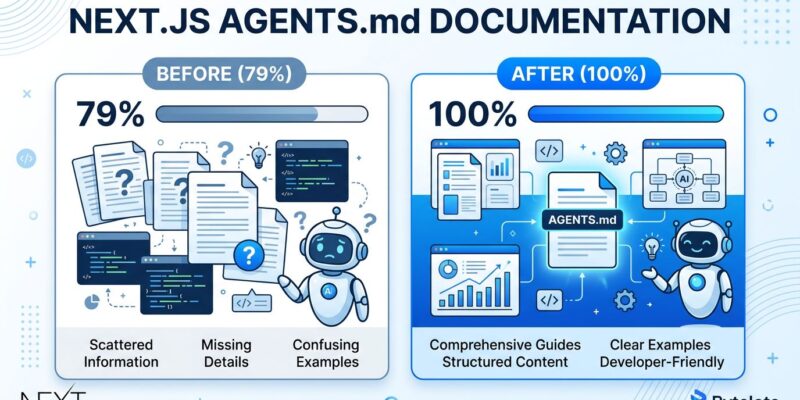
Next.js 16.2 introduced AGENTS.md in March 2026—a minimal markdown file directing AI coding agents to read bundled, version-matched documentation before writing code. Vercel’s research shows this “dumb” static approach achieves a 100% pass rate on Next.js evals, outperforming sophisticated skill-based retrieval systems that maxed out at 79%. The 21-percentage-point improvement validates a counterintuitive insight: always-available context beats on-demand search because agents don’t know when they need documentation.
The 100% vs 79% Breakthrough That Flips Conventional Wisdom
Vercel published eval research in January 2026 comparing three approaches: training data only (baseline), skills-based retrieval (79% pass rate), and AGENTS.md with bundled docs (100% pass rate). The finding challenges conventional wisdom. Moreover, sophisticated RAG systems with semantic search, embeddings, and on-demand retrieval scored 79%. A static markdown file pointing to local docs scored 100%.
The problem isn’t retrieval quality—it’s that agents don’t recognize when they need to retrieve. LLMs assume their training data is sufficient, leading to hallucinated APIs and deprecated patterns. However, AGENTS.md forces documentation consultation upfront, solving the blindness problem. Consequently, the “dumb” approach beats “smart” systems because it acknowledges agent limitations rather than working around them.
AGENTS.md achieved perfect scores across Build, Lint, and Test evals. Furthermore, Vercel compressed the full Next.js documentation to 8KB (an 80% reduction) with zero quality loss. This isn’t theoretical—it’s measurable, data-driven proof that documentation shipping beats documentation searching.
How AGENTS.md Works: Local Docs Beat Training Data Lag
Next.js 16.2+ bundles the entire Next.js documentation inside the npm package at node_modules/next/dist/docs/. The docs mirror the structure of nextjs.org: App Router, Pages Router, API reference, all as plain Markdown files. When you install next, you get version-matched documentation automatically. Additionally, no network requests, no external lookups, no API keys.
AGENTS.md sits at your project root with a simple directive:
<!-- BEGIN:nextjs-agent-rules -->

# Next.js: ALWAYS read docs before coding

Before any Next.js work, find and read the relevant doc in `node_modules/next/dist/docs/`. Your training data is outdated — the docs are the source of truth.

<!-- END:nextjs-agent-rules -->
Most AI coding tools—Claude Code, Cursor, GitHub Copilot—automatically read AGENTS.md when starting a session. The agent sees the directive, consults bundled docs before writing code, and references current APIs instead of hallucinating deprecated patterns from 12-month-old training data.
create-next-app generates AGENTS.md automatically as of April 2026. Existing projects drop in two files (AGENTS.md + CLAUDE.md using @AGENTS.md import syntax). Therefore, setup takes under a minute. This solves the “training data lag” problem: LLMs trained on outdated docs suggest broken code when frameworks evolve. In contrast, bundled docs update automatically with Next.js version upgrades.
MCP Integration: Static Knowledge Meets Runtime State
AGENTS.md provides static knowledge (documentation), but debugging needs runtime visibility. Next.js 16+ includes Model Context Protocol (MCP) support, exposing real-time dev server state—errors, routes, rendered components, Partial Prerendering shells—to agents via a standardized protocol.
The MCP ecosystem has accelerated in 2026. The protocol reached 97 million SDK downloads, with support from 50+ enterprise partners including Salesforce, ServiceNow, and Workday. Additionally, Anthropic donated MCP to the Linux Foundation’s Agentic AI Foundation in March 2025, where it joined OpenAI’s AGENTS.md and Block’s goose as founding projects.
Next.js 16.2 adds agent-first features beyond MCP: browser log forwarding (client errors appear in terminal), dev server lock files (agents get structured errors with PID when trying to start duplicate servers), and experimental agent devtools (next-browser CLI for inspecting component trees). These features acknowledge that agents operate primarily through terminals, not browsers.
The philosophy: “treat agents as first-class users.” Vercel spent a year building and sunsetting an in-browser agent (Vector), shipping MCP integration, and learning that better agent support means thinking from the agent’s perspective. Documentation (AGENTS.md) solves knowledge gaps. MCP solves runtime visibility.
Broader Implications: The Pattern Other Frameworks Will Follow
Next.js is the first major framework to ship AGENTS.md, but the pattern is spreading. OpenAI contributed AGENTS.md to the Linux Foundation’s Agentic AI Foundation alongside MCP. React, Vue, Svelte, and backend frameworks (Express, Django, Rails) are expected to adopt similar approaches in 2026-2027.
Gartner predicts 40% of enterprise applications will include task-specific AI agents by end of 2026, up from less than 5% today. With 90% of developers using AI coding tools daily, frameworks that “work well with AI” have a competitive advantage. Consequently, accurate agents, fewer hallucinations, better debugging—these aren’t nice-to-haves. They’re developer experience fundamentals in an AI-assisted world.
The “treat agents as first-class users” philosophy is becoming industry consensus. Framework maintainers are recognizing that shipping documentation is as critical as API design. Moreover, developers will favor frameworks that make AI tools smarter by default.
This isn’t just a Next.js feature—it’s the beginning of a paradigm shift. Frameworks that don’t ship docs will lag behind as AI-assisted development becomes the norm. The 21-point improvement isn’t hype. In fact, it’s measurable evidence that the “how” of documentation delivery matters as much as the “what.”
What Developers Should Do
If you’re using Next.js with AI coding tools (90% of developers in 2026), upgrade to Next.js 16.2+ and verify AGENTS.md exists at your project root. New projects get it automatically via create-next-app. Existing projects add two files:
# Install Next.js 16.2+
npm install next@latest

# Verify bundled docs exist
ls node_modules/next/dist/docs/

# AGENTS.md already exists in new projects
# For existing projects, create manually or run:
npx @next/codemod@latest agents-md
The accuracy boost is free. No build configuration, no environment variables, no API keys. If you maintain a framework or open-source project, consider shipping your own documentation. The eval data is clear: bundled docs beat skills-based retrieval by 21 points. Therefore, static markdown files work because they solve the agent blindness problem—agents don’t know when to search, so give them docs upfront.
AGENTS.md isn’t a silver bullet. The eval scope is limited (Next.js-specific tasks: Build, Lint, Test). It doesn’t fix agent reasoning, context limits, or architectural mistakes. However, for the narrow problem of “agent uses outdated Next.js APIs,” it’s a solved problem with measurable proof.