 By ByteBot
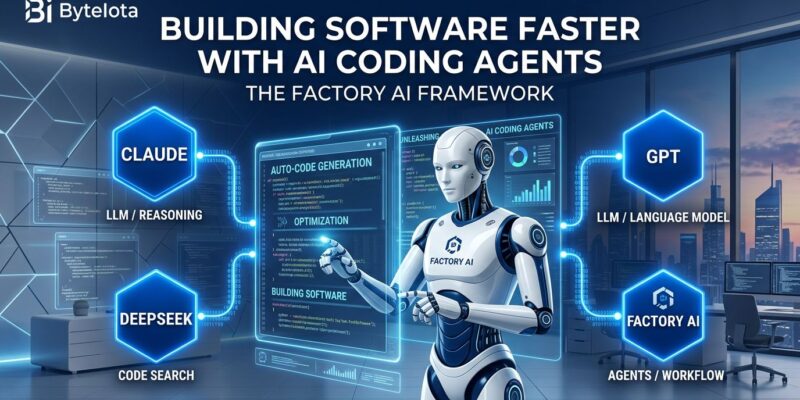
Factory, an AI coding startup, raised $150 million at a $1.5 billion valuation on April 16, 2026, led by Khosla Ventures with participation from Sequoia Capital, Insight Partners, and Blackstone. The 3-year-old company developed “Droids”—AI agents that automate the full software development lifecycle—handling testing, code review, documentation, deployment, and refactoring, not just code generation. What sets Factory apart: a model-agnostic architecture that switches between foundation models like Claude and DeepSeek to avoid vendor lock-in, plus enterprise customers including Nvidia, Adobe, EY, and Palo Alto Networks. Keith Rabois, Khosla Ventures managing director, joined Factory’s board.
Model-Agnostic Beats Single-Vendor Lock-In
Factory’s model-agnostic approach separates it from single-model competitors. While GitHub Copilot relies primarily on GPT and Cursor locks you into an AI-first IDE, Factory switches between Claude, DeepSeek, or GPT depending on the task. Matan Grinberg, Factory’s CEO, told the Wall Street Journal the company’s “key differentiator is ability to switch between different foundation models.”
This matters because enterprises optimize cost and performance per task—Claude for complex refactoring, DeepSeek for high-volume processing, GPT for reasoning-heavy debugging. Single-model tools lock you into one vendor’s strengths and weaknesses.
Factory covers the full software development lifecycle with specialized Droids: the review Droid leaves insightful code comments, the test Droid maintains test coverage, the documentation Droid auto-generates technical docs, the knowledge Droid answers codebase questions, and the project Droid plans requirements from customer tickets. GitHub Copilot focuses on code completion; Cursor centers on IDE replacement. Factory automates tasks developers don’t want to do—testing, debugging, refactoring, migrations—across any IDE.
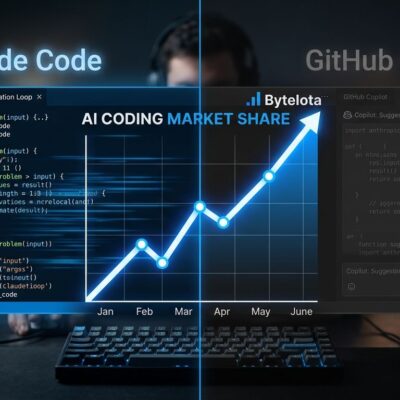
The competitive landscape: GitHub Copilot has 4.7 million paid subscribers and reaches 90% of the Fortune 100, while Cursor hit a $50 billion valuation with $2 billion in annual revenue. Factory’s $1.5 billion valuation looks modest in comparison, but the company posted 200% quarter-over-quarter growth in 2025 and doubled revenue month-over-month for six months.
Enterprise Traction: Nvidia, Adobe, MongoDB
Factory’s customer list: Nvidia, Adobe, EY, Palo Alto Networks, MongoDB, Zapier, Bayer, and Adyen. These companies use Droids for feature development (autonomous spec-to-deployment), code migrations (large-scale modernization), testing automation, code review, and documentation. “Hundreds of thousands” of developers now use Factory’s platform.
The 200% QoQ growth and strong 2025 retention metrics suggest the model-agnostic + full-SDLC approach solves real problems. When MongoDB or Nvidia choose Factory over GitHub Copilot, they’re betting that flexibility and lifecycle coverage outweigh single-vendor deep integration.
The Job Displacement Debate
Factory’s $150 million raise reignites the “AI will replace developers” conversation. A Silicon Snark headline frames it bluntly: “Factory Raised $150M to Replace Your Engineers.” Fast Company takes a softer angle, calling it “turning AI into a junior developer in a box.”
Factory automates tasks developers actively dislike—writing tests, refactoring legacy code, updating documentation, debugging obscure errors. It frees senior developers for higher-value work: architecture, design, complex problem-solving, judgment calls.
The AI code quality paradox: In 2026, 42% of code is AI-generated, yet AI code introduces 23% more bugs than human-written code. Factory’s strong enterprise retention suggests its Droids manage quality better than average.
The real question isn’t whether Factory’s Droids replace developers today—they don’t—but whether they’re building toward full automation. Devin, Cognition’s autonomous AI engineer, already operates more independently than Factory’s Droids. The line between “junior developer assistance” and “autonomous software engineering” is blurring.
Why Investors Bet $150M Despite Quality Concerns
Keith Rabois’s decision to join Factory’s board signals strong conviction. Rabois, known for early investments in Square, Stripe, Airbnb, and DoorDash, focuses on “hard truths about building in the AI era.” Khosla Ventures leading a $150 million round suggests investors see Factory’s model-agnostic architecture and enterprise relationships as defensible moats.
The timing matters. AI coding tools hit $4.5 billion in total revenue, but quality concerns persist. The Model Context Protocol crossed 97 million installs in March 2026, and GitHub launched Agent HQ in February. Factory positions itself for this “agent-native development” era with specialized Droids and model flexibility.
Compare valuations: Cursor’s $50 billion puts it 33x higher than Factory’s $1.5 billion, but Factory’s 200% QoQ growth rate outpaces Cursor’s mature market position. Investors betting on Factory see upside in enterprise adoption, model-agnostic flexibility, and full-SDLC coverage.
What Developers Should Watch
For developers, Factory’s rise suggests multi-model tools may offer better long-term flexibility than single-vendor solutions. Learning to manage and direct AI agents—not just write code—becomes more valuable. Quality review grows more critical when AI generates 42% of your codebase.
For enterprises, Factory’s model-agnostic approach mitigates vendor lock-in risk. The ROI case: automate tedious tasks like testing, migrations, and documentation; free developers for higher-value architecture and design work. Cost optimization becomes practical—switch models per task based on complexity and volume.
The AI coding tools market is heading toward consolidation. GitHub, Cursor, and Factory compete for enterprise share. Factory’s $150 million war chest funds the race to prove model-agnostic, full-SDLC automation beats single-vendor depth. Nvidia, Adobe, and MongoDB are already betting it does.