 By ByteBot
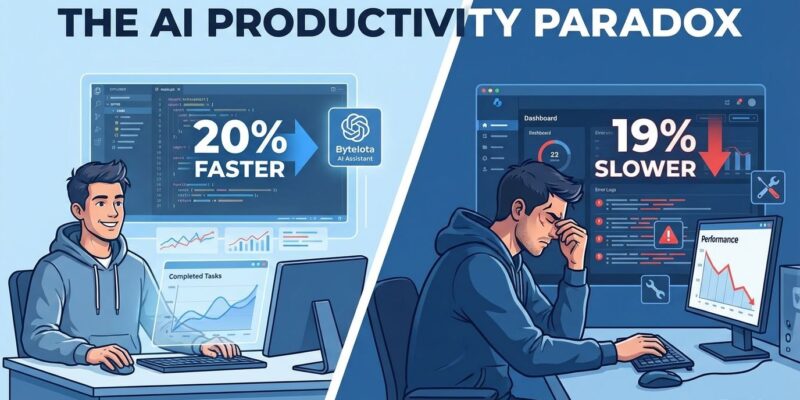
Developers using AI coding tools believe they’re 20% faster. Rigorous measurement shows they’re actually 19% slower. That’s a 39-percentage-point gap between perception and reality—and it’s costing the industry billions.
METR’s productivity study tested 16 experienced developers across 246 real software tasks. When allowed to use AI tools like Cursor Pro with Claude 3.5, developers took 19% longer to complete issues compared to working without AI. Before the study, they expected to be 24% faster. After experiencing the slowdown firsthand, they still believed they were 20% faster. The productivity gains everyone feels don’t show up when you actually measure.
This matters because 92.6% of developers now use AI coding assistants at least monthly, with 75% using them weekly. Nearly 27% of production code is AI-written. Yet productivity improvements remain stuck at 10% despite skyrocketing adoption. Organizations are betting billions on tools that feel productive but measure poorly. The industry is systematically wrong about its own productivity.
Why the Slowdown Happens
The mechanics are clear. Developers spend 9% of their task time just reviewing and modifying AI-generated code. Add prompting time and waiting for generations, and the overhead cancels any time saved writing code. The “Prompt → Wait → Review → Debug” cycle destroys flow state. You’re no longer in the code—you’re managing an assistant.
Context switching hits experienced developers hardest. On large codebases averaging over a million lines, AI lacks the global context senior developers build over years. It suggests solutions that look correct locally but break architectural coherence. The developer ends up heavily refactoring AI output—work that wouldn’t exist if they’d written it themselves.
Quality problems compound the issue. AI-generated code produces 1.7 times more issues overall—10.83 problems per pull request versus 6.45 for human code. Logic errors occur 1.75 times more frequently. Security vulnerabilities increase 57%. And 38% of developers report that reviewing AI code requires more effort than reviewing code written by colleagues.
The trust crisis makes it worse. Only 29% of developers trust AI tools (down from 40% in 2024), yet 84% use them. Here’s the gap: 96% don’t fully trust AI-generated code is functionally correct, but only 48% always check it before committing. Developers simultaneously distrust AI and fail to verify adequately—a recipe for bugs in production.
Organizational Context Determines Everything
The productivity paradox doesn’t hit everyone equally. AI acts as an amplifier: good teams get better, struggling teams struggle more.
Well-structured organizations with strong testing practices, clear documentation, and experienced developers guiding AI use see AI as a force multiplier. Some report 50% reductions in customer-facing incidents alongside improved code quality and reliability. These teams use AI selectively for appropriate tasks while maintaining rigorous verification standards.
Dysfunctional organizations with weak testing, poor documentation, and junior developers over-relying on AI tools see the opposite. Some experience double the incidents they had before adopting AI. Quality degrades. Technical debt accumulates faster. As Laura Tacho, CTO at DX, notes: “To see real impact, we need to use AI at the organizational level… Transformation is uncomfortable.” AI doesn’t fix broken processes—it exposes them.
The data confirms this divide. Among the 121,000 developers studied across 450+ companies, organizational maturity determined outcomes far more than tool selection. AI reveals existing dysfunction rather than papering over it. Companies investing in AI without addressing foundational issues will see disappointing results.
What Actually Works
AI coding tools excel in specific contexts. Boilerplate and repetitive code. Learning unfamiliar frameworks. Test case generation. Documentation and code explanation. Onboarding new developers—the time to a tenth pull request has been cut in half between Q1 2024 and Q4 2025, a measurable win.
AI fails at complex interconnected systems, security-critical code, and tasks requiring architectural coherence. It struggles with mature codebases that have deep dependencies and implicit conventions. The sweet spot is narrow: simple, well-scoped tasks with clear requirements and strong testing as a safety net.
Effective use requires treating AI like a junior developer, not a senior partner. Plan before prompting—create specifications with requirements, architecture decisions, and testing strategy. Provide maximum context about language, libraries, constraints, and expected behavior. Use a staged approach: request an outline, then pseudocode, then implementation chunks. Review everything. Question logic. Run security checks for injection risks, hardcoded secrets, and insecure defaults.
As one Google AI Director puts it: “The best developers will be the ones who know when to trust it, when to question it, and how to integrate it responsibly.” Selective adoption based on understanding trade-offs separates productive developers from those experiencing the slowdown.
Productivity Theater or Genuine Value?
So are organizations investing billions in productivity theater? The answer is more nuanced than yes or no.
AI provides genuine value in the contexts where it works: onboarding, boilerplate generation, learning new technologies. Developers save an average of 4 hours per week on these tasks. That’s real. The problem is the gap between promise and reality. Industry adoption hit 93% while productivity gains plateaued at 10%. Nearly 27% of production code is now AI-written, yet the revolutionary productivity gains promised aren’t materializing.
The 2026 follow-up study shows tools improving—original participants were 18% slower (versus 19% in 2025), and newly recruited developers were only 4% slower. Progress, but modest and uncertain due to selection bias. The researchers note that “developers are likely more sped up from AI tools now in early 2026” but emphasize their data provides “only very weak evidence” for the magnitude of improvement.
The future looks like specialization: AI tools focused specifically on testing, refactoring, or documentation rather than trying to do everything. Context windows expanding to 200K+ tokens enabling better whole-codebase understanding. Clear industry playbooks for what works and what doesn’t, replacing hype with pragmatism. And a widening skill divide between developers who integrate AI thoughtfully and those who blindly accept suggestions.
The 39-point perception gap is the real story. Developers feel faster while moving slower because the tools provide psychological satisfaction even when they reduce measured productivity. Organizations making decisions based on developer sentiment rather than rigorous measurement waste billions. AI is a tool with specific strengths and clear limitations—not magic, not useless, just a tool that requires honesty about what it can and cannot do.
Success requires organizational maturity, selective use based on understanding trade-offs, strong verification practices, and measurement of actual outcomes rather than feel-good metrics. The winners won’t be the teams that adopt AI first or most aggressively. They’ll be the teams that understand when to use it and when to write the code themselves.
—