 By ByteBot
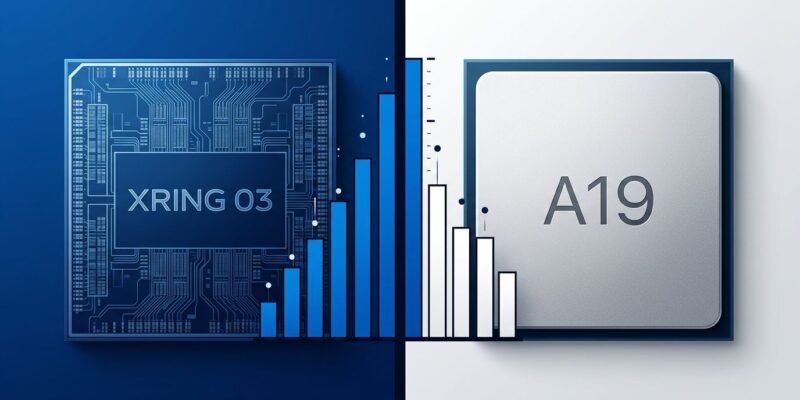
Xiaomi today announced the XRing O3, a 3nm chip that does something no Android processor has managed before: match Apple’s A19 Pro in single-threaded CPU performance. The numbers released August 24, 2026 show a Geekbench 6.5 single-core score of 3,945 against the A19 Pro’s ~3,895 — effectively dead even. On multi-core, the XRing O3 runs away: 15,221 versus Apple’s ~9,700, a 57% gap in Xiaomi’s favor. The chip also scores 5,228,014 in AnTuTu V11, the first mobile SoC to break 5 million. Apple’s mobile CPU lead, which the company held unchallenged since the A14 era, now has company.
What Makes the Xiaomi XRing O3 Different
The XRing O3 is built on TSMC’s N3P node and packs 24 billion transistors into a 133mm² die. The CPU is all-big-core: 10 large performance cores (2x C1-Ultra at 4.35GHz, 4x C1-Premium at 3.68GHz, 4x C1-Pro at 3.15GHz), with no efficiency cores at all. That architectural choice drives the dramatic multi-core lead — more large cores doing actual work, while Apple uses a performance-and-efficiency mix where the efficiency cores don’t contribute to peak multi-core bursts.
The GPU story is sharper still. In 3DMark Solar Bay Extreme, the XRing O3’s 16-core Mali-G2 Ultra NX scores 3,628, roughly 63% ahead of the A19 Pro. Xiaomi attributes the jump partly to GPU-integrated tensor accelerators — frame generation and spatial upscaling execute inside the GPU cache hierarchy rather than hitting the memory bus, reducing bandwidth bottlenecks. That’s an architectural decision, not just a die-area advantage.
Related: NVIDIA CUDA Targets RISC-V: What the Server Play Means for Devs
What XRing O3 Means for Developers
The benchmark headlines are the hook, but the specs that matter most for developers are buried underneath. The XRing O3 is the first mobile SoC to support LPDDR6 memory, running at 10,667 MT/s with peak bandwidth of 113.8 GB/s. That bandwidth figure is the key variable for on-device LLM inference — it determines how fast quantized model weights can be streamed into compute units. Higher bandwidth means lower per-token latency without a cloud round-trip.
The quad-core NPU delivers 200 TOPS at A8W4 precision (INT8 activations, INT4 weights), a 45% improvement over the XRing O1 and purpose-built for Xiaomi’s MiMo on-device AI models. Combined with 44MB of total cache and the new memory bandwidth, this makes premium Android a credible platform for running 3–7B parameter quantized models locally. That’s a change in kind, not just degree — until now, on-device inference on Android meant significant compromises in model quality or response latency that iOS devices didn’t face at the same price tier.
The Honest Caveat on XRing O3 Performance
Benchmark results are taken under ideal conditions. The Hacker News community, drawing on hands-on experience with all-big-core designs, notes that real-world sustained single-core performance in production phones tends to land closer to 3,300 — not 3,945. Thermal headroom in a slim phone chassis compresses peak numbers once the chip runs sustained workloads. Apple’s A19 Pro, by contrast, maintains closer to its benchmark figures under sustained load because its big.LITTLE design handles background tasks without heating up the performance cores.
The all-big-core approach is a deliberate tradeoff. Bigger cores produce bigger benchmark numbers and bigger battery drain at idle. For bursty AI inference workloads — processing a single prompt, then idle — the XRing O3’s design is well-matched. For sustained CPU-intensive tasks, Apple’s architecture still holds a real-world efficiency edge that the Geekbench delta doesn’t fully capture.
The Bigger Picture: Design Capability vs Independence
The XRing O3 is part of a broader Xiaomi silicon announcement: the company also unveiled the XRing O100 for cloud and edge AI, and the XRing D100 for automotive — a full chip ecosystem in a single day. The trajectory from XRing O1 (2024) to XRing O3 (2026) matching Apple in two generations is genuinely remarkable. Chinese chip design has reached parity. Chinese chip independence has not.
The XRing O3 is still fabbed by TSMC in Taiwan. If US export controls extend to block advanced node access for Chinese fabless designers — a live policy discussion — Xiaomi’s chip roadmap stalls regardless of its engineering capability. Qualcomm and MediaTek are meanwhile preparing 2nm chips, and Apple’s A20 is expected in October 2026. The performance lead Xiaomi claims today may have a shorter shelf life than the launch benchmarks suggest.
Key Takeaways
- Xiaomi’s XRing O3 matches Apple’s A19 Pro in single-core Geekbench (3,945 vs ~3,895) and leads by 57% in multi-core — the first Android chip to genuinely close Apple’s CPU gap
- LPDDR6 support (113.8 GB/s bandwidth) and a 200 TOPS NPU make premium Android a viable platform for on-device inference on 3–7B parameter quantized models
- Benchmark parity is not production parity — sustained real-world single-core performance drops to ~3,300 under thermal constraints; Apple’s efficiency architecture holds up better under continuous load
- The XRing O3 is fabbed on TSMC N3P — Chinese chip design has arrived, chip independence has not, and Qualcomm/MediaTek are already moving to 2nm