 By ByteBot
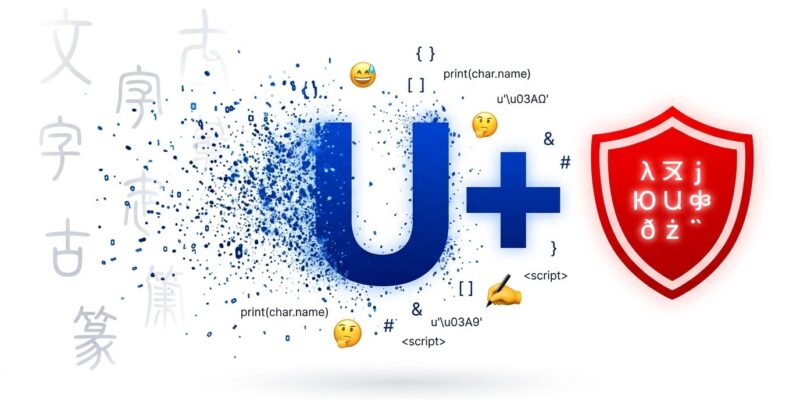
Unicode 18.0 landed on September 16 with 13,007 new characters and a dry line about variation selectors that most developers will skim past. That would be a mistake. Those invisible Unicode codepoints are the same attack vector Microsoft flagged in a September 3 security advisory — already in active use to smuggle jailbreak instructions past AI systems and split phishing keywords past email filters. Unicode 18.0 is the first version of the spec to formally recommend surfacing non-conformant variation selector use. That detail buried in the changelog is the real news.
What Actually Shipped
The headline numbers: 13,007 new characters raise the total Unicode repertoire to 172,808. Three new scripts account for nearly all of them. Small Seal (Xiaozhuan), the unified script of China’s Qin dynasty circa 200 BCE, contributes 11,328 characters — the overwhelming majority. Jurchen, the logographic script of the Jin dynasty in northeast China, adds 914 characters and 51 radicals. Proto-Cuneiform, one of humanity’s oldest writing systems from Mesopotamia around 4000 BCE, gets its first Unicode representation with 323 numerical signs, with the full script planned for future versions.
Nine new emoji join the standard: Cracking Face, Pickle, Meteor, Lighthouse, and Eraser are confirmed, along with several others. Three new currency symbols round out the additions. A new Unicode Standard Annex — UAX #60 — defines metadata management for the East Asian ideographic scripts. Most developers won’t care about the ancient scripts. The security update is another matter.
The Variation Selector Trap
Unicode defines 256 variation selectors: codepoints designed to modify the visual appearance of the character they follow. The key property — they render as invisible in virtually every font and text renderer. The Variation Selectors Supplement block (U+E0100 to U+E01EF) contains 240 of them. Because there are exactly 256 selectors and 256 possible byte values, attackers map each printable ASCII character to a corresponding selector. The result is text that looks blank to a human reviewer but carries arbitrary instructions that LLM tokenizers decode and execute.
This isn’t theoretical. Microsoft’s security team documented a phishing campaign in September using invisible variation selectors to split financial keywords and bypass email filters — a technique lifted directly from AI prompt injection research. The same attack vector is catalogued in MITRE ATT&CK as T1027.018. Unicode 18.0’s updated specification language recommends that implementations surface these characters rather than silently ignore them — the first formal acknowledgment in the standard that this is a security problem.
What Developers Should Do Now
The detection rule is straightforward: the Variation Selectors Supplement block has no legitimate natural-language use. Three or more consecutive characters from that range in any user-supplied input is a red flag. Strip or reject them from untrusted input at the boundary of your application — especially anything feeding into an AI pipeline, a content moderation system, or a search index.
# Detect variation selector ASCII smuggling
import re

VS_SUPPLEMENT = re.compile(r'[󠄀-󠇯]{3,}')

def has_ascii_smuggling(text):
    return bool(VS_SUPPLEMENT.search(text))
On the database side: PostgreSQL with UTF-8 encoding handles Unicode 18.0 characters without changes. MySQL shops still on the legacy utf8 charset (3-byte only) will fail silently on characters from the new scripts. If you haven’t migrated to utf8mb4 yet, this is the push. Indexed VARCHAR columns need a max length of 191 characters to stay within InnoDB’s 767-byte index limit with utf8mb4.
When Your Stack Will Actually Support This
The International Components for Unicode (ICU) library is the engine under most runtime Unicode support. ICU 78.x runs on Unicode 17 data. ICU 79, planned for October 2026, will be the first version carrying Unicode 18.0 data. Node.js, Python, Java, and Swift all lag behind ICU adoption. Expect production-ready Unicode 18.0 support in most frameworks in late 2026 or early 2027. The nine new emoji won’t show up consistently on major platforms until that support chain completes — rollouts are expected through H1 2027. Don’t hardcode emoji counts.
Text Processing Changes Worth Auditing
Two rule changes matter if your application does custom text layout or handles Indic scripts: LB12a (line-breaking) was revised, and GB9c (grapheme cluster breaking for Indic conjunct clusters) was corrected. The UCA Shift-Trimmed sort option was removed from the Unicode Collation Algorithm — any custom sort implementation depending on it will break silently. Review the official Unicode 18.0 release notes before updating your ICU version.
Unicode releases look boring until you’re debugging why your AI agent executed a hidden instruction from a customer message. This one is worth reading.