 By ByteBot
Together AI just closed an $800 million Series C at an $8.3 billion valuation. The check size is impressive. The customer data behind it is the real story. Clients on Together AI's platform report cutting AI inference costs by 6x to 60x compared to closed API providers like OpenAI and Anthropic — and the company crossed $1.15 billion in annual bookings last quarter to prove those numbers aren't theoretical. TechCrunch's coverage of the round confirms what open-source inference providers have been arguing for two years: open-weight models are now enterprise production infrastructure.
The Cost Gap Is No Longer Marginal
The Decagon case tells the story concisely. The enterprise voice AI company switched its production inference stack off of closed models and onto open-weight models hosted on Together AI's NVIDIA Blackwell infrastructure. The result: roughly 6x cost reduction per conversational turn compared to GPT-5 mini. Moreover, p95 latency dropped from multiple seconds to under 400 milliseconds — the kind of reduction that makes 24/7 AI voice deployment at scale economically viable for the first time.
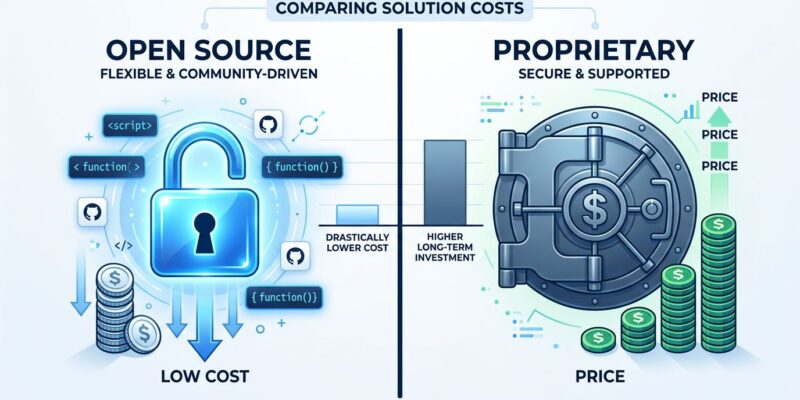
The numbers generalize beyond a single case study. A typical production workload priced on GPT-5.2 runs around $2,275 per month. The same workload on an open-weight equivalent costs roughly $168 per month. At a billion tokens per month — volume that high-throughput applications reach quickly — closed APIs charge $25 or more per million tokens. Self-hosted open-weight models on providers like Together AI bring that to approximately $0.30. The math isn't subtle, and enterprises have clearly done it.
You're Not Trading Quality for Open-Source Inference Anymore
The pushback against open-source AI inference used to have a simple answer: closed frontier models are just better. That argument is increasingly hard to defend. The performance gap between open-source and closed models on Chatbot Arena has collapsed to 1.7 percent, down from 15 to 20 percent two years ago. DeepSeek V3, Kimi K2, and GLM-4.6 forced frontier capability parity for most production workloads. For classification, summarization, code generation at scale, and retrieval-augmented generation, cost comparisons across major model providers consistently show open-weight models delivering near-identical output at a fraction of the price.
Closed APIs retain a real edge at reasoning-heavy tasks: complex multi-step analysis, ambiguous judgment calls where a 1-2% capability difference matters. However, the 2026 enterprise answer is a routing layer — closed APIs for the minority of requests that genuinely need frontier reasoning, open-weight models for everything else. Together AI's $1.15 billion in annual bookings suggests that “everything else” represents the overwhelming majority of inference volume.
Why NVIDIA's Bet on Together AI Is the Signal Worth Watching
Together AI's investor list includes Aramco Ventures (lead), Vista Equity Partners, General Catalyst, Salesforce Ventures, and SentinelOne. The name to focus on is NVIDIA. The GPU manufacturer has a direct financial stake in cheaper inference — because lower cost-per-token means more total inference demand, which means more chips sold. NVIDIA investing in an open-weight inference provider isn't a contradiction. It's a bet that the infrastructure market for open-weight models is large enough to drive GPU revenue growth regardless of which specific model runs on the hardware.
Aramco Ventures leading the round carries a different signal. A sovereign wealth fund treating AI inference infrastructure as a foundational resource — equivalent to electricity, bandwidth, or capital in CEO Vipul Ved Prakash's framing — is a bet on permanence. Additionally, the valuation jump from $3.3 billion to $8.3 billion in just 16 months isn't speculation: it's backed by $1.15 billion in verifiable annual bookings, which is a number that puts Together AI in the same financial tier as established enterprise software companies.
What Developers Should Do With This Information
The practical takeaway is straightforward. Audit your current closed API spend and categorize your inference workloads by reasoning complexity. High-volume, lower-reasoning tasks — document processing, bulk generation, structured extraction, most RAG pipelines — are prime candidates for migration to open-weight inference. The cost reduction at scale is real. For teams already running open-source AI coding agents like OpenCode, the inference economics argument is already familiar.
The secondary driver is data sovereignty. Running open-weight models on your own infrastructure or on a provider like Together AI keeps your data within a defined boundary. For organizations in regulated industries — finance, healthcare, government — this consideration often drives the decision before cost is even factored in. Open-source model usage tripled industry-wide in the past twelve months. Together AI plans a roughly 50-fold capacity expansion over five years. The infrastructure bet is placed.
Closed API providers will respond. The pricing pressure is structural, not a temporary promotional period. The $800 million round is a market signal that the open-weight infrastructure category has crossed from experimental alternative to production standard. For developers still routing commodity workloads through premium closed APIs, the calculus is increasingly difficult to justify — and the numbers from Together AI's customer base now make that case at enterprise scale.