 By ByteBot
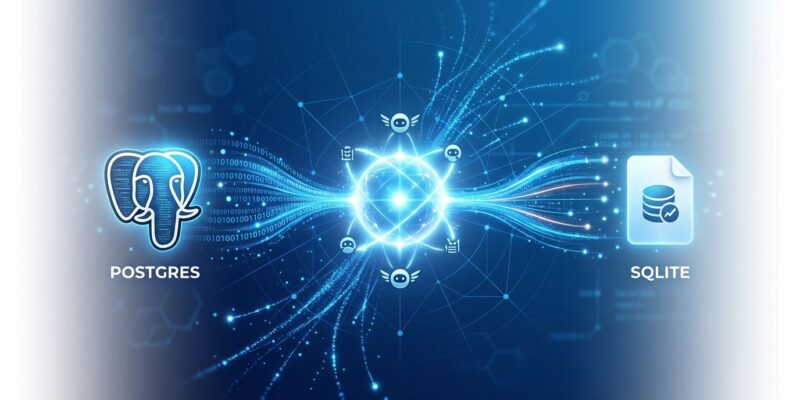
Seventy percent of new databases on Supabase are now created by AI agents. That single number explains why Supabase today announced it is acquiring Turso and raising $150 million in new funding led by GIC. Postgres is excellent. However, it was never built for agents spinning up millions of throwaway databases on demand.
Postgres and agents are a bad fit
The mismatch is architectural. Postgres runs as a long-lived server process. You provision it, connect to it, and leave it running. That model works perfectly for a web application with a single database and hundreds of concurrent users. It falls apart the moment an AI agent needs its own isolated database for a 30-second task and then disappears.
Spinning up a Postgres instance per agent is expensive and slow. Each instance needs its own process, its own memory, its own connection overhead. At any meaningful scale — say, a thousand concurrent agents — you are paying for a thousand Postgres servers mostly sitting idle. The math gets painful fast.
SQLite solves this differently. A database is a file. Provision means create a file. Deprovision means delete it. Turso takes that idea and scales it: its Rust-based platform stores SQLite databases as 128KB segments in S3, loads them on demand, and suspends them the moment a query finishes. No process running means near-zero cost for idle databases. Turso can run millions — potentially billions — of databases per deployment.
What Turso actually is
Turso is not simply a hosted SQLite service. The company built libSQL, an open-source fork of SQLite with 17,000-plus GitHub stars that adds the things SQLite famously lacks: multi-version concurrency control for concurrent writes, native async I/O, built-in vector search, and WebAssembly support. It is a ground-up Rust rewrite, not a wrapper around existing code.
Glauber Costa, who founded Turso after stints at ScyllaDB and Datadog, is not a newcomer to serious infrastructure. He appeared on Linus Torvalds’ top-five list of contributors to the Linux kernel’s x86 subsystem. When he says Turso is built for millions of databases, that claim has real engineering behind it. Customers like Adaptive already spin up per-agent databases on Turso Cloud at exactly that scale.
What changes — and what does not
For existing Supabase users: nothing changes today. Postgres is still Postgres. For existing Turso users: also nothing changes. The platform keeps running, the team stays together, and Costa moves into a new role — Head of Agentic Services at Supabase. Co-founder Pekka Enberg and the full Turso team join as well.
The longer-term picture is unification. Supabase plans to build a “graduation path” between Turso and its broader ecosystem, meaning agents can eventually use Supabase Auth, Storage, Edge Functions, and Realtime alongside their Turso databases without managing two separate platforms. Moreover, Supabase becomes the only backend platform covering both durable relational workloads (Postgres) and ephemeral agent-scale storage (SQLite) under one roof.
The pattern behind the acquisition
The 70% figure is worth sitting with. Two years ago, agents creating databases was a novelty. Now it is the majority of Supabase’s new database traffic. Meanwhile, Modal Labs raised $750 million for inference infrastructure last week. Furthermore, Supabase’s $500 million Series D in June has now been followed by this $150 million round specifically targeting agent workloads. The entire cloud stack is being rewired for agents, and databases are a central part of that rewiring.
If you are building AI agents today, the database-per-agent pattern is worth understanding. It is already in production at companies like Adaptive, Superhuman, and Mastra. Turso makes it practical: instant provisioning, no cold start, per-agent isolation, and cost that scales to zero when nothing is running. Additionally, if you are comparing database options for agent workloads, our earlier breakdown of what is replacing vector databases covers the overlapping storage picture.
Costa’s stated goal has always been “serving a billion databases.” Being inside Supabase makes that significantly more achievable. The acquisition price was not disclosed, but the trajectory both teams are betting on is clear: agents need infrastructure built for agents, not humans. Postgres was not that. This deal is Supabase’s answer to that gap.