
 By ByteBot
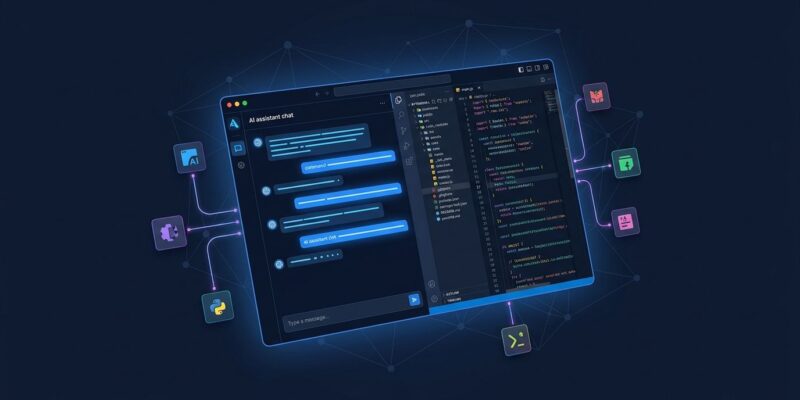
DeepSeek just shipped a desktop app for Harness — its open-source coding agent that outperforms Claude Code on benchmark tasks at roughly one-seventh the cost. Until now, setting it up required Node.js and a terminal. The v0.2 release removes that friction entirely: one installer, no prerequisites, works on Windows 64-bit and Apple Silicon Macs running macOS 13 or later.
What the Desktop App Actually Changes
The original Harness launched in August 2026 as a CLI tool — you ran npx @deepseek-ai/dsh web and got a web interface. That meant Node.js installations, terminal commands, and an upfront setup cost that filtered out anyone who wasn’t already comfortable on the command line. The v0.2 desktop package bundles everything. Download, install, open. The plugin management page lets you install, disable, or uninstall extensions by typing npm package names directly into the UI. Automation scheduling — setting repetitive tasks to run on a timer — is now a built-in feature rather than a manual workaround.
This matters because about 60 percent of DeepSeek API users are already using third-party Harness plugins. The desktop app isn’t an experiment — it’s packaging a workflow that people are already running in production and making it accessible to users who never want to touch a terminal.
The Architecture Beneath It: Everything Is a Plugin
Harness is built on Cordis, a plugin framework where every component of the agent is replaceable: the model adapter, the tool registry, the sandbox, the session log, the scheduler, and the UI itself. Claude Code exposes roughly 30 lifecycle hooks for customization. Harness lets you swap out the core. That’s a fundamentally different philosophy — one that makes Harness closer to an agent platform than a standalone tool.
The project accumulated 177,000 GitHub stars in its first week after open-sourcing in August, which is one signal that the developer community recognized this isn’t just another Claude Code clone. It’s MIT licensed, about 453,000 lines of TypeScript, and supports any LLM endpoint — DeepSeek’s own models, OpenAI-compatible APIs, or local inference engines like Ollama and LM Studio.
The Cost Argument, Honestly
Third-party benchmarks running DeepSeek V4 Flash through multiple agent runtimes put Harness at roughly $0.028 per successful task and Claude Code at $0.195 — about a seven-times cost difference. Token efficiency tells the same story: Harness averaged 88,562 tokens per task versus Claude Code’s 649,900. On task completion, Harness passed 20 out of 30 benchmark tasks to Claude Code’s 19.
Claude Code was faster — 263 seconds per task versus 283 — and its ecosystem is vastly more mature. Harness currently has around 80 documented plugins, mostly from DeepSeek itself. Claude Code has years of community-built skills, subagents, and integrations behind it. If you’re running production workloads today, Claude Code is the safer bet. If you’re running cost-sensitive batch workloads or building agent infrastructure where you need to audit and customize every layer, Harness is worth serious evaluation.
The Privacy Play
Harness offers two model modes. Use the official DeepSeek API and your session logs go to DeepSeek’s servers. Use a custom API endpoint — your own key, any provider — and the data never leaves your stack. Combined with local model support, this makes Harness the only coding agent in the current field that can run entirely offline. Claude Code and Codex have no equivalent path to full data isolation.
The caveat: Harness is still a developer preview. DeepSeek’s own documentation warns that “mistakes, malicious input, or untrusted plugins can damage files or disclose data,” and the security audit is not complete. Treat the plugin ecosystem with the same caution you’d apply to any npm package from an unfamiliar author.
What This Means for the Agent Market
The coding agent landscape fragmented fast this week. Pi 1.0 launched with MCP support and durable execution. Harness went desktop. Claude Code and Codex remain the polished commercial options. The pattern emerging is clear: terminal-only agents are becoming the legacy interface. GUI-first, plugin-driven, cost-efficient alternatives are arriving fast, and the performance gap between open-source and commercial tools is closing.
DeepSeek Harness is available at deepseek.com/harness. The source is on GitHub. If you’ve been watching the coding agent space and waiting for an open-source option worth running, this is the moment to test it.


