
 By ByteBot
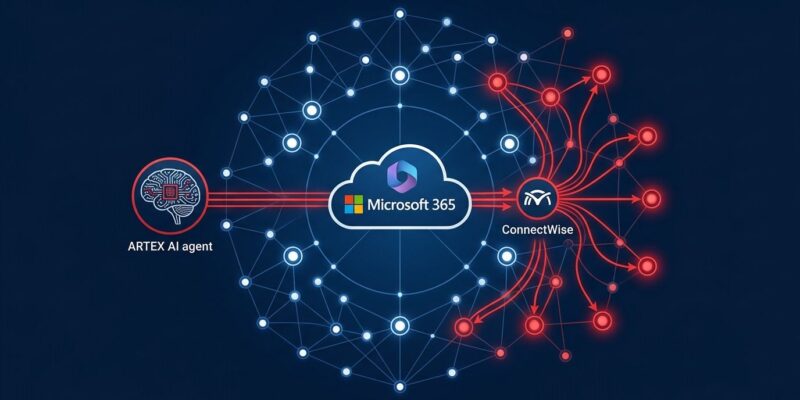
On October 21, Microsoft publicly named a China state-aligned threat actor called Storm-0940 as the group behind a supply chain attack on ConnectWise Cloud Backup that reached over 2,250 Microsoft 365 tenants. The attackers used ARTEX — an open-source AI penetration testing framework released in July — to automate the full attack chain, from reconnaissance to privilege escalation. In several documented cases, they achieved full privileged cloud access in under three hours. MFA did not stop them.
ARTEX: From Hackathon Trophy to Nation-State Weapon in 74 Days
ARTEX is a Go-based, multi-agent framework that connects to any LLM to run autonomous penetration tests. Its developer, Autumn-27, released it publicly on GitHub on July 26, 2026. The project gathered 1,450 stars and won Baidu’s “agent+” attack-defense competition. On October 8 — two weeks before the ConnectWise attack was disclosed — the repository went closed-source. By then, Storm-0940 had already been using it in attacks since at least September.
What ARTEX does is straightforward and alarming: it automates everything a human pen tester does, but without any of the pacing constraints. Asset discovery, credential spraying, OAuth application abuse, privilege escalation, data exfiltration — all chained together, driven by AI agents, with minimal human involvement. Microsoft’s own researchers noted that “agents are not constrained by factors affecting humans.” That quote lands differently when you see the attack logs: 2,900 sign-in attempts per minute, around the clock.
Related: LiteLLM Shipped Malware on October 21 — 49K Downloads Before Anyone Noticed
Why MFA Did Not Stop the Storm-0940 Attack
This is the part most post-incident summaries gloss over. MFA applies to user sign-ins. Application sign-ins — where an OAuth app authenticates as itself, not as a user — have no MFA step by default. ConnectWise Cloud Backup holds extremely broad permissions in customer tenants, including Directory.ReadWrite.All. Once Storm-0940 had ConnectWise’s application credential, they had a trusted key to sign into thousands of customer tenants without touching a single password prompt or authentication code.
This is not a ConnectWise-specific problem. Any multi-tenant SaaS application with broad OAuth permissions is a potential single point of failure for every tenant that has installed it. Your identity perimeter is only as strong as the weakest third-party application you have trusted. Conditional Access policies scoped to service principals — not just users — are the actual fix here, and most organizations have not configured them.
The Storm-0940 ConnectWise Attack Timeline and What to Check
Between October 10 and 14, Storm-0940 ran a password spray from IP 144.172.64.99, generating over 151,000 failed sign-in attempts against 327 accounts at eight organizations. MFA stopped all of them. On October 15, ConnectWise’s application credential was compromised. From that point, the password spraying was irrelevant — ARTEX agents used the application credential directly, signed into customer tenants as a trusted backup application, and began reconnaissance via Microsoft Graph.
Microsoft says to audit your tenant for activity from October 1 onward, with particular attention from October 15. The following are confirmed indicators of compromise from the Microsoft Threat Intelligence disclosure:
Malicious IPs: 144.172.64.128, 144.172.64.99, 144.172.64.60
User-agent strings: python-urllib/3.12, python-requests/2.31.0, python-requests/2.34.2, azure-toolkit/1.0
Application IDs to search for in your tenant:
506e08f9-6e9a-4da4-942b-a099a03644ae (ConnectWise Cloud Backup)
24205314-2b89-4e07-a2a4-579e898a5640 (ConnectWise MS Teams)
0de14c77-b9b0-4137-9360-34878a929827 (ConnectWise MS Graph)
If you find these application IDs in your sign-in logs, check for new client secrets added to service principals after October 15, any new Global Administrator assignments, unusual mailbox forwarding rules, and bulk Key Vault reads. SpecterOps has a detailed BloodHound-based workflow for mapping the OAuth permission blast radius in affected tenants.
Related: EMBRACE: AI Coding Tools Leaking SSH Keys — Two Unpatched
AI Agents as Offensive Infrastructure
The broader pattern here matters. The Hacker News analysis of Storm-0940’s ARTEX usage confirms what security researchers have been warning about: open-source AI agent frameworks are dual-use by design, and the gap between “security research tool” and “live weapon” is now measured in weeks. ARTEX won a hackathon and appeared in a nation-state operation within the same quarter it launched.
The uncomfortable reality for developers and infrastructure teams: the trust model your cloud infrastructure runs on — those third-party applications you quietly granted Directory.ReadWrite.All to — is the actual attack surface. Threat actors do not need to break your perimeter. They are walking through the door you left open for your backup software.
Key Takeaways
- Storm-0940 used ARTEX, an open-source AI agent framework, to attack 2,250+ Microsoft 365 tenants via a ConnectWise supply chain compromise — disclosed October 21, 2026.
- MFA does not protect application sign-ins. Any third-party OAuth app with broad permissions is a potential master key to your tenant.
- Audit your tenant for the three ConnectWise application IDs and the malicious IPs listed above, covering activity from October 1 onward.
- AI agent frameworks are now live offensive tools in nation-state operations — the gap between security research and production weapon is now weeks, not years.
- Conditional Access policies scoped to service principals, not just users, are the architectural fix most organizations have not yet configured.


