 By ByteBot
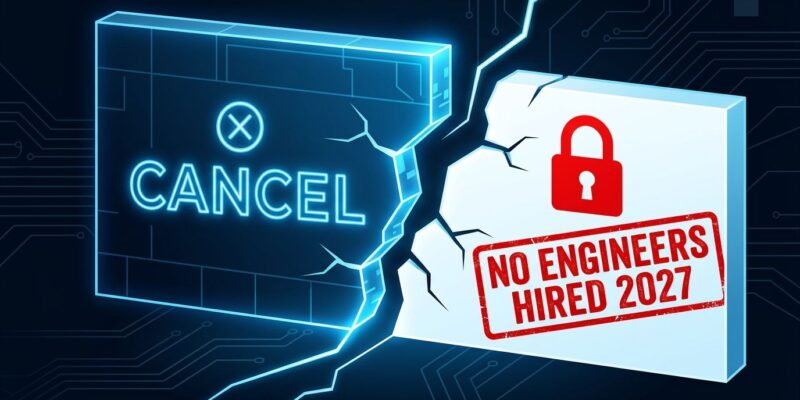
Proton’s CEO backed down on the forced AI re-interviews last night. What he did not back down on: the declaration that 2026 is the last year Proton will hire engineers. The re-interview retreat is the headline. The hiring freeze is the story.
What Happened
After a 404 Media investigation published Thursday revealed the full scope of Proton’s AI push — forced re-interviews, surveillance software tracking AI code output, and a CEO who called security testing “loser thinking” — CEO Andy Yen announced at an all-hands Friday that the re-interviews were cancelled. CTO Bart Butler added: “We fucked up, we know we fucked up.”
That sounds like a win. It isn’t, quite. According to an employee quoted by 404 Media: “They said they want to continue pushing AI and that the things to be measured in re-interviews would become a component of the performance reviews.” The process changed. The pressure did not.
The Part Nobody Is Talking About
Lost in the re-interview drama is a Slack message Yen sent to staff that 404 Media also surfaced: “This will be the last year that we hire engineers.” Starting in 2027, Proton plans to hire product managers to build things with AI instead of hiring engineers. That announcement was not cancelled. It was not walked back. It was not addressed at the all-hands.
For a company that markets itself on privacy and trust, this is a remarkable pivot. Proton is not just automating tasks — it is betting that the engineering function itself is replaceable.
The Security Irony
The detail that should make any Proton user uncomfortable: CTO Bart Butler reported that 90% of Proton’s October code was AI-written, most of it via Anthropic’s Claude. When an employee asked to spend a few days running a penetration test on freshly written code before it shipped, Yen’s response in Slack was: “That’s bullshit and loser thinking.”
Proton sells privacy. Proton Mail, Proton VPN, and Proton Drive exist because users do not trust big tech with their data. The company’s entire value proposition is security by design. Skipping pen tests on AI-generated code is not a neutral tradeoff — it is a direct contradiction of the product’s core promise.
This Playbook Has Already Failed
Klarna tried a version of this. The Swedish fintech cut 700 engineering positions between 2024 and 2025, replacing them with AI tools. Quality declined. Institutional knowledge walked out the door. Technical debt accumulated faster than AI could address it. Klarna is now rehiring. Gartner estimates that by 2027, roughly half of companies that cut staff to rely on AI will rehire, typically under new job titles.
Proton is not Klarna — the stakes are higher because the product is security-sensitive. But the pattern is the same: a CEO under financial pressure (internal documents describe Proton as “underperforming by all metrics that matter”) makes a dramatic AI pivot, frames employee resistance as a failure of imagination, and skips the step where you ask whether the product can tolerate the risk.
What This Means for Developers
Proton is not an outlier — it is an early adopter of a policy other companies will attempt. The coercive version (surveillance, re-interviews, “get on board or get crushed”) is what happens when leadership treats AI adoption as a morale problem rather than an engineering challenge. It generates press, damages culture, and tends to divide developer communities sharply.
The more durable version is what Proton should have done: measure outcomes, not AI usage. Ship faster with AI, but keep the humans who understand the system. Security is not “loser thinking.” It is the product.
If you work at a company where AI adoption is tracked by surveillance software and your job depends on how many AI completions you accept, Yen just made the stakes explicit. The re-interviews were cancelled. The direction was not.