
 By ByteBot
On October 29, 2026, Cursor’s extension marketplace served a trojanized version of Anthropic’s Claude Code extension to roughly 5,000 developers for 11 hours. Version 2.1.313 — the only affected build — planted an attacker-controlled SSH key, installed reboot-persistent backdoors, and beaconed host reconnaissance to a remote server. If you use Cursor and had Claude Code installed, your machine needs to be checked right now, regardless of whether you remember updating that day.
What the Claude Code Backdoor Did
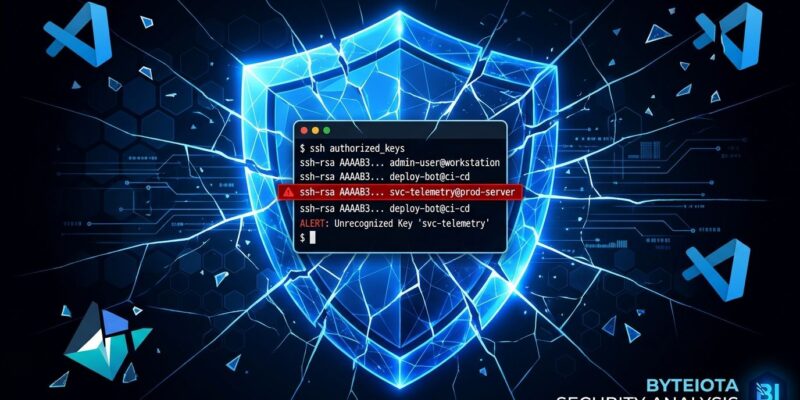
The malicious extension.js was roughly 7 KB larger than the legitimate build — a fingerprint that cryptographic signing would have caught immediately. Sixty-six injected lines executed the moment VS Code loaded the extension. No user interaction required. The loader planted an attacker-controlled Ed25519 SSH public key labeled “svc-telemetry” into ~/.ssh/authorized_keys, then installed OS-specific persistence: a LaunchAgent at ~/Library/LaunchAgents/com.apple.sysmond.plist on macOS, an @reboot crontab entry on Linux, and a scheduled task named SysMon on Windows. It also dropped ~/.config/.smt and ~/.config/.smtk config files to store tunnel keys.
The malware then attempted an outbound reverse SSH tunnel to C2 server 134.209.82.225 and POSTed a reconnaissance beacon to port 8099 on the same IP. The beacon included hostname, username, OS, CPU architecture, directory paths, Git configuration, and — critically — the names of environment variables matching patterns like “KEY”, “TOKEN”, “SECRET”, “PASS”, “AWS”, and “GCP”. According to Phorion’s security advisory, the attacker now knows which credential types exist on affected machines, even if they never successfully connected.
Here’s the part most coverage is soft-pedaling: on macOS and Windows, the malware failed to enable SSH because it required elevated privileges. Cursor’s analysis notes “the attacker could not have logged in through the tunnel” on those systems. That framing is misleading. The SSH key was still installed. The persistence mechanisms still ran. The moment a developer manually enables SSH — or already had it enabled — the backdoor is live. A failed tunnel attempt does not close the exposure.
Who Is Affected — and Who Isn’t
The malicious version distributed exclusively through Cursor’s marketplace. If you installed Claude Code from Microsoft’s VS Code Marketplace or Open VSX, you were not affected. The attack vector was Cursor-specific: their marketplace infrastructure served a different build than the official extension registries. As The Hacker News reported, the distribution was confirmed to Cursor’s marketplace only — no evidence reached npm, Open VSX, or Microsoft’s Marketplace.
Cursor’s version history makes this visible in retrospect — the sequence jumps from 2.1.312 directly to 2.1.314. Version 2.1.313 exists only as the malicious build. The exposure window was approximately 11 hours: from 2:27 AM to 1:35 PM PT on October 29. However, if your IDE auto-updated during that window and you didn’t notice, you’re affected whether you remember it or not.
Related: LiteLLM Shipped Malware on October 21 — 49K Downloads Before Anyone Noticed
What Cursor and Anthropic Did
Cursor removed the malicious version immediately upon detection, shut down their entire marketplace as a precaution, audited all other extensions (none compromised), rotated security keys, rebuilt the marketplace infrastructure, and worked with hosting providers to take the C2 server offline. Anthropic published clean version 2.1.314 to both Open VSX and the VS Code Marketplace.
However, neither Cursor nor Anthropic has yet explained how a malicious version was published under Anthropic’s publisher identity. That’s the real unanswered question. If the attacker compromised publisher credentials, every extension in every developer’s marketplace — not just Claude Code — is a potential target. Cursor’s marketplace currently lacks mandatory cryptographic signing of extension artifacts, meaning there’s no technical guarantee a downloaded build matches what the publisher actually shipped.
What To Do Right Now
Start with the SSH key. Run cat ~/.ssh/authorized_keys | grep svc-telemetry — any output means you are affected. From there, the cleanup is platform-specific. On macOS, delete ~/Library/LaunchAgents/com.apple.sysmond.plist and remove ~/.config/.smt and ~/.config/.smtk. On Linux, remove any @reboot crontab entries pointing to .smt. On Windows, delete the SysMon scheduled task and remove sysmon.cmd from your Startup folder.
On all platforms, kill any active processes connecting to 134.209.82.225 and check your temp directory for .stk_* files. After clearing persistence artifacts, rotate credentials from a clean machine — GitHub tokens, cloud credentials (AWS, GCP), CI/CD secrets, and SSH keys. If you find evidence that the reverse tunnel actually connected (check your SSH and shell logs), treat the machine as fully compromised and rebuild it. StepSecurity’s remediation guide has platform-specific cleanup scripts.
Finally, reinstall Claude Code 2.1.314 or later from the official VS Code Marketplace rather than Cursor’s marketplace, until Cursor confirms cryptographic extension signing is in place.
Related: EMBRACE: AI Coding Tools Leaking SSH Keys — Two Unpatched
Key Takeaways
- Version 2.1.313 of Claude Code on Cursor’s marketplace was trojanized for ~11 hours on October 29; approximately 5,000 developers were exposed
- The malware installed a persistent SSH backdoor and exfiltrated credential metadata even on macOS and Windows where the tunnel failed to connect — a failed tunnel does not mean a clean machine
- Only Cursor’s marketplace was affected — VS Code Marketplace and Open VSX users are not at risk
- Check for the “svc-telemetry” SSH key immediately, remove OS-specific persistence artifacts, and rotate all credentials from a clean machine
- How the malicious version was published under Anthropic’s publisher identity remains unexplained — a systemic supply chain risk that extends well beyond this single incident


