 By ByteBot
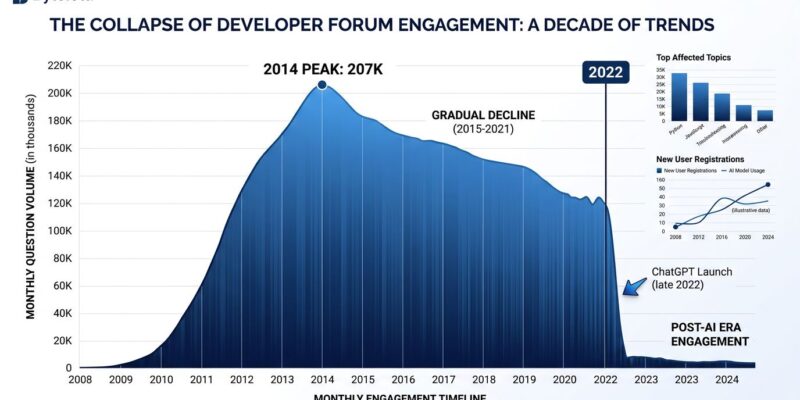
A graph went viral on Hacker News today, July 18, and it needs no caption. Stack Overflow’s monthly question volume: 207,000 at the 2014 peak, a slow slide through 2022, then a cliff edge in November of that year. Today the number sits around 1,226. That is a 99.41% collapse — and the Hacker News discussion thread hit 316 upvotes and 365 comments within hours, because developers apparently had a lot of feelings to process.
AI Didn’t Kill Stack Overflow. It Just Finished the Job.
The cliff edge in November 2022 is ChatGPT’s launch date. That correlation is not subtle. AI tools gave developers three things Stack Overflow had stopped providing: instant answers, comparable quality, and basic human decency. Of the 84% of developers who now use AI in their workflow, most weren’t abandoning a beloved community — they were escaping one that had turned hostile.
There’s a bitter irony baked into this data. ChatGPT, GitHub Copilot, and every other AI coding assistant were trained substantially on Stack Overflow’s golden-age corpus. Millions of carefully verified, community-audited answers — the accumulated labor of hundreds of thousands of developers over 15 years — became the foundation for the tools that made Stack Overflow irrelevant. AI didn’t replace Stack Overflow. It became Stack Overflow, stripped of the gatekeeping.
Stack Overflow Set Itself Up for This
The decline didn’t start with ChatGPT. Look at that chart again: the slide begins in 2014, eight years before any of this. That’s when Stack Overflow improved moderation efficiency — which in practice meant more aggressive duplicate closures, faster question downvotes, and a steeper barrier to participation. A 2023 study found 49% of new users faced closed questions, no responses, or unexplained downvotes. The platform wasn’t maintaining quality. It was selecting for the developers already inside the walls.
By 2023, volunteer moderators were resigning in waves, citing policies they described as “reactive, unclear, and dismissive of the community.” The most upvoted sentiment in today’s discussion says it plainly: “People were just happy to finally have a tool that didn’t tell them their questions were stupid.” That’s not nostalgia for AI. That’s relief.
Stack Overflow’s response to AI made things worse. In 2023, the platform banned AI-generated answers — a reasonable call on quality grounds — while simultaneously licensing its corpus to OpenAI and building AI Assist features. It tried to fight the wave with one hand while feeding it with the other. The Stack Internal pivot toward enterprise knowledge management may save the business, but the public platform’s role as the developer internet’s help desk is done.
What’s Actually Lost
Being honest about the loss matters. Stack Overflow’s public archive is genuinely irreplaceable in one specific way: the verified, community-audited long-form answer that still works eight years later, indexed by Google, discoverable in two seconds. The serendipitous moment of finding a perfect 2012 answer to your 2026 edge case is a dying experience. AI can’t replicate that — it has a training cutoff, it hallucinates details, and its answers don’t link back to human-readable reasoning chains.
There’s also a longer-term structural problem worth naming. AI models are trained on Stack Overflow’s historical data. As the platform stops generating new high-quality human-authored content, future models will increasingly train on AI-generated content — a degradation loop researchers call model collapse. According to The Pragmatic Engineer, even without large language models, Stack Overflow faced structural decline; AI simply turned a manageable retreat into a rout.
Related: MOSAIC Attack: AI Coding Agents Fail 96% of the Time
Where Developer Knowledge Lives Now
Fragmented, mostly. For real-time help, framework-specific Discord servers now handle what Stack Overflow used to. GitHub Discussions embeds Q&A directly in the codebase where the question actually lives. Reddit — despite its own moderation chaos — remains more forgiving than SO ever was in its later years. And for anything involving “how do I do X in Python,” AI tools are simply faster, in the IDE, and available at 2 AM without judgment.
The collective developer knowledge isn’t gone — it’s scattered. Across chat logs that expire, Discord channels without search, and closed GitHub issues. The difference from Stack Overflow’s model is discoverability. As Futurism notes, the critical question now is where AI models will source high-quality coding knowledge for future training — the very corpus they learned from is going static. A well-answered SO thread could surface for a decade via Google. A Discord message from last Thursday is already buried. Whether that tradeoff is acceptable is the question this graph doesn’t answer.
Key Takeaways
- Stack Overflow’s question volume collapsed 99.41% from its 2014 peak — a graph going viral on Hacker News today shows the cliff edge at ChatGPT’s November 2022 launch
- AI didn’t cause the Stack Overflow decline alone; hostile moderation culture drove the pre-2022 slide and made developers eager to leave
- The irony: AI tools were trained on Stack Overflow’s own corpus, then replaced the platform entirely
- What’s actually lost is the discoverable, community-verified canonical answer — not the hostile gatekeeper experience that surrounded it
- Developer knowledge is now fragmented across Discord, GitHub Discussions, and AI chat sessions with no long-term discoverability