 By ByteBot
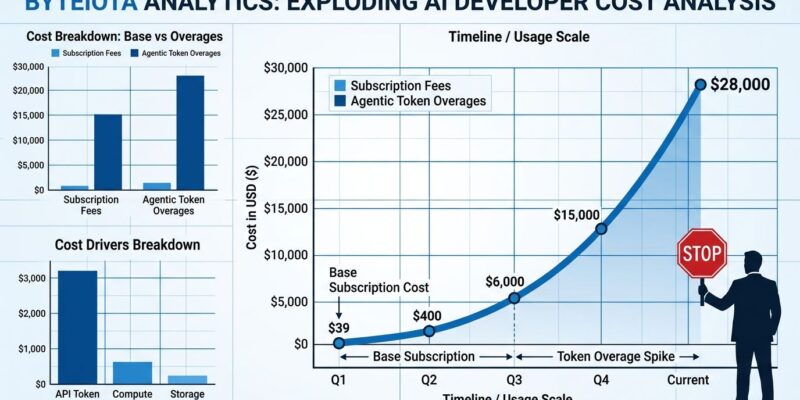
The median all-in cost of a fully loaded developer AI stack hit $28,000 per engineer per year in 2026 — and CFOs who spent two years rubber-stamping AI tool requests are now actively blocking spending. This isn’t the $39/month GitHub Copilot seat that got approved without a second thought in 2024. This figure accounts for agentic workflow token overages, observability and security tooling, vector database infrastructure, and governance overhead. Uber burned through its entire 2026 AI budget for coding tools by April. Four months in, budget gone.
The $39/Month Seat Was Just the Entry Fee
Most engineering managers approved AI coding tools thinking they were approving a subscription — a predictable line item. The $28,000/dev/year median breaks down very differently. IDE assistant seats are a rounding error: GitHub Copilot at $228/year, general AI subscriptions at another $720/year. The real money is elsewhere. Agentic workflow token overages run $5,000–$15,000 per developer annually. Observability, security scanning, and vector database infrastructure add $3,000–$8,000 more. According to analysis of enterprise billing data from large SaaS organizations, governance and compliance infrastructure adds another $1,000–$5,000 on top.
GitHub Copilot’s effective cost illustrates the gap well. Listed at $39/month, the actual effective cost is $60/month because it requires GitHub Enterprise Cloud at $21/month. Promotional credits expire this month — August 2026 — revealing the true baseline. Agent-heavy developers exhaust credit allotments mid-month and hit $0.04-per-request overages. One Copilot user documented going from $29 to $750/month when shifting to agentic workflows. Another jumped from $50 to $3,000. These aren’t outliers — they’re early adopters showing what happens when the rest of the organization catches up.
Why AI Coding Agentic Workflows Are the Real Cost Driver
A simple code completion in 2023 cost $0.04 per interaction. A complex agentic system in 2026 — with tools, MCP servers, reasoning models, subagents, and retries — costs $1.20 per interaction. That’s a 30x jump, and it happened precisely as agentic AI became the default mode of developer work. Per-developer token consumption grew 18.6x across enterprise organizations in just nine months, according to enterprise billing analyses from multiple FinOps teams.
The mechanism is architectural, not incidental. Each step in an agentic workflow requires the model to re-process the entire conversation history before generating its next action. Research from multiple inference cost analyses puts re-sent context at 62% of total agent inference bills. Meanwhile, model inference — the part engineers think of as the cost — represents only about 20% of total ownership. The other 80% is orchestration overhead: evaluation, monitoring, governance, and retry loops triggered by a single timeout. API prices dropped 280x since 2024. Total enterprise AI spend is still up 483%. Consumption grew faster than prices fell.
The Uber Warning Every Engineering Leader Should Know
Uber is the case study every engineering leader is now citing. Claude Code was introduced to ~5,000 Uber engineers in December 2025. By March, 84% were classified as agentic users. By April, the entire 2026 AI budget for coding tools was gone. Monthly costs per engineer averaged $150–$250, but power users hit $500–$2,000. Uber subsequently capped individual spending at $1,500/month after the blowout.
What made Uber’s situation worse wasn’t just the tool — it was the incentive structure. Uber ranked engineers on internal leaderboards based on Claude Code usage. That cultural decision directly incentivized higher token consumption. More usage meant better scores, better scores meant higher billing, and nobody saw the aggregate total in real time. The combination of usage-based billing and leaderboard culture is a budget disaster formula. This pattern will repeat at organizations that haven’t learned from it yet.
Related: Claude Code Self-Hosted Runner: Keep Your Code Off Anthropic’s Cloud
The ROI Math CFOs Are Now Running
Vendors claim 3–10x productivity improvement from AI coding tools. Measured data from 400+ organizations, published by getdx.com’s 2026 pricing and ROI analysis, tells a different story: median PR throughput gain is 7.76%, with a mean of 13.1% across the sample. To justify $28,000 per developer per year, organizations need AI tools delivering 0.3–0.5 FTE equivalent output per engineer.
The math is straightforward. Hiring one mid-level engineer costs $120,000–$160,000 per year and delivers 1.0 FTE of output. Spending $140,000 on AI stacks for five engineers makes sense only if you extract 1.5–2.5 FTE equivalents from that investment. A 7.76% PR throughput gain doesn’t clear that bar. Gartner projects 40% of AI agent projects will be cancelled by 2027 due to cost overruns alone. Deloitte found fewer than one-third of organizations could link AI spend to measurable outcomes. CFOs are running this math now — engineering leaders need answers ready before the next budget review.
What Engineering Orgs Are Actually Doing About AI Coding Costs
The organizations managing this well are working three levers simultaneously. Model routing sends routine tasks to cheaper models — something like Kimi K2.6 at $0.25 per million input tokens — and reserves frontier models for the hard problems requiring full reasoning. Properly implemented, tiered model routing cuts blended per-developer costs by 40–60% with no measurable productivity drop. Prompt caching extends savings further: cache reads cost $0.30 per million tokens versus $3.00 standard, a 90% reduction that breaks even after 2.3 reuses within one hour.
The third lever is context management at the shell level. The RTK CLI (Rust Token Killer) is an open-source proxy that intercepts shell command output before it reaches the AI context window. In CLI-heavy sessions, it reduces total token consumption by 60–90%. Beyond tools, governance structure matters: centralized AI procurement, team-level usage dashboards, explicit quotas on reasoning-heavy workflows, and quarterly reviews of cost-per-PR and effective FTE multipliers. These aren’t experimental — they’re becoming standard practice at any org that has been through the budget shock cycle once.
Key Takeaways
- The $28,000/dev/year figure is real and growing — it’s not the subscription fee driving costs, it’s agentic token overages and infrastructure overhead
- Agentic workflows cost 30x more per interaction than simple completions; per-developer consumption grew 18.6x in nine months — this is a consumption problem, not a pricing problem
- Uber’s experience burning a full year of AI coding budget in four months is a preview for any organization adding usage-based billing without governance controls
- Vendor productivity claims (3–10x) significantly outpace measured reality (5–15% PR throughput gain); justify the AI investment with actual metrics before CFO review season
- Model routing, prompt caching, and context management can cut costs 40–60% without reducing developer output — governance is the actual solution, not tool reduction