 By ByteBot
950 Claude agents ran for 21 hours, burned 210 million tokens, and pulled a previously unknown enzyme system out of a database of 200,000 genetic sequences. Anthropic announced the result last Tuesday. The biology is genuinely interesting. But if you build agent pipelines, the more useful result is the architecture — a production multi-agent workflow built entirely on Claude Science and Claude Code, tools any developer already has access to.
What Claude Found
The discovery is a system Anthropic is calling Array-Associated Reverse Transcriptases, or ART. It’s a three-part structure — a reverse transcriptase gene, a partner gene, and an evenly-spaced array of repeated DNA sequences — found primarily in bacteriophages, the viruses that infect bacteria.
The reason everyone is reaching for a CRISPR comparison is the repeat array. CRISPR’s power in gene editing comes from exactly this kind of structured repeat, and early experiments show that the ART array also expresses as distinct short RNAs — the same functional signature. One of the agents flagged the match directly in its output: “I can see by eye a tandem repeat array… that’s a CRISPR-like… repeat array?!”
That said: ART has no confirmed function. No gene-editing capability has been demonstrated. The finding is published as a preprint with peer review pending. The CRISPR comparison is structural, not functional — worth watching, not worth overstating.
The Workflow That Made It Possible
This is the part developers should spend time on. Here is what the pipeline actually looked like:
- A custom harness coordinated roughly 950 parallel Claude sessions simultaneously
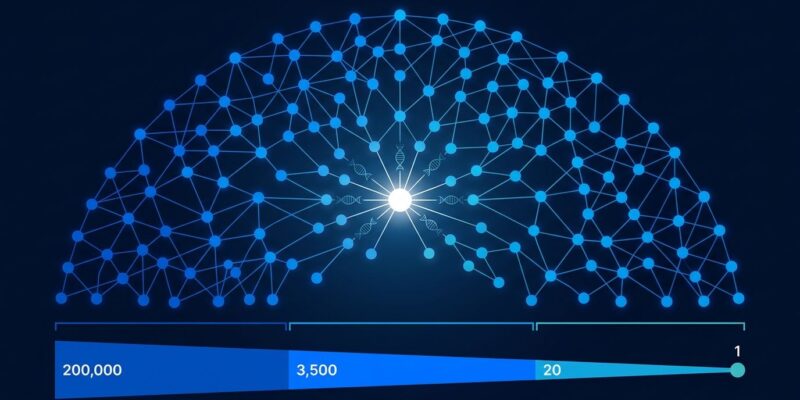
- Each agent worked through a segment of a 200,000-sequence reverse transcriptase database
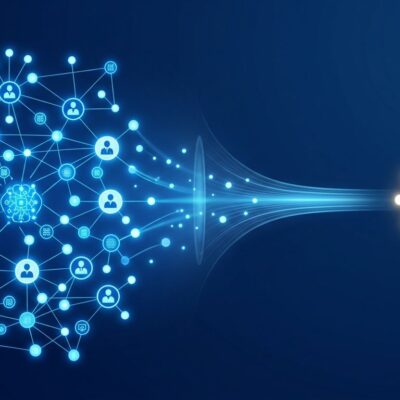
- A sequential filter narrowed the field: 200,000 candidates → 3,500 candidate systems → 20 final candidates → human-readable reports
- Output format was structured written reports — auditable artifacts, not black-box scores
- Human wet-lab validation came after the computational filtering, not before
The tools involved were Claude Science and Claude Code. No proprietary internal models, no secret infrastructure. The same workbench is available to external researchers today.
The generalizable pattern: large corpus + cheap first-pass filter + structured report output + human review gate before the expensive step. That is a production pattern. The biology was the domain; the architecture applies anywhere you need to search a large space intelligently.
Who Did What
Anthropic CEO Dario Amodei was direct about the split: “Claude mostly led the discovery work while humans chose the search area and ran the wet-lab checks it proposed.”
Humans handled two things: selecting the domain (reverse transcriptases in phage genomes) and validating the top candidates in the physical lab. Every step between those bookends — pattern recognition, literature cross-referencing, hypothesis generation, candidate ranking — was Claude’s job.
That is a meaningful distinction for anyone designing agent systems. Oversight was concentrated at the expensive, irreversible step (wet-lab work), not distributed across every computational operation. The agents were trusted to filter autonomously; humans reviewed before money was spent on physical experiments.
The Lab Behind This
Anthropic’s biology group was formed in spring 2026 following the $400 million acquisition of Coefficient Bio — a small team of former Genentech computational biology researchers. The Bay Area wet lab operates at BSL-1 and BSL-2 levels, focusing exclusively on non-pathogenic work.
The ART discovery is the lab’s first major public result. Anthropic also recently published the Model Hardware Standard (MHS) — a hardware counterpart to MCP that connects Claude agents directly to laboratory instruments including microscopes, liquid handlers, and robotic arms. The long-term aim is agents that run physical experiments autonomously; that step has not happened yet, and Amodei has been careful to say it requires “appropriate safeguards” before it does.
The Economics
210 million tokens at Opus 5.5 list pricing works out to roughly $1,500–$3,000 for the full 21-hour run — depending on the input/output split. That is the cost of a potential biological discovery. For context, a single wet-lab screen of equivalent scope would typically require months of researcher time and equipment costs an order of magnitude higher.
The implication is not just biological. It applies to any domain where a large structured corpus needs intelligent filtering: security research, materials science, legal discovery, financial analysis. The pattern scales.
What to Watch
The ART system still needs wet-lab characterization to establish whether it actually does anything useful. The TechCrunch write-up is worth reading for the full context on what Anthropic is and is not claiming. Feng Zhang at MIT’s Broad Institute called it “an exciting example of how AI agents can contribute to biological discovery” — a measured endorsement from someone who knows exactly what CRISPR required to go from structural curiosity to functional tool.
The more skeptical read is also worth keeping in mind: nobody knows what ART does yet, and a structural similarity to CRISPR does not make it a gene editor. What is established is the workflow — and that part is already running.