 By ByteBot
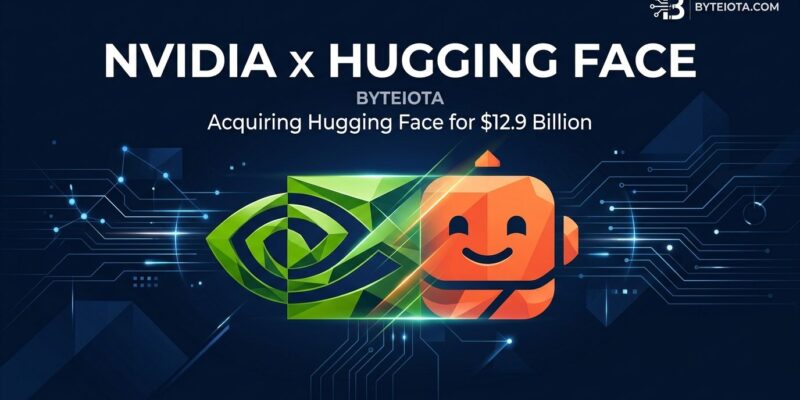
Nvidia just bought the place where most developers get their AI models. On September 3, Nvidia confirmed a $12.93 billion acquisition of Hugging Face — the platform hosting 3 million models, 500,000 datasets, and 1 million apps for 18 million developers worldwide. Jensen Huang says it stays open. The developer community is skeptical. Both things can be true at the same time.
What Actually Happened
Hugging Face CEO Clément Delangue approached Nvidia — not the other way around. Earlier in 2026, Hugging Face turned down a $500 million investment from Nvidia specifically because Delangue was worried about depending on a single dominant investor. Months later, he sold the company outright for nearly three times that implied valuation. Make of that what you will.
The deal is structured as $11.9 billion in cash plus $1 billion in equity retention to keep Hugging Face’s team intact. Regulatory review is underway — FTC, DOJ, EU, and UK competition authorities all have a say — and the deal is not expected to close until 2027. Until then, nothing changes operationally.
The Promise and Its Gap
Jensen Huang made the right noises at the announcement. “Developers will choose the models they want, the frameworks they want, the clouds and inference service providers they want,” he said. “Nvidia compute will not be required to build on or deploy through Hugging Face.”
That commitment is real but limited. What it covers: Nvidia won’t lock out non-Nvidia hardware or block access to models. What it does not cover: how models are ranked in search, what gets promoted on the front page, which hardware paths get first-class library support, or whether inference pricing tiers favor Nvidia-backed endpoints.
Analyst Sanchit Vir Gogia put it plainly: “Nothing addresses ranking, search placement, or default routing.” That is where the real risk lives — not in an explicit policy change, but in defaults drifting over time.
Three Risks Worth Tracking
Here are the concrete things to watch:
- Discovery drift. Hugging Face’s trending models, front-page listings, and search rankings are the platform’s most powerful influence. If models optimized for Nvidia hardware quietly surface higher than alternatives, it shapes what developers reach for without any explicit policy change.
- Library prioritization. Core libraries like Transformers and Accelerate define how developers interface with models. If CUDA-specific optimizations ship first and AMD or Intel backends lag, the Nvidia path becomes the path of least resistance.
- Inference tier pricing. Hugging Face’s hosted inference endpoints could offer discount tiers tied to Nvidia compute. That would make Nvidia hardware economically easier without technically prohibiting anything else.
Brian Levine, a consultant who has tracked similar platform acquisitions, described the dynamic well: “The Nvidia-optimized path quietly becomes the easy path, and everything else becomes the friction path.”
Zooming Out: A $21 Billion Week for AI Infrastructure
The Hugging Face deal did not happen in isolation. The same week, Stripe finalized its $7.5 billion acquisition of OpenRouter, which routes token calls across 400+ models from 80+ providers. Together, these two deals represent roughly $21 billion of infrastructure-layer control changing hands within days.
Neither company bought the models. They bought the plumbing — the discovery layer, the deployment defaults, the routing layer. As Ashish Nadkarni at IDC put it: “Owning that front door gives Nvidia a major position in the mindshare of today’s AI development personas.” The models themselves remain open. The infrastructure those models depend on is increasingly owned.
What to Do Right Now
This is not a crisis — it is a vendor change. Treat it like one. Here is the practical checklist from VentureBeat and security practitioners:
- Mirror your models. Download and store model weights, tokenizers, and configs in an internal registry or S3 bucket. Do not rely on live Hugging Face URLs in production.
- Version-pin like you do code. Record exact revisions and checksums for every model in production. Upstream changes should not be able to silently break your stack.
- Archive model cards and licenses. The licensing and documentation for the model version you deployed should live inside your infrastructure, not linked externally.
- Decouple inference from discovery. Use Hugging Face to find and evaluate models. Run them from your own infrastructure. Those are two different jobs.
- Test portability before you need it. Spin up a deployment on Azure AI Foundry, SageMaker JumpStart, or a self-hosted registry and verify it actually works. Theoretical portability is not portability.
The Bottom Line
Jensen Huang’s commitment to openness is plausible. Nvidia has real incentives to keep Hugging Face neutral — it drives demand for GPUs regardless of what model you’re running. The historical precedents are mixed but not uniformly bad: GitHub under Microsoft improved. Red Hat under IBM improved. Not every acquisition destroys what made the target valuable.
But the structure of ownership has changed, and structure has consequences independent of intent. The right response is not panic — it is to architect as if you might need an exit. Mirror your models. Version-pin your dependencies. Test your fallbacks. The commitment is probably genuine. Your stack should not need to trust it.