 By ByteBot
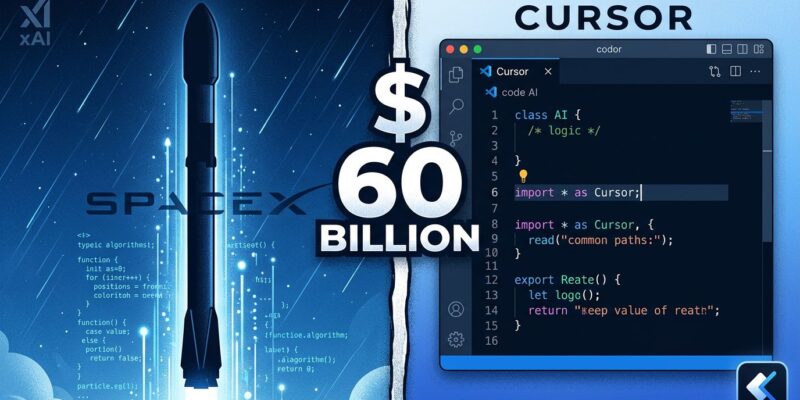
On June 16, 2026, SpaceX announced a $60 billion all-stock acquisition of Anysphere — the company behind Cursor — making it the largest deal in AI developer tooling history. If you write code in Cursor today, you now work in a tool that feeds Grok’s training pipeline and will shortly sit inside Elon Musk’s vertically integrated AI empire. The deal closes Q3 2026. That’s roughly 90 days to assess what this means for your team before the ink dries.
Four million developers use Cursor. It runs on approximately 50% of Fortune 500 developer machines. This isn’t news you can file away — it’s a vendor risk event, and the window to respond is short.
The IDE Is a Loss Leader
SpaceX didn’t pay $60 billion for a VS Code fork. They bought 150 million lines of enterprise code per day — a training data pipeline that no synthetic dataset can replicate. xAI, which merged with SpaceX earlier this year, had a coding problem: its tools were falling badly behind rivals, specifically Claude Code and OpenAI Codex. Cursor fixes that in a way that would take years to build independently.
The Cursor blog confirmed that SpaceX and Anysphere had been jointly training a new model for several months before the announcement, using Colossus 2’s compute — a cluster described as equivalent to a million H100s. A jointly developed model is already slated for release on both Cursor and Grok Build. Your daily coding sessions are the training data. The editor is just the collection mechanism.
This changes how you should think about the acquisition. SpaceX isn’t buying a product. They’re buying a habit — 4 million developers opening Cursor every morning, generating the real-world coding data that makes AI models better at coding.
Related: SpaceX Acquires Cursor for $60B: What Developers Need to Know
Three Vendor Risks Worth Taking Seriously
Three specific risks have materialized from the acquisition, each with a concrete window to respond.
Data privacy: Cursor’s Privacy Mode — zero data retention — was how security-conscious teams got it past procurement. An ownership change doesn’t automatically void that guarantee, but it puts it back in play. A guarantee written for one owner is only as durable as the next owner wants it to be. The time to get written confirmation that Privacy Mode survives the acquisition is before Q3 2026 close, not after.
Model lock-in: The Hacker News thread on the acquisition — 207 points, 147 comments — is dominated by one question: will Cursor still work with models other than Grok? Cursor’s value proposition has always been model flexibility: point it at Claude, GPT-4, or Gemini. If that flexibility narrows toward Grok, the product most teams adopted is gone, replaced by something that serves SpaceX’s model distribution goals.
Pricing pressure: $60 billion is a large multiple to justify on $4 billion ARR. The current $20/month Pro price was Cursor’s growth lever. Once the acquisition closes, that math changes. Microsoft already showed the playbook — it switched GitHub Copilot to token-based billing in June 2026, triggering visible developer churn. Cursor pricing will face the same pressure.
Every Coding Tool Is Now a Hyperscaler Asset
Cursor isn’t an outlier. It’s the last major coding tool to be absorbed. The pattern is complete: GitHub Copilot belongs to Microsoft (tied to OpenAI), Gemini Code belongs to Google, CodeWhisperer belongs to Amazon, and Cursor now belongs to SpaceX/xAI. The only major independent tool is Claude Code, which Anthropic ships as a model-agnostic CLI agent without a proprietary IDE layer.
Developer tools have become loss leaders for AI model revenue and training data pipelines. The JetBrains 2026 developer survey shows Claude Code growing fastest — from 31% awareness to 57% in 18 months, 18% work adoption up from essentially zero. Developers are gravitating toward it partly for performance, but also because its API-first architecture doesn’t lock you into a specific IDE owner’s model preferences. That distinction matters more now than it did six months ago.
Four Things to Do Before Q3 2026
The deal closes in roughly 90 days. That’s your action window — not because the product changes tomorrow, but because the leverage to secure commitments disappears at close.
- Abstract your AI layer now. Route model calls through a configuration boundary so any provider change is a config edit, not a rearchitecture. This applies to both internal tools and Cursor-integrated workflows.
- Refresh VS Code skills. Cursor is a VS Code fork. The migration cost is minimal today and substantial if you wait until forced. Keep that optionality alive.
- Retain direct API credentials. Keep your own Claude, OpenAI, or Gemini API keys separate from Cursor subscriptions. If model selection narrows, IDE plugins can bypass it — but only if you have the credentials.
- Enterprise teams: request written commitments now. Before Q3 2026 close, ask Cursor/SpaceX to confirm in writing that data-retention guarantees survive the acquisition and that future changes require consent. This is your window and it closes with the deal.
Avoid reflexive migration — the product is functionally unchanged today. However, systematic preparation for potential dependency shifts is reasonable, and the preparation costs nothing.
Key Takeaways
- SpaceX bought Cursor for the training data, not the editor — 150 million lines of enterprise code per day is the real acquisition target.
- Three concrete risks exist now: data privacy guarantees under new ownership, model lock-in toward Grok, and pricing pressure to justify a $60B multiple.
- Every major coding tool is now owned by a hyperscaler or AI lab — GitHub Copilot (Microsoft), Gemini Code (Google), CodeWhisperer (Amazon), Cursor (SpaceX/xAI). Claude Code is the only major exception.
- The window to secure written data commitments from Cursor/SpaceX is before Q3 2026 close — after that, leverage disappears.
- Don’t migrate immediately; prepare systematically. Abstract your AI layer, keep VS Code skills current, and retain independent API credentials.