 By ByteBot
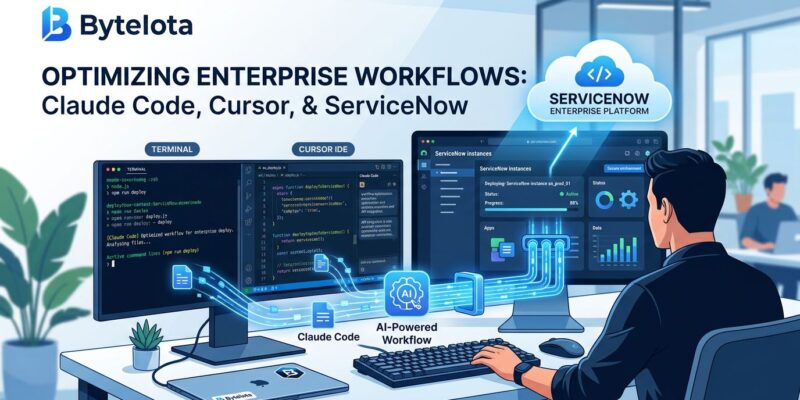
ServiceNow just opened its enterprise platform to every developer using Claude Code, Cursor, Windsurf, or GitHub Copilot. At Knowledge 2026 on May 6, the company announced Build Agent is now generally available and its npm SDK — @servicenow/sdk — plugs directly into those tools. Write ServiceNow apps in your preferred environment, deploy to a production instance with full enterprise governance, and never open Studio if you don’t want to.
The SDK Is the Actual Unlock
The mechanism is the @servicenow/sdk npm package. Install it, point it at your ServiceNow instance, and your coding agent gains full platform intelligence: the data model, scoped app structure, catalog patterns, and ServiceNow best practices. Build Agent’s skills are open-sourced, meaning Claude Code, Cursor, Windsurf, Codex, GitHub Copilot, and Antigravity can all consume them.
The workflow is three commands:
# Initialize a ServiceNow app project
npx @servicenow/sdk init

# Build and test locally without deploying
npx @servicenow/sdk dev

# Deploy to your ServiceNow instance
npx @servicenow/sdk install
The dev server proxies requests to your instance during local iteration — you’re not guessing at whether generated code will run. When you’re satisfied, install packages and deploys the scoped app to your instance.
Claude Is the Default Engine — and That’s Not Neutral
Build Agent runs on Anthropic’s Claude by default, and the partnership is explicit. ServiceNow chose Claude specifically for long context windows — an entire app build can run in a single session without the agent losing coherence. That matters when you’re generating workflows, catalog items, UI components, and integration logic simultaneously.
The scale of the commitment: ServiceNow is rolling Claude and Claude Code out to all 29,000 employees, expects Build Agent usage to quadruple within 12 months, and reports cutting internal seller preparation time by 95%. This is not a pilot program.
If you’re already using Claude Code, the native path is to install the ServiceNow SDK alongside it. The ServiceNow community has a detailed walkthrough. Claude Code picks up the SDK context and gains awareness of your specific instance — existing tables, application scopes, and configured policies.
Governance Comes from the Platform, Not Your Tool
ServiceNow also announced at Knowledge 2026 that App Engine Management Center (AEMC) — its deployment governance layer — is now free for all customers. Previously a paid add-on, AEMC provides deployment approvals, release management, audit trails, security role enforcement, and full application lifecycle controls.
The positioning is “governed by default.” Build in Claude Code — a tool with no native enterprise governance — and when you deploy via the SDK, full governance applies automatically. Compliance lives on the platform side, not the tool side. For enterprises that have been reluctant to give developers unchecked AI deployment access, this changes the risk calculus.
Build Agent also runs a self-healing test loop validating generated code against quality gates before deployment. You can encode your organization’s coding standards into Custom Instructions, so every AI-assisted build follows your team’s patterns rather than generic ServiceNow defaults.
The Reality Check: What It Actually Does Well
Community experience is clear-eyed about the limits. Build Agent works well for incremental, well-scoped tasks: building a single workflow, creating a catalog item, scaffolding a scoped app. Large, compound prompts that try to generate an entire interconnected application in one shot tend to struggle. The model can hallucinate ServiceNow-specific behavior or generate queries that hit large tables without indexes, causing timeouts in production.
There are also call limits to know: customer instances get 100 free Build Agent calls per month; Personal Developer Instances get 25. If you’re building in volume, you’ll hit these. The tool accelerates experienced ServiceNow developers — it has not replaced them.
What This Signals for Enterprise Platforms
ServiceNow is the first major enterprise SaaS platform to explicitly support Claude Code, Cursor, Windsurf, and Codex without IDE lock-in. Microsoft Power Platform defaults to Copilot tied to M365. Salesforce’s Agentforce builder lives inside the Salesforce UI. ServiceNow’s strategy is the opposite: meet developers where they already work, and let the platform handle the enterprise requirements.
The official announcement frames it as “build anywhere, run on ServiceNow.” With AEMC now free, the last pricing obstacle to governed AI development on ServiceNow is gone. The real question is whether SAP, Oracle, and Salesforce treat this as a threat worth matching — or an experiment they can afford to ignore. Given how quickly developers have adopted Claude Code and Cursor, the former seems more likely.
For developers already using Claude Code or Cursor, the move is straightforward: install the SDK, point it at a Personal Developer Instance, and evaluate what Build Agent can actually deliver. The 25 free monthly calls is enough to find out. Whether it becomes a production workflow depends on your projects — and your tolerance for an AI that occasionally forgets to add indexes.
Further reading: DevOps.com on ServiceNow’s polyglot developer strategy