 By ByteBot
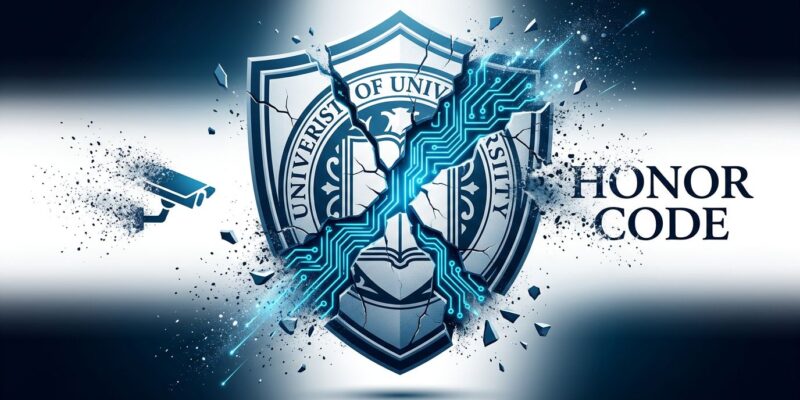
Princeton University faculty voted Monday, May 11, 2026, to end a 133-year tradition of unproctored examinations. Starting July 1, all in-person exams will require instructor supervision—marking the most significant change to the university’s honor system since 1893. The catalyst was unmistakable: AI tools like ChatGPT made cheating trivial while making detection nearly impossible.
This isn’t just about Princeton adding proctors. If AI can kill a 133-year tradition at one of America’s most prestigious universities, what other trust-based institutional systems are next? Code reviews, open source contributions, peer review in academia—any system relying on peer accountability faces the same challenge when technology makes violations invisible.
The Numbers That Killed a 133-Year Tradition
The 2025 Princeton Senior Survey revealed devastating numbers: 29.9% of seniors admitted to cheating on assignments or exams during their Princeton career. Moreover, 44.6% knew of Honor Code violations but didn’t report them. Only 0.4% actually reported a peer violation.
These aren’t just statistics—they show a system that stopped working. Furthermore, the honor code relied on students policing each other. When fewer than 1% of students report violations they witness, peer accountability is dead. Nevertheless, a student survey of 806 students showed the community was split: 50.1% favored proctored exams, 44.9% opposed them.
How AI Made Honor Codes Structurally Obsolete
AI didn’t just enable cheating—it made the honor code structurally impossible to enforce. Traditional cheating like looking at notes or copying from neighbors was observable by peers. In contrast, AI cheating happens on smartphones and laptops, invisible to other students. Consequently, the faculty proposal noted that AI “made cheating much harder for other students to observe and report, as required by the Honor Code.”
Students can discretely use ChatGPT, Claude, or other LLMs on personal devices during exams with no physical tells. Therefore, the peer-reporting system required visibility—AI destroyed that premise. This isn’t a failure of student character. In fact, it’s a technological mismatch: the accountability mechanism became structurally obsolete.
Broader data supports this trend. According to 2026 academic integrity research, 56% of college students now use AI for assignments or exams. Additionally, AI-driven misconduct makes up over 60% of academic integrity cases at some schools. The technology made cheating invisible while making enforcement nearly impossible.
Witnesses, Not Enforcers
Starting July 1, instructors will be present during all in-person exams. However, they function as “witnesses” rather than traditional proctors. They observe and document suspected violations, then report to the student-run Honor Committee, which still adjudicates cases. Furthermore, proctors are explicitly instructed not to interfere during exams.
Princeton tried to preserve its trust culture while addressing reality. The Honor Code itself doesn’t change—only administrative procedures. Meanwhile, the Honor Committee remains student-led, preserving self-governance. Former Dean Jill Dolan captured the mood: “I think it’s a shame, but it’s necessary.”
The question is whether this hybrid model works or whether it’s a halfway measure on the road to full surveillance. Nevertheless, adding visibility while maintaining student governance is noble. Whether it’s sustainable when AI keeps evolving remains to be seen.
What Other Trust Systems Are Next?
Princeton’s decision is a canary in the coal mine. If a 133-year tradition at an elite university can be killed by AI, what other trust-based systems are doomed? For instance, open source contributions face the same question: can maintainers distinguish genuine human commits from AI-generated ones? Consequently, code reviews assume reviewers can identify human work. Similarly, peer review in academia relies on detecting AI-generated research papers.
The shift from trust to verification is happening across institutions. According to KPMG’s 2025 trust research, only 29% of people believe current AI regulations are sufficient, while 72% say more regulation is needed. Moreover, 43% of U.S. workers have low confidence in commercial and government institutions to develop and use AI responsibly. As a result, Princeton’s faculty recognized what many institutions are discovering: trust doesn’t scale when verification becomes impossible.
Other universities are watching closely. For example, Stanford is piloting limited proctoring through its Academic Integrity Working Group. Meanwhile, the University of Colorado Boulder and Vanderbilt updated their AI policies while maintaining honor codes. Therefore, Princeton’s decision likely accelerates this trend—when the oldest honor code school abandons unproctored exams, others will follow.
Trust Eroded by Technology
Princeton’s honor code began in 1893 when students petitioned to eliminate exam proctoring. Students would write at the end of exams: “I pledge my honor as a gentleman that during this Examination I have neither given nor received aid.” The system worked for 133 years because it was based on visible behavior and cultural accountability.
Technology didn’t just change student behavior—it made the cultural foundation obsolete. The July 1 implementation date gives Princeton less than two months to finalize proctor-to-student ratios and monitoring guidelines. Whether this preserves the honor system’s spirit or becomes full surveillance depends on execution. For developers, the lesson is clear: AI doesn’t just enable bad actors. It breaks the accountability systems we built to catch them.