 By ByteBot
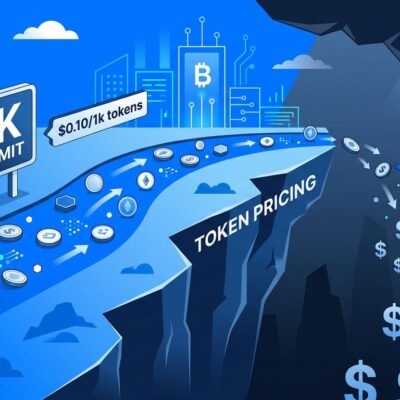
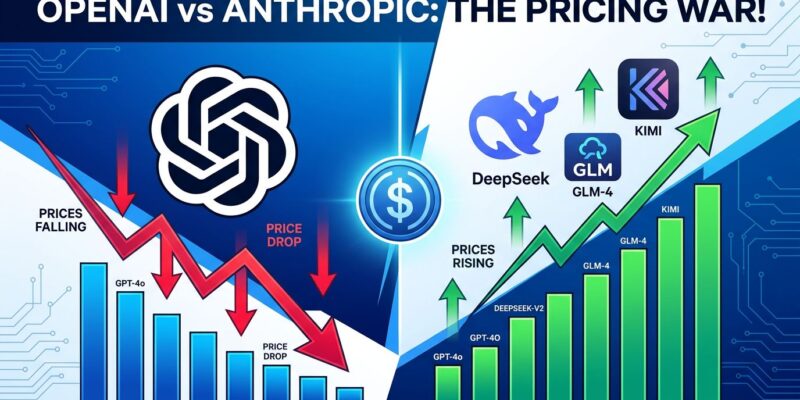
The Wall Street Journal reported this week that OpenAI is weighing “drastic” cuts to its token pricing — timed specifically to anticipated cuts from Anthropic as both companies race toward dueling IPO filings. OpenAI filed a confidential S-1 on May 22; Anthropic followed on June 1. The message from both companies is identical: whatever it takes to own the developer and enterprise market before going public. For teams building AI-powered products, that means the cost of running these models is about to fall — and locking into annual API contracts right now is a mistake.
How Anthropic Flipped the AI Price War Script
OpenAI entered 2025 with roughly 50% of enterprise LLM spending. That number has collapsed to 25-27%. Anthropic now commands 32-40% of the market and, more tellingly, captures 73% of net-new enterprise AI spending according to Ramp’s March 2026 index — meaning companies choosing an AI vendor for the first time are overwhelmingly choosing Claude. Anthropic’s annualized revenue grew from approximately $1 billion in January 2025 to $47 billion by May 2026, a 30x increase in fifteen months.
The reason is performance, not price. Anthropic’s Fable 5 scores 80.3% on SWE-Bench Pro compared to GPT-5.5’s 58.6% — a 22-point gap on the benchmark enterprise engineering teams use to evaluate coding agents. Stripe documented that Fable 5 compressed a 50-million-line Ruby migration from two months to a single day. Claude Code’s run-rate revenue surpassed $2.5 billion, with weekly active users doubling since January 2026. OpenAI is losing the developer workflow battle, which eventually becomes the enterprise revenue battle. The token cuts are a defensive move, not a confident one.
The Silent Third Force in This AI Price War
Chinese open-source models — DeepSeek V4-Pro, Kimi K2.6, Zhipu GLM-5.1, and MiniMax M2.5 — now account for 60% of OpenRouter API traffic, up from under 2% at the start of 2025. They cost 10 to 20 times less than US alternatives. A standardized coding workload costs $1,071 on DeepSeek versus $4,811 on Claude — a 4.5x differential for equivalent output. For pure coding volume at commodity prices, the cost-sensitive developer segment has already moved on.
The performance gap that once justified premium US pricing has also narrowed significantly. Kimi K2.6 and GLM-5.1 both score around 58-59% on SWE-Bench Pro — near GPT-5.5 territory. Programming tasks now represent more than 50% of all OpenRouter usage, up from 11% in early 2025. The battleground is coding, and Chinese open-source models are winning on cost with near-competitive quality. OpenAI and Anthropic aren’t only cutting prices to compete with each other — they’re responding to a floor that already collapsed beneath them.
Related: LLM Model Routing in 2026: Cut AI Costs 70% With Smart Model Selection
The IPO Trap Behind the Token Price Cuts
Here is the strategic contradiction neither company is stating explicitly. OpenAI projects $14 billion in losses in 2026 alone and doesn’t expect profitability until 2030. Anthropic targets break-even by 2028. Both companies need IPO valuations that justify $852 billion (OpenAI) and $965 billion (Anthropic) price tags — and both need revenue growth to support those numbers. Cutting token prices increases volume, which shows growth, but reduces per-token margins, which hurts the profitability story investors care about. Sam Altman has publicly acknowledged that AI costs have become “a huge issue” for enterprise customers. The solution — drastic price cuts — creates a different problem.
Analysts tracking the situation suggest the most probable OpenAI scenario is a significant reduction on GPT-5 pricing, paired with a new GPT-5.6 launch positioned at near-Mythos performance for 2-3x less than current Mythos pricing. That lets OpenAI defend the volume tier while maintaining some premium structure. However, whether price alone can reverse a 22-point benchmark gap is a separate question — and a harder one. The dueling IPO timeline means any announcement should come before Anthropic’s October 2026 listing.
What Developers Should Do Before the Price War Lands
The practical guidance here is unusually specific. Avoid committing to 12-month API contracts at current rates without future-benefit clauses. Negotiate quarterly terms, or secure explicit language guaranteeing that your rate drops when list prices drop. A 30-60 day delay costs little while both companies announce their strategies. If your workloads are high-volume coding tasks without regulated data requirements, Chinese open-source models already match US incumbents on cost benchmarks and are worth serious evaluation today.
Key Takeaways
- OpenAI is weighing drastic token price cuts as both it and Anthropic file confidential IPO documents — the AI price war is official, not speculative
- Anthropic reversed OpenAI’s enterprise lead: 73% of net-new enterprise AI spending and a 22-point SWE-Bench gap are what forced OpenAI’s hand on pricing
- Chinese open-source models hold 60% of global API traffic at 4-20x lower cost — the pricing floor collapsed before US labs started competing with each other
- Do not lock into 12-month API contracts right now; negotiate quarterly terms or future-benefit clauses while both vendors finalize pricing
- Watch Q3 2026 — at least one major lab will announce cuts before Anthropic’s October IPO listing