 By ByteBot
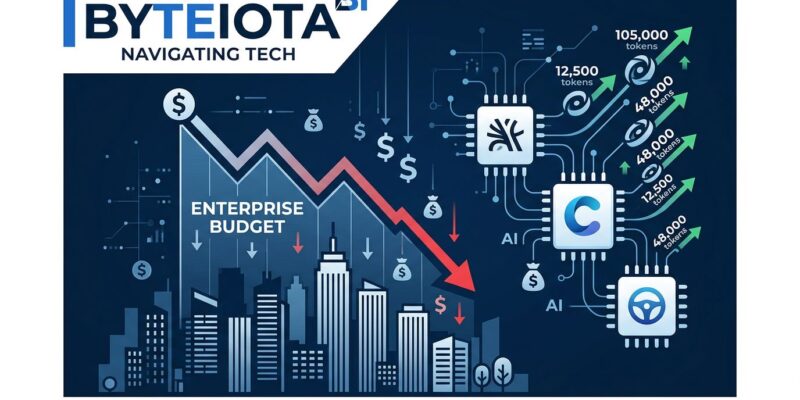
Microsoft is cutting Claude Code access for roughly 5,000 engineers on June 30. The official explanation — “unifying toolchains around GitHub products” — is a fig leaf. The real explanation is simpler and more uncomfortable: the company burned through its AI coding budget and is redirecting engineers to a tool it owns. The unit economics of enterprise AI coding at current token prices do not work. Microsoft is not the first to discover this. It will not be the last.
What It Actually Costs
Claude Code runs $500 to $2,000 per engineer per month under usage-based API pricing. Microsoft gave access to approximately 5,000 engineers in its Experiences and Devices division — Windows, Microsoft 365, Outlook, Teams, Surface — in December 2025. Adoption reached 84–95% within months. Developers loved it. At a conservative $1,000 average, that is $5 million per month, $60 million per year, for one division. The budget did not survive contact with reality.
Uber tells the same story. Also 5,000 engineers, also December 2025, also rapid adoption. By April 2026, the entire year’s AI coding budget was gone — in four months. COO Andrew Macdonald put it plainly: “Budget I thought I would need is blown away already.” Uber now caps AI tool spending at $1,500 per tool per month.
This Is Systemic, Not a Microsoft Problem
Meta’s internal “Claudeonomics” leaderboard tracked 85,000 employees competing for “Token Legend” status. In one month, they consumed 60.2 trillion tokens — roughly $900 million at API prices. CTO Andrew Bosworth killed the leaderboard within days of it becoming public. Meta replaced it with “AI Gateway,” a centralized cost monitoring platform with spending controls.
Accenture once told employees that not using AI could jeopardize promotions. It is now blocking AI use for basic tasks like PDF-to-presentation conversion. Agentic AI Strategy Lead Justice Kwak framed it directly: “We’re hitting this inflection point where AI is becoming material to the cost structure. Spend is becoming very unpredictable.”
Gartner places generative AI in the trough of disillusionment. Only 28% of AI infrastructure projects fully deliver against their business cases. Twenty-five percent of planned 2026 AI budgets are slipping to 2027. The pattern is consistent across companies: fast adoption, surprising productivity gains, budget shock, course correction.
The Tokenmaxxing Trap
The failure has a name: tokenmaxxing. Companies built leaderboards that rewarded employees for consuming the most tokens, treating AI usage as a proxy for productivity. The problem is that token consumption does not map to business outcomes. An engineer spending three hours prompting an agent through a complex refactor consumes far fewer tokens than one who casually asks it to convert a presentation. The metric was wrong from the start.
The pricing model was never designed for agentic workloads. Original AI pricing was built for autocomplete — lightweight, occasional interactions. Agentic sessions run extended reasoning threads, process large codebases as context, spawn parallel sub-tasks. Token consumption explodes. The bills arrive.
The Conflict of Interest Worth Naming
Microsoft owns GitHub. GitHub owns Copilot. The engineers being cut from Claude Code are being moved to GitHub Copilot CLI — a Microsoft product. A JetBrains survey from April 2026 found Claude Code was the most-loved AI coding tool at 46%, versus Copilot’s 9%. That is a five-to-one preference gap. This is not a better tool winning a fair fight. It is a cost-control decision dressed as product strategy.
The irony: GitHub Copilot itself moved to usage-based billing on June 1, 2026. Agentic sessions now cost $30–$40 each. The same cost problem is coming for Copilot. Microsoft has not solved the unit economics — it has transferred the problem to a product it controls.
What Developers Should Actually Do
The productivity gains are real. Uber reports 70% of committed code now originates from AI, with roughly 1,800 changes deployed per week by autonomous agents. The tools work. The current pricing models do not scale to unlimited enterprise access.
The practical response is context engineering over token maximization: be deliberate about what enters the context window, use powerful models for complex tasks and cheaper models for routine work, and build workflows that function within budget caps rather than assuming unlimited access. Treat AI coding tools like cloud infrastructure — useful, powerful, and metered.
Budget caps are coming regardless of what enterprise sales teams promise. The teams that adapt their workflows now will have an advantage when the caps arrive.