 By ByteBot
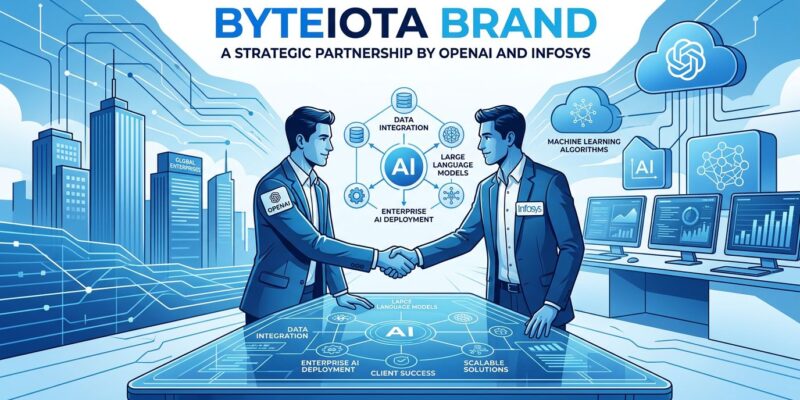
OpenAI announced a strategic partnership with Infosys on April 22, 2026, to deploy Codex—its AI coding assistant used by 4 million developers weekly—across global enterprises through Infosys Topaz Fabric. This isn’t another AI tool announcement. It’s a distribution strategy. Infosys becomes the “AI deployment layer” for thousands of enterprises that lack AI expertise, bringing governance frameworks, security controls, and compliance capabilities that tech companies desperately need.
The timing matters: 100% of organizations already have AI-generated code in production, but 81% lack visibility into how it’s being used and 50% have no governance policies. That’s not innovation—that’s chaos. This partnership addresses the governance crisis head-on.
The Distribution Play: Why Infosys Matters
OpenAI partnered with seven Global Systems Integrators simultaneously—not just Infosys, but also Accenture, Capgemini, CGI, Cognizant, PwC, and Tata Consultancy Services. This coordinated enterprise push reveals OpenAI’s scaling strategy: they provide the AI, consulting firms handle implementation, governance, and industry-specific compliance.
Infosys brings 300,000+ employees serving clients in 60+ countries, 12,000 AI assets, 150+ pre-trained models, and 50+ purpose-built IT operations agents. More importantly, they bring the “Scan-Shield-Steer” governance framework that scans tasks against security policies, shields sensitive data with masking and access controls, and steers requests to appropriate models based on risk assessment.
Enterprises don’t just need AI tools. They need deployment expertise, regulatory compliance knowledge, and integration with existing enterprise systems (ServiceNow, Jira, SAP, Salesforce). However, Infosys solves the “last mile” problem that prevents most companies from moving AI from experimentation to production.
The Governance Crisis This Partnership Solves
A 2026 survey of 400 CISOs found alarming statistics: 100% of organizations have AI-generated code in production, 81% lack visibility into how AI is actually used, and 50% still lack enforceable governance policies. Moreover, one in five organizations reported a serious security incident linked to AI-generated code.
Specific vulnerabilities include prompt injection attacks in GitHub Copilot pull requests (CVSS score 9.6, enabling remote code execution) and developers uploading proprietary code to ungoverned AI tools for debugging—potentially exposing trade secrets. Furthermore, the EU AI Act and Colorado AI regulations both took effect in 2026, requiring documented governance programs. Enterprises can’t deploy AI coding tools without compliance frameworks.
Infosys addresses this with enterprise-grade security controls: SCIM for user provisioning, EKM for encryption control, RBAC with detailed permissions, and audit logs via the Compliance API. Consequently, this makes Codex enterprise-ready by solving the governance gap that’s blocking deployment at scale.
From Experiment to Production in 6 Weeks
The partnership includes “Codex Labs,” an onboarding program that embeds OpenAI experts directly in client organizations for hands-on workshops and implementation guidance. Additionally, the typical timeline: 6 weeks from discovery workshops to pilot deployment to governance setup to scale planning.
Focus areas include software engineering (AI-assisted feature development), legacy modernization (converting old codebases to modern stacks), DevOps automation (CI/CD pipeline optimization), and e-commerce platform development. Infosys Topaz Fabric provides the orchestration layer, combining Codex with Infosys’ pre-trained models, governance agents, and integration adapters for 9 enterprise platforms.
This isn’t “buy software and figure it out.” It’s a structured implementation program that reduces risk and accelerates time-to-value. Therefore, enterprises get governance, security, and integration—everything needed to move from experimentation to repeatable production deployment.
What This Means for Developer Careers
Despite widespread anxiety about AI replacing developers, software developer employment grew 3.8% in 2025, reaching 28.7 million globally—a new high. However, roles are shifting. Job postings requiring AI coding tool experience increased 340% between January 2025 and January 2026, while pure implementation role postings declined 17%.
AI-savvy developers earn 38-53% more than traditional roles: $90K-$130K for entry-level AI positions versus $65K-$85K for traditional development jobs. Indeed, 65% of developers expect their role to be redefined in 2026, moving from routine coding toward architecture, integration, and AI oversight. Developers are doing less routine coding work and devoting more of their schedule to overseeing AI-powered code-writing agents.
This partnership will accelerate that transformation. Enterprises deploying Codex at scale need developers skilled in AI collaboration, system architecture, and governance—not just coding. As a result, the market rewards these skills with higher salaries. Focus on learning AI tool mastery, architectural thinking, and human oversight capabilities rather than fearing replacement.
OpenAI built the AI. Infosys makes it deployable in Fortune 500 companies. That last mile—governance, compliance, integration—is harder than it looks. This partnership proves that enterprise AI adoption isn’t about technology alone. It’s about distribution, governance, and implementation expertise. The seven-partner strategy shows OpenAI understands this. Enterprises get choice. Developers get career evolution, not obsolescence. And the governance crisis finally gets addressed.