 By ByteBot
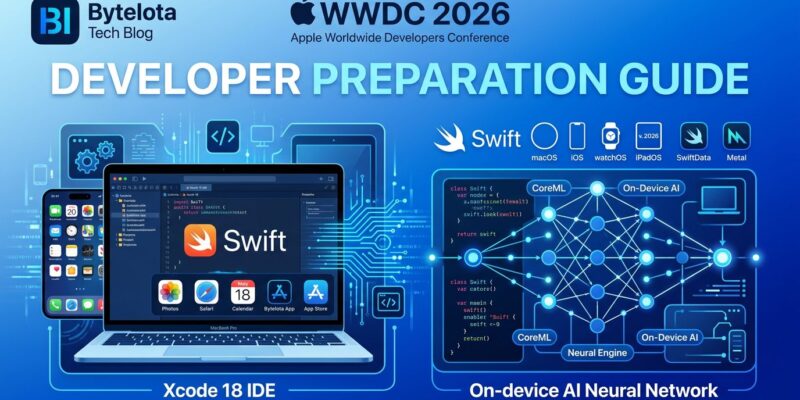
WWDC 2026 starts in six days. The keynote is June 8 at 10 AM PT, and the iOS 27 developer beta drops the same afternoon. Apple has a lot to prove this year — Apple Intelligence was widely criticized in 2025 for being half-baked, Siri is getting its most significant overhaul since launch, and the developer community is waiting to see whether Foundation Models v2 is actually worth building on. Here is what to watch, what to prepare, and what to install the moment the keynote ends.
Siri Gets a Full Rebuild — and Your App Intents Are the Integration Point
The biggest story at WWDC 2026 is not a framework. It is Siri. Apple is overhauling it from scratch: a dedicated Siri app with saved chat history, an iMessage-style conversation view, Dynamic Island access, and an interface that may replace Spotlight entirely. Third-party AI services — including Claude and Gemini — will be able to receive handoffs from Siri if users grant permission.
For developers, this is not just a consumer feature. The integration surface is App Intents. Any app that exposes proper App Intents will be surfaceable in Siri’s new context model. Any app that does not will be invisible to it. If your app has not yet adopted App Intents, that is the single highest-value thing you can do before the developer beta drops:
import AppIntents

struct CheckOrderStatus: AppIntent {
    static var title: LocalizedStringResource = "Check Order Status"

    @Parameter(title: "Order ID")
    var orderID: String

    func perform() async throws -> some IntentResult & ProvidesDialog {
        let status = await OrderService.status(for: orderID)
        return .result(dialog: "\(status)")
    }
}
The session to prioritize at WWDC: “What’s New in App Intents.” Apple expands this framework every year. This year it will be the backbone of the new Siri.
Foundation Models v2: The On-Device AI API Apple Needs to Get Right
At WWDC 2025, Apple shipped the Foundation Models framework — a roughly 3-billion-parameter on-device LLM with a Swift API. Nothing leaves the device. No API keys. No per-token cost. That part is genuinely good.
The problem is quality. At 3B parameters, the model handles simple summarization and classification well enough, but struggles with reasoning-heavy tasks. Developer reaction in 2025 was measured: useful for narrow tasks, nowhere near GPT-4 class. WWDC 2026 is expected to bring Foundation Models v2 with a larger model, possible on-device fine-tuning, and deeper MLX integration. Apple also has a Google Gemini partnership — a custom 1.2-trillion-parameter model — handling server-side requests when on-device quality is not enough.
Apple’s bet is that developers do not want to pay per-token and users do not want their data in the cloud. If Foundation Models v2 clears the quality bar, that bet pays off. Watch the Foundation Models session closely — specifically what Apple says about model size, reasoning benchmarks, and the Private Cloud Compute expansion.
Xcode 18 and Swift 7: AI Coding That Actually Knows Swift
Xcode 26 already ships Predictive Code Completion — an on-device ML model trained specifically for Swift and Apple SDKs. Xcode 18 is expected to mature this with better multi-model support, tighter Git workflow integration, and continued refinement of Swift Assist.
The differentiator is worth stating plainly: Xcode’s AI features require no API key, use on-device or Private Cloud Compute, and Apple does not use your code for model training. If you have been running GitHub Copilot or Cursor for Swift projects, Xcode 18 is worth a direct comparison this fall.
On Swift 7: after Swift 6’s strict concurrency migration, the community wants stability over new features. Expect concurrency diagnostic improvements, better C++ interoperability, and Swift Package Manager refinements. If you have not migrated to Swift 6 strict concurrency yet, do it before the developer beta ships.
What to Do Before June 8
Concrete actions to take now, before the keynote:
- Verify your apps build against the iOS 26 SDK. Apple began rejecting submissions not using it on April 28, 2026.
- Add
PrivacyInfo.xcprivacyif your app does not already have one — it is now mandatory for all submissions. - Review your App Intents implementation. Siri’s new architecture will reward apps that get this right from day one.
- Update your App Store age rating questionnaire. Updated ratings take effect June 18 for Australia and Vietnam — the deadline is approaching.
On June 8: watch the keynote at 10 AM PT, but prioritize the Platforms State of the Union at 1 PM PT. The keynote is the consumer show. The State of the Union is where Apple engineers explain what actually changed in the frameworks. The iOS 27 developer beta drops around the same time — download Xcode 18 beta alongside it and start testing your existing apps immediately.
The Real Question
Apple Intelligence was Apple’s most scrutinized product launch of 2025. Features were delayed, quality was inconsistent, and developers who bet on the Foundation Models API early found themselves constrained by the model’s limitations. WWDC 2026 is the correction.
Privacy-first, on-device AI is a genuinely differentiated position. No other major platform is making the same bet at this scale. The Siri redesign, Foundation Models v2, and the Google Gemini partnership are all aimed at answering one question: can Apple deliver AI that developers actually want to build on? We find out June 8.