 By ByteBot
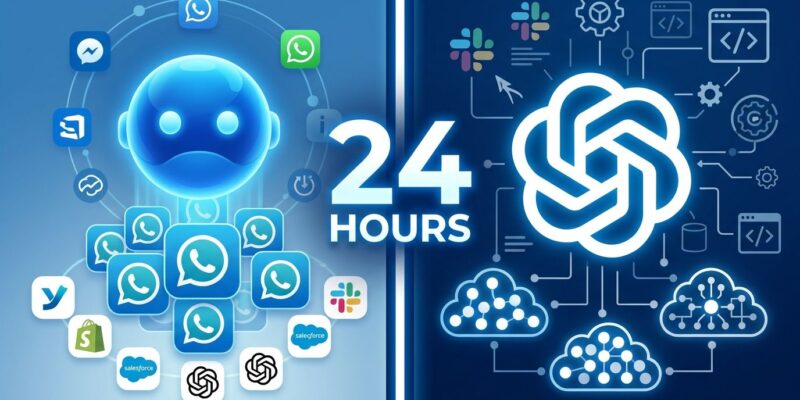
On September 28, Meta launched its Enterprise Platform built around Muse — the AI agent that hit 2.5 million downloads in three weeks and briefly topped the US App Store. One day later, at DevDay 2026 in San Francisco, OpenAI unveiled Dots: always-on autonomous agents running on GPT-6 Astra. Two companies, 24 hours apart, competing directly for the same enterprise AI agent market. The timing was not accidental. The race is now official.
The prize both companies are chasing is the AI agent layer — the software that autonomously handles business workflows, connects to thousands of apps, and operates 24/7 without being prompted each time. Whoever controls that layer controls how companies work. For developers, the decision of which platform to build on carries real architectural lock-in. Waiting is not a neutral option.
Meta Got There First — With Enterprise AI Agents Already in Production
Meta launched Muse on September 8 and spent three weeks gathering traction before turning it into an enterprise platform. By September 28, when CJ Desai — the former MongoDB CEO Meta poached to run its new enterprise division — announced the full platform, Muse already had 2.5 million downloads and Meta’s Business Agent had over one million businesses running on it via WhatsApp and Messenger. The enterprise platform launch added Shopify, Dropbox, Slack, Asana, Zoom, Intuit, Box, Canva, and Salesforce as integrations, making the case that Meta’s consumer distribution advantage translates directly into enterprise reach.
The developer pitch is aggressive. Meta’s Muse Spark API is priced at $1.25 per million input tokens and $4.25 per million output tokens — about eight times cheaper than OpenAI’s GPT-6 Astra. More pointedly, Meta built the API with native OpenAI and Anthropic SDK compatibility, so developers don’t have to rewrite existing codebases to start using it. Zuckerberg called it “the first time we’re doing a real serious API” and promised pricing would be “very aggressive and attractive.” It is.
Related: MongoDB CEO CJ Desai Quits for Meta — Stock Drops 25%
OpenAI Answered With Premium — and a Sting in the Tail
OpenAI did not respond to Meta’s free tier with a cheaper product. It went the other direction entirely. Dots, launched at DevDay 2026 on September 29, runs on GPT-6 Astra — OpenAI’s most powerful model — and ships bundled with Pro and Business Premium plans. A new $500-per-month Pro 500 tier adds Ultrafast mode at 300 tokens per second and 25 times the Plus allowance. Sam Altman opened the reveal with: “I have been waiting for this product for years.” The stage demo glitched mid-task, which the internet noted immediately, but the capability story is real.
The sting: the existing $200 Pro plan is being nerfed. Effective October 30, task allowances drop from 20x to 10x and GPT-6 messages fall from 200 to 100 per week — with no corresponding price cut. OpenAI is pushing power users toward the $500 tier. Developers building on Pro-tier features need to account for this in their cost projections. ByteIota covered the full plan breakdown here.
Dots itself connects to 4,000-plus apps through ChatGPT’s plugin ecosystem, runs on dedicated cloud computers with isolated browsers, and includes a three-tier permission model: what the agent can do autonomously, what requires approval, and what is prohibited entirely. For developer-heavy use cases — autonomous bug investigation via Slack, code deployment from design specs, invoice generation — Dots is clearly the more powerful option. See the full Dots breakdown for implementation details.
What Each Autonomous Agent Actually Does Well
Muse excels in consumer-to-business workflows and environments where Meta’s existing distribution matters. If your users are already on WhatsApp or Messenger, and you want an agent handling customer conversations, product recommendations, and sales automation — Meta Business Agent is live, battle-tested with a million businesses, and significantly cheaper at the API layer. Muse also beats Dots on breadth of immediate availability: free tier, iOS, Android, web, and WhatsApp, versus Dots’ requirement for ChatGPT Pro or Business Premium with enterprise beta access requiring admin approval.
Dots excels for developer-centric autonomous work where model capability matters more than distribution. Running on GPT-6 Astra — OpenAI’s top model — Dots handles complex, multi-step tasks that require reasoning across long contexts. The Agents API supporting these scenarios improved task success rates from 10% to 35% on 8-to-16-hour tasks between January and July 2026, per DevDay technical announcements. That 35% is progress. It also means a 65% failure rate on hard tasks — keep that in mind when scoping agent workloads.
The Lock-In Risk Neither Company Mentions
Both Muse and Dots are competing for the same position: becoming the default AI integration layer that enterprise software connects to. That position carries more long-term value than subscription revenue. However, neither company controls the full app ecosystem they’re promising agents access to. Integration breadth depends on third-party apps maintaining access — and any one of them can revoke it. Amazon reportedly pulled Muse’s access at some point during its early rollout; Dots’ 4,000-app ecosystem faces identical exposure. Before building a product that depends on agent integrations, verify what happens when a key connector goes down. Both platforms need to answer that question better than they currently do.
Key Takeaways
- Meta moved first with a consumer-to-enterprise strategy and a significant API pricing advantage ($1.25/$4.25 per million tokens vs. Astra’s $10/$50)
- OpenAI bet on premium positioning: Dots are bundled with high-tier plans, powered by GPT-6 Astra, and built for complex autonomous developer workflows
- The $200 OpenAI Pro plan is being nerfed October 30 — developers on that plan need to adjust cost models now
- Muse wins for consumer and SMB workflows on Meta’s platforms; Dots wins for developer-centric autonomous coding and complex operations
- Both platforms share the same core risk — third-party integration stability is not guaranteed, and neither controls the full stack their agents depend on