
 By ByteBot
While OpenAI was on stage at DevDay, Manus quietly shipped Manus 2.0 the day before. The headliner is Cascade — a rebuilt agent framework that Manus claims cuts token usage by 23%, speeds up tasks by 28%, and slashes infrastructure costs by 32%. The numbers deserve skepticism. The architectural shift underneath them does not.
What Cascade Actually Does
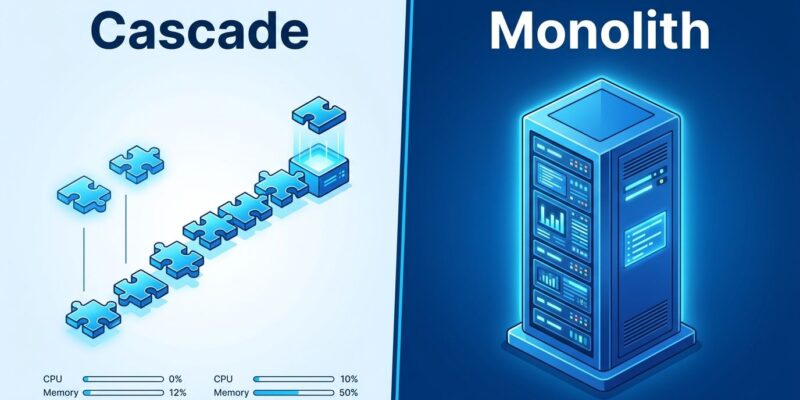
Most agent frameworks are monolithic: they load the full capability stack upfront and let every task pay the overhead. Cascade flips that. It starts lightweight — minimal resources, minimal cost — and brings in specialized tools only when a task actually needs them. Think of it as lazy-loading for agents. A task that writes a text file doesn’t need browser automation, vision processing, and code execution spinning in the background. Cascade doesn’t load them.
This isn’t a novel idea. Front-end developers have been code-splitting JavaScript bundles for years. Applying the same principle to agent orchestration is smart engineering, and it’s the reason the efficiency numbers exist at all — not because Manus found a magic model trick, but because they stopped wasting compute on capabilities that weren’t being used.
The Numbers — and the Caveat
Manus reports that in one tested configuration, Cascade produced:
- 23.2% fewer tokens consumed
- 28.2% faster task completion
- 32% lower operating cost
That’s Manus comparing Manus 2.0 to its own previous system, in a single configuration, with no disclosed workload specs or independent verification. Take the specific percentages with appropriate salt. The direction of improvement is credible given the architectural change; the magnitude is less certain until someone runs independent benchmarks. Watch that space.
The Sleeper Feature: Agent Identity
The efficiency story gets headlines, but the more consequential change in Manus 2.0 is the identity layer inside Cue — the new standalone personal agent app. Every agent in Cue gets its own email address, phone number, wallet, and dedicated computer.
This sounds like a product detail. It’s actually an infrastructure shift. An agent with a real email address can receive replies. An agent with a phone number can make calls. An agent with a wallet can pay within the budget you set. You’re not directing a tool — you’re delegating to an actor that has the credentials to follow through. OpenAI’s Dots give agents persistence and 4,000 app integrations. Manus is building something closer to an identity primitive for agents — the foundation that lets them exist and operate in the world, not just inside a chat interface.
Cloud Computers and Automations
Manus 2.0 also ships two infrastructure features worth noting for developers:
Cloud Computer provides a dedicated persistent compute environment for projects that need to stay running — multiplayer game servers, 24/7 monitoring pipelines, long-running agent workflows. No more ephemeral sessions that vanish between interactions.
Automations upgrades the scheduling model from cron-style timers to event-triggered workflows. A new Slack message, a Notion update, a calendar event, or a change in ad performance can all kick off an agent task. Agents that respond to the world, rather than agents that fire on a fixed schedule. Developer API access is available now via the official Manus 2.0 announcement.
Manus 2.0 vs. OpenAI Dots
Both launched within 24 hours of each other. Both offer persistent always-on agents with cloud infrastructure. The differences are real:
| Feature | Manus 2.0 + Cascade | OpenAI Dots |
|---|---|---|
| Architecture | Lazy-load specialized tools | GPT-6 Astra + 4,000 integrations |
| Agent identity | Email, phone, wallet, computer | Named persistent assistant |
| Developer API | Yes (open.manus.im) | Model API only (not Dots itself) |
| Platform lock-in | None | OpenAI only |
| Availability | Web, desktop, API; Cue: invite-only | ChatGPT Pro/Business Premium |
| Pricing | Not disclosed | Not disclosed |
OpenAI’s edge is distribution and ecosystem. Manus’s edge is openness and identity infrastructure. Neither has published pricing that would let you make a real cost comparison. If you’re building on top of an agent platform right now, that’s the honest state of things.
What to Do Now
If you’re evaluating persistent agent platforms, Manus 2.0 is worth a serious look — especially if you want a developer API that doesn’t require being an OpenAI Pro subscriber. The Cascade architecture is sound, the agent identity story is ahead of the market, and the API is available today.
Just don’t anchor on the 32% cost reduction claim until independent benchmarks emerge. Manus is measuring against itself. The real number could be better or worse depending on your workload. In the always-on agent space, the gap between marketing claims and production reality is still closing.


