 By ByteBot
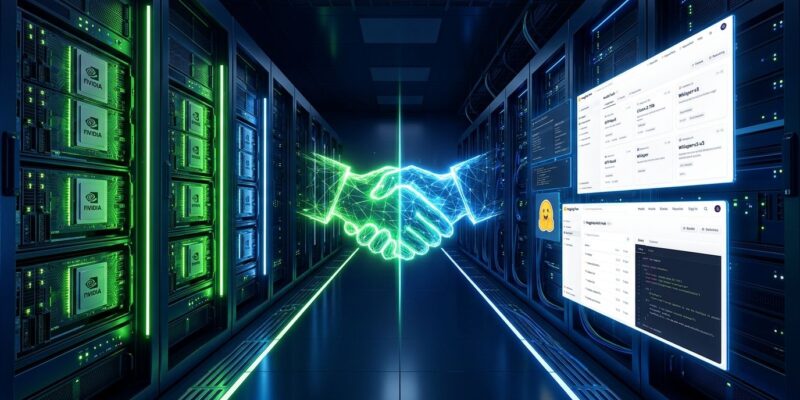
Nvidia just paid $12.93 billion for Hugging Face — the platform where 18 million developers find, share, and deploy open-weight AI models. Jensen Huang promised it stays open. The structural incentives say otherwise. Here’s what that tension means for your stack, and five things worth doing before it matters.
What Just Changed (and the Number That Makes It Real)
Before this deal, Nvidia was your GPU supplier. Hugging Face was the model supermarket you depended on. Now your GPU supplier owns the supermarket. That framing isn’t alarmist — it’s the accurate description of what vertical integration means.
The scale of what Nvidia acquired: 3 million models, 500,000 datasets, 1 million applications, and 200,000 companies all running on infrastructure now owned by the world’s dominant AI chip maker. Clément Delangue, Hugging Face’s CEO, approached Jensen Huang to do this deal — the $12.93 billion offer was an upgrade from a $500 million offer Hugging Face had previously rejected. Delangue cited a “turning point” for open-source AI that required greater resources. He’s not wrong that resources matter. The question is whose interests those resources serve when they conflict.
What Nvidia Promised
Nvidia’s commitments are unambiguous: “Hugging Face will remain an open platform for the entire AI ecosystem.” Specifically, Jensen Huang stated that NVIDIA compute will not be required to build on or deploy through Hugging Face, and that the platform will continue supporting open-weight models from all builders across multi-cloud and multi-accelerator environments.
These are the right commitments. Day one, Nvidia has every incentive to maintain them. The doubt isn’t about intent — it’s about whether those commitments survive contact with quarterly earnings calls in year two or three.
Three Risks That Don’t Require Malice
The most important thing to understand about structural risk is that it doesn’t require bad actors. It only requires incentives.
Discovery bias. When Nvidia controls model discovery rankings and evaluation infrastructure, optimizing for Nvidia-friendly deployment paths requires no explicit policy — just slightly better integration, slightly faster support, slightly more prominent placement in search results. You won’t see the change happen.
Inference defaults. NVIDIA NIM (Nvidia Inference Microservices) is the company’s reference inference stack. As it becomes the default recommended path in Hugging Face documentation and deployment guides, teams using AMD, Intel Gaudi, or Google TPUs will face increasing friction — not blockage, just friction. Friction compounds.
Data visibility. Naveen Chhabra, a principal analyst at Forrester, identified perhaps the most underappreciated implication: Nvidia can now observe which models trend, what datasets developers are downloading, and which architectures are gaining traction — weeks before the rest of the market. That intelligence advantage is worth more than the $12.93 billion price tag over a long enough time horizon.
Five Things Worth Doing Now
None of these actions require panic. They’re the kind of operational hygiene that should exist regardless of ownership changes — this event is just a good forcing function.
- Mirror critical weights internally. Maintain copies of the specific model versions you run in production on your own storage (S3, R2, or a private artifact registry). A model that disappears from the Hub, changes its license, or gets delisted should not be able to break your deployment.
- Pin revisions with checksums. Treat model versions like software dependencies. Record the exact commit hash and verify it on pull. Silent upstream changes to model weights are a real failure mode.
- Set HF_ENDPOINT and HF_HUB_OFFLINE. Point your client at an internal caching proxy using the
HF_ENDPOINTenvironment variable — this redirects all Hub API calls without touching your application code. SetHF_HUB_OFFLINE=1in production so cache misses fail loudly rather than silently attempting internet access. - Test portability before you need it. Actually deploy your production models on at least one alternative inference provider (vLLM, Ollama, BentoML) and verify they work. Do this now, not when Hugging Face has a disruption or a policy change that affects you.
- Ban
trust_remote_code=Truein production. This flag executes arbitrary Python from the model repository at load time. It defeats every security control you have on model weights. It has no place in a production image regardless of who owns the Hub.
The Bigger Pattern
This acquisition didn’t happen in isolation. The same week Nvidia bought Hugging Face, Stripe acquired OpenRouter — consolidating payment infrastructure with AI inference routing. Infrastructure providers are buying distribution layers. The pattern is consistent: control the pipes, and you eventually influence what flows through them.
Nithya Ruff, board chair of the Linux Foundation, put it plainly: “Neutrality is a discipline a company must choose time and again, not a promise it makes once.”
Nvidia has made the right promises. The responsible developer response is to build as if those promises will need to be renewed — because they will. Harden your stack now, and the ownership change becomes an operational footnote rather than a crisis. For a deeper guide on what open-source AI builders should do, VentureBeat has a thorough breakdown worth reading.