 By
By Microsoft shipped Project Zenith on September 4, 2026 — a preconfigured Windows 11 experience for developer hardware packing at least 64 GB of unified memory and 250 GB/s of bandwidth. The real pitch: buy the right machine and you can run models with 30 billion or more parameters on your desk, unmetered, without touching a cloud API. The first device is AMD’s Ryzen AI Halo dev kit, available now at $3,999.
What You Actually Get
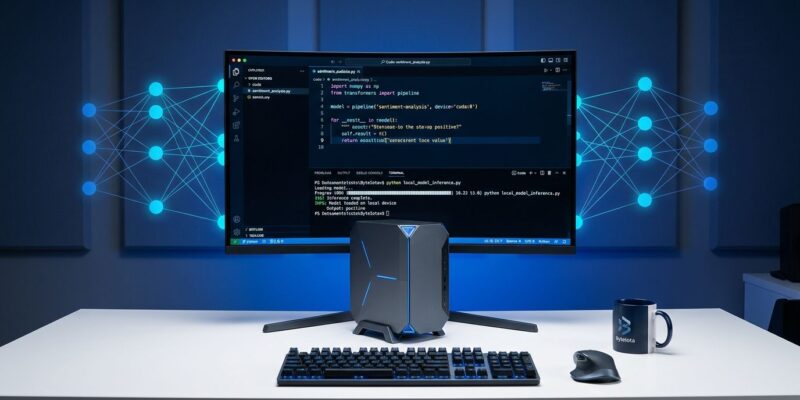
Project Zenith is not a new Windows SKU. It is a hardware class plus a preconfigured software environment. On the hardware side, the AMD Ryzen AI Halo dev kit ships with the Ryzen AI Max+ 395 processor (126 TOPS), 128 GB of LPDDR5x unified memory shared between CPU and GPU, and a 2 TB NVMe drive — all in a mini workstation form factor. It can run models up to 200 billion parameters, though the 30B–70B range is where it performs best day-to-day.
On the software side, you get a surprisingly clean out-of-the-box developer setup: Visual Studio Code and Windows Terminal pinned to the taskbar, GitHub Copilot, PowerShell 7, PowerToys, Python 3.14 with uv, Node 24 via nvm, WSL 2 with Ubuntu, and .NET 10. File extensions and hidden files are visible by default. The full path shows in the title bar. Long-path support is on. Account nags and ads are muted. It is, bluntly, how Windows should have shipped for developers years ago.
Why Local Inference Is Worth Taking Seriously
The unmetered part deserves more attention than it typically gets in the coverage. Cloud API costs at scale add up fast, and rate limits are a real constraint when you are iterating on agentic pipelines or running evals. Local inference sidesteps both: the cost per inference drops to near zero after the hardware purchase, and your throughput ceiling is the hardware, not a billing tier.
Privacy is the other underrated angle. Every prompt you send to a hosted model leaves your machine. For developers working on sensitive codebases — enterprise software, financial systems, anything with IP concerns — that is a real issue, not just legal boilerplate. Project Zenith devices running Windows AI Foundry and Windows ML keep inference entirely on-device. Latency is also real: a local 30B model on the Halo dev kit hits single-digit millisecond time-to-first-token once the model is warm.
The Price and Who It Is Actually For
The AMD Ryzen AI Halo dev kit is $3,999, available at MicroCenter in the US (in-store pickup only). Lenovo’s ThinkCentre X Ultra, the second Zenith-class device, starts at $3,699 and ships in November 2026. More OEM hardware is expected.
At that price, the target audience is narrow but real: AI researchers running large-model experiments, enterprise development teams with strict data privacy requirements, and developers spending enough on cloud API credits each month that the hardware pays for itself within six months. If you are a solo developer using an AI assistant for code completion, this is not your machine — yet.
The Honest Assessment
The criticism that Project Zenith is a marketing misfire has some merit. It is not a new OS, not a new hardware category, and not a new idea. Apple Silicon Macs with 128 GB of unified memory have been doing this for a while, with tighter framework integration through Core AI and CoreML. Enterprise IT departments re-image developer machines anyway, so the pre-configuration advantage largely evaporates in organizational settings.
But here is what the skeptics underweight: Microsoft committing to a named developer hardware class, bundling a complete dev environment by default, and integrating it with their on-device AI stack is a signal worth paying attention to. If the OEM ecosystem delivers more Zenith hardware at accessible price points over the next 12 months, the platform story gets significantly more compelling. This is the opening bet, not the finished product.
What to Watch
Track three things: how quickly more OEM partners ship Zenith-class hardware and at what price points; whether Windows AI Foundry matures into a platform that can match Apple’s Core AI in framework support; and whether Microsoft’s developer community actually adopts this or treats it as another Surface-style experiment. The hardware capability is real. The platform potential is real. Whether Microsoft executes is the open question.