 By ByteBot
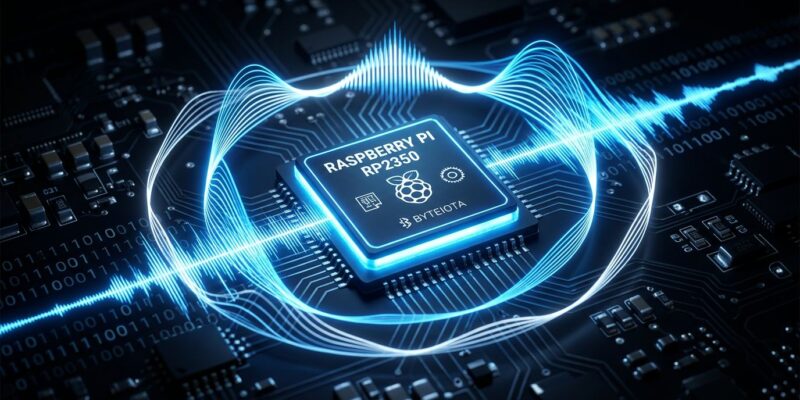
Voice AI just got small enough to run on an 80-cent chip. Moonshine AI released Moonshine Micro this week — a complete voice interface stack that runs voice activity detection, speech-to-text, and text-to-speech inside 468 KB of SRAM on a Raspberry Pi RP2350, with no cloud connection required. It is MIT-licensed, responds in under a second, and ships with fully retrainable speech recognition for custom vocabularies. For embedded and IoT developers, this is the threshold they have been waiting for.
Three Components, One Pipeline
Moonshine Micro splits voice processing into three discrete components that chain together efficiently. Voice activity detection (VAD) runs first — it listens for human speech and gates the heavier models, avoiding wasted compute when nobody is talking. VAD uses 89 KB of flash and 36 KB of SRAM, small enough to run continuously without draining a battery-constrained device.
When VAD fires, the speech-to-text engine activates. Moonshine Micro uses SpellingCNN, a command recognizer trained for a 50-word vocabulary that developers can retrain for their own domain. The model fits in approximately 1.3 MB of flash. Text-to-speech follows via neural diphone synthesis, generating spoken output in the same pass. End-to-end, the pipeline goes from detected speech to spoken response in 0.7 to 1.0 seconds.
The RP2350 has 520 KB of SRAM total. Moonshine Micro uses 468 KB of it at peak. This is not slack engineering — it is deliberate constraint optimization, and it works.
Custom Vocabulary Is the Right Abstraction for IoT
General-purpose speech recognition is the wrong abstraction for most embedded use cases. A thermostat does not need to transcribe natural language; it needs to recognize “warmer,” “cooler,” “hold,” and “cancel.” Moonshine Micro’s 50-word recognizer covers the real surface area of device control without the overhead of a full ASR system.
The retraining pipeline is included in the Moonshine Micro GitHub repository. Vocabularies up to 30 words stay near the default model size because only the final classification layer changes. Developers retrain on their own data and deploy a binary sized for their command set.
Pete Warden — creator of TensorFlow Lite Micro, the embedded ML runtime that underpins Moonshine Micro — runs Moonshine AI. He did not stumble into this space; he built the inference runtime that makes it possible. When the person who designed the foundation ships a voice toolkit on top of it, the efficiency characteristics are not accidental.
Why Cloud Dependency Is an Actual Problem
Cloud speech recognition costs real money at scale. Google Cloud Speech-to-Text runs roughly $0.006 to $0.016 per minute depending on tier. A fleet of 10,000 voice-enabled devices averaging ten minutes of daily voice interaction generates $600 to $1,600 in daily API fees. Moonshine Micro eliminates that line item entirely — inference runs on the chip you already bought for $0.80.
Beyond cost, cloud dependency creates three problems embedded developers deal with that web developers often overlook. Latency: a round-trip to a cloud API adds 100 to 300 milliseconds before inference even starts. Offline operation: devices in industrial settings, basements, rural areas, or behind firewalls cannot call home reliably. Privacy: always-on cloud voice capture is a real liability in healthcare, finance, or any consumer product where users expect their audio to stay on their device.
Moonshine Micro addresses all three simultaneously. Audio never leaves the device. Responses arrive in under a second. The device works without a network connection.
The MIT License Makes This Shippable
The existing embedded voice landscape was mostly commercial or cloud-bound. Picovoice offers capable wake-word and STT models for microcontrollers, but production deployment requires a commercial license. Whisper.cpp is powerful but requires far more RAM than most MCUs provide. Cloud SDKs (Alexa Voice Service, Google Assistant) require internet, accounts, and continuous data sharing.
Moonshine Micro is MIT-licensed. No royalties, no usage reporting, no per-minute fees. Developers can ship it in commercial products, fork it, retrain it, and distribute it without a legal review. A lot of embedded voice projects have stalled over licensing concerns, not technical ones. That obstacle is gone.
An Inflection Point in On-Device AI
The direction of travel in 2026 is unambiguous: AI inference keeps shrinking. Bonsai 27B demonstrated a 27-billion-parameter model running on a smartphone earlier this month. Moonshine Micro pushes in the opposite direction — the smallest footprint that still delivers a useful, complete voice interface. Both are expressions of the same underlying shift.
The IoT promise of smart, voice-controlled devices that operate independently has been technically blocked for years. Voice required servers. Servers required connectivity. Connectivity required infrastructure. Moonshine Micro removes that constraint on hardware that costs less than a cup of coffee. Whether you are building a thermostat, an industrial control panel, a medical device, or a maker project, the calculus on adding voice just changed.
The repository, including the RP2350 reference implementation, training scripts, and component documentation, is at github.com/moonshine-ai/moonshine/micro. The original Moonshine research paper provides the model architecture background for developers who want to go deeper.